


Hardness Hardness |
|---|
|
Hardness Rating Hardness Rating |
|---|
|
Flexibility Flexibility |
|---|
 | Flexible |
Material Material |
|---|
|
Container Type Container Type |
|---|
 | Spool |
Weight Weight |
|---|
|
REACH (Registration, Evaluation, Authorization and Restriction of Chemicals) REACH (Registration,Evaluation, Authorization and Restriction of Chemicals) |
|---|
|
RoHS (Restriction of Hazardous Substances) RoHS (Restriction ofHazardous Substances) |
|---|
|
For Printer Speed For Printer Speed |
|---|
|
Tensile Strength Rating Tensile Strength Rating |
|---|
|
Tensile Strength Tensile Strength |
|---|
|

Density Density |
|---|
|
DFARS (Defense Acquisition Regulations Supplement) DFARS (Defense AcquisitionRegulations Supplement) |
|---|
Flexural Modulus Flexural Modulus |
|---|
|
Spool Material Spool Material |
|---|
|
Color Color | Show |
|---|
 | Silver |


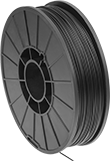
Flexible 3D Printer Filaments
 |  |  |  |  |
 |  |  |  |
Stretchy, soft, and sturdy, these filaments make durable parts that resist wear and breakage despite repeated use. Stronger than ABS and PLA filaments, they create long-lasting, wear-resistant parts, such as seals, sleeves, and gaskets, as well as components that take on high-impact forces, such as springs and snap-fit parts.
These filaments don't require a heated printer bed, and they won't shrink or warp when cooling. Use them with a fused filament fabrication (FFF) 3D printer. In general, these flexible filaments require a slow feed rate so they don't jam. Store them in a sealed container with a desiccant, or use a dehumidifying cabinet, since ambient humidity will cause the plastic to degrade and weaken.
For the most flexible parts, use durometer 85A TPU filaments. They're more flexible than PCTPE and other TPU filaments.
For a quick print without sacrificing flexibility, choose durometer 95A TPU filaments. They print much faster than other TPU filaments.
Durometer 75D TPU filaments make tough, durable parts that act similar to a tire tread—flexing repeatedly without cracking.
Tensile strength is the best measure of a filament's overall strength. Similar to the stress applied on a rope during a game of tug-of-war, it's the amount of pulling force a material can handle before breaking. A higher rating means a stronger filament. A tensile strength of 5,000 psi and above is considered good; 12,000 psi and above is excellent.
Maximum exposure temperature is the point at which a printed part will begin to deform. Above this temperature, your printed parts will start to lose structural integrity.
Spool | |||||||||||
|---|---|---|---|---|---|---|---|---|---|---|---|
| Dia., mm | Printing Temp. | For Printer Bed Temp. | Tensile Strength | Max. Exposure Temp. | For Min. Nozzle Opening Dia., mm | Dia., mm | Dp., mm | Wt., g | Color | Each | |
Durometer 85A (Medium Soft) TPU Plastic | |||||||||||
| 1.75 | 225° to 235° C 437° to 455° F | 21° to 40° C 70° to 104° F | 580 psi (Poor) | 111° F 44° C | 0.25 | 200 | 70 | 1,000 | Opaque Silver | 00000000 | 000000 |
| 2.85 | 225° to 235° C 437° to 455° F | 21° to 40° C 70° to 104° F | 580 psi (Poor) | 111° F 44° C | 0.25 | 200 | 70 | 1,000 | Opaque Silver | 00000000 | 00000 |
Durometer 95A (Medium Soft) TPU Plastic | |||||||||||
| 1.75 | 230° to 240° C 446° to 464° F | 21° to 40° C 70° to 104° F | 1,250 psi (Poor) | 120° F 49° C | 0.25 | 200 | 70 | 1,000 | Opaque Silver | 00000000 | 00000 |
| 2.85 | 230° to 240° C 446° to 464° F | 21° to 40° C 70° to 104° F | 1,250 psi (Poor) | 120° F 49° C | 0.25 | 200 | 70 | 1,000 | Opaque Silver | 00000000 | 00000 |
Durometer 75D (Medium) TPU Plastic | |||||||||||
| 1.75 | 220° to 230° C 428° to 446° F | 21° to 45° C 70° to 113° F | 3,900 psi (Poor) | 106° F 41° C | 0.25 | 200 | 70 | 1,000 | Opaque Silver | 00000000 | 00000 |
| 2.85 | 220° to 230° C 428° to 446° F | 21° to 45° C 70° to 113° F | 3,900 psi (Poor) | 106° F 41° C | 0.25 | 200 | 70 | 1,000 | Opaque Silver | 00000000 | 00000 |