


Length Length |
|---|
|
|
|
Material Material |
|---|
|
Color Color | Show |
|---|
 | White |


Flexibility Flexibility |
|---|
|
Hardness Hardness |
|---|
|
Hardness Rating Hardness Rating |
|---|
|
|
Performance Properties Performance Properties |
|---|
|

Minimum Printing Temperature Minimum PrintingTemperature |
|---|
|
|
|
Clarity Clarity |
|---|
|
Maximum Printing Temperature Maximum PrintingTemperature |
|---|
|
|
|
Maximum Exposure Temperature Maximum ExposureTemperature |
|---|
|
|
|

RoHS (Restriction of Hazardous Substances) RoHS (Restriction ofHazardous Substances) |
|---|
|
REACH (Registration, Evaluation, Authorization and Restriction of Chemicals) REACH (Registration,Evaluation, Authorization and Restriction of Chemicals) |
|---|
|
DFARS (Defense Acquisition Regulations Supplement) DFARS (Defense AcquisitionRegulations Supplement)  |
|---|
Density Density |
|---|
|
|
For Printer Bed Temperature For Printer Bed Temperature |
|---|
Easy-to-Print 3D Printer Filaments
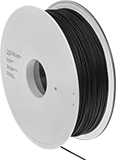

The most commonly used 3D printing material, these PLA filaments make detailed parts at a low melting point, so they won’t warp as they cool, rarely clog nozzles, and don’t require a heated printer bed. They’re also unlikely to drip and produce plastic strings for a clean finished part. In general, they’re best for printing prototypes instead of load-bearing parts since they’re not as strong as ABS or as heat resistant as PEEK. These filaments don’t emit toxic fumes, which means you can safely print them without ventilation. Print them on a fused filament fabrication (FFF) 3D printer.
PHA-filled PLA filaments produce tougher, less brittle parts than unfilled PLA filaments.
Filaments with an annealing temperature can be heat treated to make parts harder, stronger, and better at resisting heat. To anneal, heat your finished part to the listed temperature and then let it cool slowly.
Tensile strength is the best measure of a filament’s overall strength. Similar to the stress applied on a rope during a game of tug-of-war, it’s the amount of pulling force a material can handle before breaking. A higher rating means a stronger filament. A tensile strength of 5,000 psi and above is considered good; 12,000 psi and above is excellent.
Maximum exposure temperature is the point at which a printed part will begin to deform. Above this temperature, your part will start to lose structural integrity. Filaments that can be annealed are also rated for maximum temperature after annealing, which is the new maximum exposure temperature once that process completes.
Spool | ||||||||||||
|---|---|---|---|---|---|---|---|---|---|---|---|---|
| Dia., mm | Printing Temp. | For Printer Bed Temp. | Tensile Strength | Max. Exposure Temp. | Annealing Temp. | Max. Temp. After Annealing | For Min. Nozzle Dia., mm | Dia., mm | Dp., mm | Wt., g | Each | |
PLA Plastic | ||||||||||||
Opaque White | ||||||||||||
| 1.75 | 195° to 225° C 383° to 437° F | 21° to 60° C 70° to 140° F | Not Rated | 140° F 60° C | 100° to 120° C 212° to 248° F | 155° C 311° F | 0.4 | 200 | 65 | 1,000 | 0000000 | 000000 |
| 2.85 | 195° to 225° C 383° to 437° F | 21° to 60° C 70° to 140° F | Not Rated | 140° F 60° C | 100° to 120° C 212° to 248° F | 155° C 311° F | 0.4 | 200 | 65 | 1,000 | 0000000 | 00000 |
PHA-Plastic-Filled PLA Plastic | ||||||||||||
Opaque White | ||||||||||||
| 1.75 | 195° to 220° C 383° to 428° F | 50° to 60° C 122° to 140° F | 8,910 psi (Good) | 131° F 55° C | __ | __ | 0.4 | 200 | 55 | 750 | 0000000 | 00000 |
| 2.85 | 195° to 220° C 383° to 428° F | 50° to 60° C 122° to 140° F | 8,910 psi (Good) | 131° F 55° C | __ | __ | 0.4 | 200 | 55 | 750 | 0000000 | 00000 |
Impact-Resistant 3D Printer Filaments
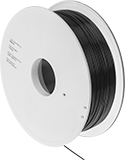

Bumps, scrapes, and falls won’t damage these tough filaments. Known for their durability, they absorb impact without cracking or breaking, and won’t degrade when heated. Use them to print tool handles, storage cases, and other parts that are handled or dropped frequently.
Use with a fused filament fabrication (FFF) 3D printer. These filaments have a high melting point, and must be printed onto a heated bed. Without it, parts will cool too quickly and warp. These filaments also release fumes as they are printed, so use an enclosed printer or a fume exhauster to ventilate them. When printing a filament with a filler, it’s recommended that you use a hardened steel nozzle. Since the filler makes them abrasive, they will wear out copper and brass nozzles.
ABS filaments are a good place to start if you’re experimenting with printing impact resistant parts. They have good strength and hardness and come in a variety of colors.
ASA filaments are the best choice for outdoor-use parts. Unlike other filaments, which warp and crack with prolonged sun exposure, parts made from ASA are UV resistant.
Tensile strength is the best measure of a filament's overall strength. Similar to the stress applied on a rope during a game of tug-of-war, it's the amount of pulling force a material can handle before breaking. A higher rating means a stronger filament. A tensile strength of 5,000 psi and above is considered good; 12,000 psi and above is excellent.
Maximum exposure temperature is the point at which a printed part will begin to deform. Above this temperature, your printed parts will start to lose structural integrity.
Spool | |||||||||||
|---|---|---|---|---|---|---|---|---|---|---|---|
| Dia., mm | Printing Temp. | For Printer Bed Temp. | Tensile Strength | Max. Exposure Temp. | For Min. Nozzle Dia., mm | Dia., mm | Dp., mm | Wt., g | Color | Each | |
ABS Plastic | |||||||||||
| 1.75 | 220° to 240° C 428° to 464° F | 100° to 110° C 212° to 230° F | 6,090 psi (Good) | 90° C 194° F | 0.25 | 195 | 75 | 1,000 | White | 00000000 | 000000 |
| 2.85 | 220° to 240° C 428° to 464° F | 100° to 110° C 212° to 230° F | 6,090 psi (Good) | 90° C 194° F | 0.25 | 195 | 75 | 1,000 | White | 00000000 | 00000 |
ASA Plastic | |||||||||||
| 1.75 | 235° to 255° C 455° to 491° F | 90° to 110° C 194° to 230° F | 6,520 psi (Good) | 95° C 203° F | 0.4 | 200 | 75 | 1,000 | White | 00000000 | 00000 |
| 2.85 | 235° to 255° C 455° to 491° F | 90° to 110° C 194° to 230° F | 6,520 psi (Good) | 95° C 203° F | 0.4 | 200 | 75 | 1,000 | White | 00000000 | 00000 |
Wear-Resistant 3D Printer Filaments
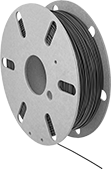

Print tough, long-lasting parts that won’t scratch or wear out from constant motion and friction, such as gears, bearings, and washers. You can even tap or drill the parts without them cracking or shattering.
Use these filaments with fused filament fabrication (FFF) printers. Because of their relatively high melting point, a heated printer bed is recommended. These filaments also emit fumes when printing, so it’s best to use them in an enclosed printer or to remove the fumes with a fume exhauster. Store them in a sealed container with a desiccant so they don’t absorb moisture in the air, which can make them unusable.
Thermoplastic-blend filaments have three times the wear resistance of nylon. While using an enclosed printer or fume exhauster is best for the other filaments, it is required for the flexible thermoplastic-blend filaments.
Tensile strength is the best measure of a filament's overall strength. Similar to the stress applied on a rope during a game of tug-of-war, it's the amount of pulling force a material can handle before breaking. A higher rating means a stronger filament. A tensile strength of 5,000 psi and above is considered good; 12,000 psi and above is excellent.
Maximum exposure temperature is the point at which a printed part will begin to deform. Above this temperature, your printed parts will start to lose structural integrity.
Spool | |||||||||||
|---|---|---|---|---|---|---|---|---|---|---|---|
| Dia., mm | Printing Temp. | For Printer Bed Temp. | Tensile Strength | Hardness | Max. Exposure Temp. | For Min. Nozzle Opening Dia., mm | Dia., mm | Dp., mm | Wt., g | Each | |
Thermoplastic-Blend | |||||||||||
White | |||||||||||
| 1.75 | 240° to 250° C 464° to 482° F | 20° to 60° C 68° to 140° F | Not Rated | Durometer 62D (Medium) | 65° C 149° F | 0.4 | 205 | 70 | 750 | 0000000 | 000000 |
| 2.85 | 240° to 250° C 464° to 482° F | 20° to 60° C 68° to 140° F | Not Rated | Durometer 62D (Medium) | 65° C 149° F | 0.4 | 205 | 70 | 750 | 0000000 | 00000 |
Flexible 3D Printer Filaments
 |  |  |  |  |
 |  |  |  |
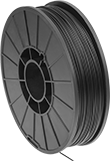
Stretchy, soft, and sturdy, these filaments make durable parts that resist wear and breakage despite repeated use. Stronger than ABS and PLA filaments, they create long-lasting, wear-resistant parts, such as seals, sleeves, and gaskets, as well as components that take on high-impact forces, such as springs and snap-fit parts.
These filaments don't require a heated printer bed, and they won't shrink or warp when cooling. Use them with a fused filament fabrication (FFF) 3D printer. In general, these flexible filaments require a slow feed rate so they don't jam. Store them in a sealed container with a desiccant, or use a dehumidifying cabinet, since ambient humidity will cause the plastic to degrade and weaken.
For the most flexible parts, use durometer 85A TPU filaments. They're more flexible than PCTPE and other TPU filaments.
For a quick print without sacrificing flexibility, choose durometer 95A TPU filaments. They print much faster than other TPU filaments.
Durometer 75D TPU filaments make tough, durable parts that act similar to a tire tread—flexing repeatedly without cracking.
Tensile strength is the best measure of a filament's overall strength. Similar to the stress applied on a rope during a game of tug-of-war, it's the amount of pulling force a material can handle before breaking. A higher rating means a stronger filament. A tensile strength of 5,000 psi and above is considered good; 12,000 psi and above is excellent.
Maximum exposure temperature is the point at which a printed part will begin to deform. Above this temperature, your printed parts will start to lose structural integrity.
Spool | |||||||||||
|---|---|---|---|---|---|---|---|---|---|---|---|
| Dia., mm | Printing Temp. | For Printer Bed Temp. | Tensile Strength | Max. Exposure Temp. | For Min. Nozzle Opening Dia., mm | Dia., mm | Dp., mm | Wt., g | Choose a Color | Each | |
Durometer 85A (Medium Soft) TPU Plastic | |||||||||||
| 1.75 | 225° to 235° C 437° to 455° F | 21° to 40° C 70° to 104° F | 580 psi (Poor) | 111° F 44° C | 0.25 | 200 | 70 | 1,000 | 00000000 | 000000 | |
| 2.85 | 225° to 235° C 437° to 455° F | 21° to 40° C 70° to 104° F | 580 psi (Poor) | 111° F 44° C | 0.25 | 200 | 70 | 1,000 | 00000000 | 00000 | |
Durometer 95A (Medium Soft) TPU Plastic | |||||||||||
| 1.75 | 230° to 240° C 446° to 464° F | 21° to 40° C 70° to 104° F | 1,250 psi (Poor) | 120° F 49° C | 0.25 | 200 | 70 | 1,000 | 00000000 | 00000 | |
| 2.85 | 230° to 240° C 446° to 464° F | 21° to 40° C 70° to 104° F | 1,250 psi (Poor) | 120° F 49° C | 0.25 | 200 | 70 | 1,000 | 00000000 | 00000 | |
Durometer 75D (Medium) TPU Plastic | |||||||||||
| 1.75 | 220° to 230° C 428° to 446° F | 21° to 45° C 70° to 113° F | 3,900 psi (Poor) | 106° F 41° C | 0.25 | 200 | 70 | 1,000 | 00000000 | 00000 | |
| 2.85 | 220° to 230° C 428° to 446° F | 21° to 45° C 70° to 113° F | 3,900 psi (Poor) | 106° F 41° C | 0.25 | 200 | 70 | 1,000 | 00000000 | 00000 | |
Dremel 3D Printer Filaments
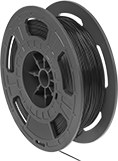

Build parts and prototypes from these filaments using Dremel fused filament fabrication (FFF) 3D printers. An RFID tag on the spool communicates with your printer, automatically adjusting it to the correct temperature and print speed for the filament material and notifying you when the filament is running out.
PLA filaments are the most commonly used in 3D printing. PLA is easy to use; it rarely clogs nozzles, doesn’t require a heated printer bed, and prints at a low temperature—meaning parts won’t warp while cooling. It produces string-free parts, so you can use it to print with a high level of detail. Less durable and more sensitive to heat than ECO-ABS, PLA is better for printing prototypes than end-use parts.
ECO-ABS is less brittle and more impact resistant than PLA, so these filaments are good for printing parts that are frequently handled, dropped, or heated. They are, however, a little more high maintenance—parts may warp during cooling, so they require a heated printer bed.
Tensile strength is the best measure of a filament's overall strength. Similar to the stress applied on a rope during a game of tug-of-war, it's the amount of pulling force a material can handle before breaking. A higher rating means a stronger filament. A tensile strength of 5,000 psi and above is considered good; 12,000 psi and above is excellent.
Maximum exposure temperature is the point at which a printed part will begin to deform. Above this temperature, your printed parts will start to lose structural integrity.
Spool | ||||||||||||
|---|---|---|---|---|---|---|---|---|---|---|---|---|
| Manufacturer Model No. | Dia., mm | Printing Temp. | For Printer Bed Temp. | Tensile Strength | Max. Exposure Temp. | For Min. Nozzle Opening Dia., mm | Dia., mm | Dp., mm | Wt., g | Color | Each | |
PLA Plastic | ||||||||||||
| __ | 1.75 | 200° to 230° C 395° to 445° F | 35° C 95° F | 6,620 psi (Good) | 60° C 140° F | 0.25 | 180 | 55 | 750 | White | 000000 | 000000 |
ECO-ABS Plastic | ||||||||||||
| ECO-WHI-01 | 1.75 | 190° to 240° C 374° to 464° F | 60° C 140° F | 8,410 psi (Good) | 63° C 145° F | 0.2 | 181 | 55 | 750 | White | 0000000 | 00000 |
Moisture-Resistant 3D Printer Filaments
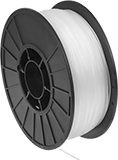

Parts printed with these filaments absorb less moisture than other types of plastic, making them ideal for use in wet or humid environments. They are more durable and flexible than PLA, and easier to print than ABS. Use these filaments with fused filament fabrication (FFF) 3D printers, and print onto a heated print bed. Printing onto a cool surface causes the molten filament to change temperature rapidly, which can warp your designs. Although finished parts are moisture-resistant, these filaments are sensitive to humidity, and should be stored in a dehumidifying cabinet or a sealed container with desiccant.
PETT forms strong bonds between layers, so prints will not split apart. It is often used to make large models with large layers.
Tensile strength is the best measure of a filament's overall strength. Similar to the stress applied on a rope during a game of tug-of-war, it's the amount of pulling force a material can handle before breaking. A higher rating means a stronger filament. A tensile strength of 5,000 psi and above is considered good; 12,000 psi and above is excellent.
Maximum exposure temperature is the point at which a printed part will begin to deform. Above this temperature, your printed parts will start to lose structural integrity.
Spool | ||||||||||||
|---|---|---|---|---|---|---|---|---|---|---|---|---|
| Dia., mm | Printing Temp. | For Printer Bed Temp. | Tensile Strength | Hardness | Max. Exposure Temp. | Specifications Met | For Min. Nozzle Opening Dia., mm | Dia., mm | Dp., mm | Wt., g | Each | |
PETT Plastic | ||||||||||||
Opaque White | ||||||||||||
| 1.75 | 235° to 242° C 455° to 468° F | 68° C 155° F | 4,060 psi (Poor) | Not Rated | 76° C 169° F | FDA Compliant 21 CFR 177.1315 | 0.2 | 200 | 70 | 1,000 | 000000 | 000000 |
| 2.85 | 235° to 242° C 455° to 468° F | 68° C 155° F | 4,060 psi (Poor) | Not Rated | 76° C 169° F | FDA Compliant 21 CFR 177.1315 | 0.2 | 200 | 70 | 1,000 | 0000000 | 00000 |
Structural Support 3D Printer Filaments
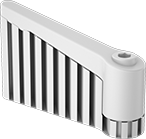
with your part to prevent the
part from losing its shape
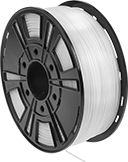

When 3D printing a model with overhangs or hollow spaces, use these filaments to prevent the model from losing its shape. They support the structure during the printing and cooling process, then dissolve or snap away once the part is hardened. Use them in dual-extrusion fused filament fabrication (FFF) printers alongside your primary filament. Unlike parts with supports printed from a single filament, there’s no cutting, sanding, or polishing required. Choose a filament that prints at a similar temperature as your primary filament so they cool at the same rate and won’t warp.
Drop parts made with soluble filaments in a warm, circulating bath to dissolve them off of your primary part, leaving a smooth finish. They’ll dissolve within 2 to 12 hours, depending on the size of the print. To accelerate this process, use ultrasonic cleaners.Parts made with HIPS filaments dissolve in limonene-based solvents. These filaments are commonly used to support ABS parts since they print at a similar temperature.
Spool | |||||||||||
|---|---|---|---|---|---|---|---|---|---|---|---|
| Dia., mm | Printing Temp. | For Printer Bed Temp. | Hardness | Max. Exposure Temp. | For Min. Nozzle Opening Dia., mm | Dia., mm | Dp., mm | Wt., g | For Use With | Each | |
Limonene Solvent Soluble | |||||||||||
HIPS Plastic—Opaque White | |||||||||||
| 1.75 | 220° to 235° C 428° to 455° F | 100° to 110° C 212° to 230° F | Rockwell R100 (Hard) | 80° C 176° F | 0.4 | 200 | 75 | 1,000 | ABS Plastic, ASA Plastic | 0000000 | 000000 |
| 2.85 | 220° to 235° C 428° to 455° F | 100° to 110° C 212° to 230° F | Rockwell R100 (Hard) | 80° C 176° F | 0.4 | 200 | 75 | 1,000 | ABS Plastic, ASA Plastic | 0000000 | 00000 |
Cleaning 3D Printer Filaments
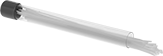
Clear your 3D printer’s extruder with these cleaning filaments. The compound in the filaments bonds to leftover material, flushing it out as the compound passes through. Run a filament through your extruder before switching to a new printing job to remove old materials or colors that could bleed over or jam the printer. Even if you’re not changing jobs, use these filaments to periodically purge residue from your system to keep it printing smoothly. At 8" long, each filament is sized for a single use, so there’s no need to cut them to size.
Foam-Forming 3D Printer Filaments
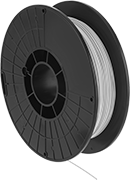
Print these polypropylene filaments into filters, gaskets, and other lightweight, foam-like parts that let air and gas pass through but repel water. They contain a filler that dissolves in water, forming hollow spaces that make up 45% of the part. Polypropylene is known for being rigid yet flexible, so it absorbs impacts and bounces back to shape after bending, making these filaments good for compressible seals and living hinges. It also resists hydrocholoric and phosphoric acids, as well as other nonoxidizing acids and bases.
These filaments work with fused filament fabrication (FFF) 3D printers. If using a glass print surface, apply an adhesive to prevent the filament from detaching. The recommended print speed is 25 mm/s. While polypropylene is likely to shrink, the filler in these filaments supports your design, preventing it from losing shape as it prints. Submerge your part in hot water for about 24 hours after printing to dissolve the filler and expose the pores.
For extra support when printing complex designs, use structural support 3D printer filaments. They dissolve in water at the same time as this filament’s filler.
Spool | |||||||||||||
|---|---|---|---|---|---|---|---|---|---|---|---|---|---|
| Dia., mm | Printing Temp. | For Printer Bed Temp. | Tensile Strength | Hardness | Max. Exposure Temp. | For Min. Nozzle Opening Dia., mm | Dia., mm | Dp., mm | Material | Wt., g | Color | Each | |
Polypropylene Plastic | |||||||||||||
| 1.75 | 190° to 240° C 374° to 464° F | 95° C to 125° C 203° F to 257° F | 1,000 psi (Poor) | Shore A90 (Medium Soft) | 140° C 284° F | 0.4 | 200 | 55 | Plastic | 500 | White | 0000000 | 0000000 |
| 2.85 | 190° to 240° C 374° to 464° F | 95° C to 125° C 203° F to 257° F | 1,000 psi (Poor) | Shore A90 (Medium Soft) | 140° C 284° F | 0.4 | 200 | 55 | Plastic | 500 | White | 0000000 | 000000 |
MakerBot 3D Printer Filaments
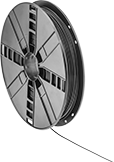
Compatible with the MakerBot Replicator 2 Desktop 3D Printer and all Fifth Generation MakerBot Replicator 3D printers.
Spool | ||||||||
|---|---|---|---|---|---|---|---|---|
| Color | Dia., mm | Wt., g | Manufacturer Model Number | For Manufacturer Series | Dia. | Dp. | Each | |
PLA | ||||||||
| White | 1.75 | 900 | MP05780 | Fifth Generation Replicator, Replicator 2 | 9 3/4" | 1 1/2" | 0000000 | 000000 |