


Performance Properties Performance Properties |
|---|
|


Material Material | Show |
|---|
|
Material Material | Hide |
|---|
|
Container Type Container Type |
|---|
 | Spool |
Flexibility Flexibility |
|---|
 | Semi-Rigid |

Density Density |
|---|
|
DFARS (Defense Acquisition Regulations Supplement) DFARS (Defense AcquisitionRegulations Supplement)  |
|---|
Flexural Modulus Flexural Modulus |
|---|
|
REACH (Registration, Evaluation, Authorization and Restriction of Chemicals) REACH (Registration,Evaluation, Authorization and Restriction of Chemicals) |
|---|
|
RoHS (Restriction of Hazardous Substances) RoHS (Restriction ofHazardous Substances) |
|---|
|
Tensile Strength Rating Tensile Strength Rating |
|---|
|
Tensile Strength Tensile Strength |
|---|
|
Water Absorption Rating Water Absorption Rating |
|---|
|
Hardness Rating Hardness Rating |
|---|
|
For Printer Bed Temperature For Printer Bed Temperature |
|---|
|
|
Clarity Clarity |
|---|
|
Impact-Resistant 3D Printer Filaments
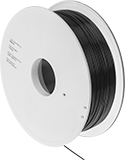


Bumps, scrapes, and falls won’t damage these tough filaments. Known for their durability, they absorb impact without cracking or breaking, and won’t degrade when heated. Use them to print tool handles, storage cases, and other parts that are handled or dropped frequently.
Use with a fused filament fabrication (FFF) 3D printer. These filaments have a high melting point, and must be printed onto a heated bed. Without it, parts will cool too quickly and warp. These filaments also release fumes as they are printed, so use an enclosed printer or a fume exhauster to ventilate them. When printing a filament with a filler, it’s recommended that you use a hardened steel nozzle. Since the filler makes them abrasive, they will wear out copper and brass nozzles.
ASA filaments are the best choice for outdoor-use parts. Unlike other filaments, which warp and crack with prolonged sun exposure, parts made from ASA are UV resistant.
Tensile strength is the best measure of a filament's overall strength. Similar to the stress applied on a rope during a game of tug-of-war, it's the amount of pulling force a material can handle before breaking. A higher rating means a stronger filament. A tensile strength of 5,000 psi and above is considered good; 12,000 psi and above is excellent.
Maximum exposure temperature is the point at which a printed part will begin to deform. Above this temperature, your printed parts will start to lose structural integrity.
Spool | |||||||||||
|---|---|---|---|---|---|---|---|---|---|---|---|
| Dia., mm | Printing Temp. | For Printer Bed Temp. | Tensile Strength | Max. Exposure Temp. | For Min. Nozzle Dia., mm | Dia., mm | Dp., mm | Wt., g | Choose a Color | Each | |
ASA Plastic | |||||||||||
| 1.75 | 235° to 255° C 455° to 491° F | 80° to 90° C 176° to 194° F | 6,880 psi (Good) | 98° C 208° F | 0.4 | 200 | 55 | 750 | Off-White | 00000000 | 000000 |
| 1.75 | 235° to 255° C 455° to 491° F | 90° to 110° C 194° to 230° F | 6,520 psi (Good) | 95° C 203° F | 0.4 | 200 | 75 | 1,000 | 00000000 | 00000 | |
| 2.85 | 235° to 255° C 455° to 491° F | 80° to 90° C 176° to 194° F | 6,880 psi (Good) | 98° C 208° F | 0.4 | 200 | 55 | 750 | 00000000 | 00000 | |
| 2.85 | 235° to 255° C 455° to 491° F | 90° to 110° C 194° to 230° F | 6,520 psi (Good) | 95° C 203° F | 0.4 | 200 | 75 | 1,000 | 00000000 | 00000 | |