

Tensile Strength Tensile Strength |
|---|
|
Tensile Strength Rating Tensile Strength Rating |
|---|
|

Flexural Modulus Flexural Modulus |
|---|
|
Flexibility Flexibility |
|---|
 |  |
| Semi-Rigid | Rigid |
Material Material | Show |
|---|
|
Material Material | Hide |
|---|
|
Performance Properties Performance Properties |
|---|
|
Hardness Rating Hardness Rating |
|---|
|
Container Type Container Type |
|---|
 | Spool |
Filler Material Filler Material |
|---|
|
REACH (Registration, Evaluation, Authorization and Restriction of Chemicals) REACH (Registration,Evaluation, Authorization and Restriction of Chemicals) |
|---|
|
RoHS (Restriction of Hazardous Substances) RoHS (Restriction ofHazardous Substances) |
|---|
|
Hardness Hardness |
|---|
|
Color Color |
|---|
 | Beige |
For Minimum Nozzle Opening Diameter For Minimum NozzleOpening Diameter |
|---|
|
For Printer Bed Temperature For Printer Bed Temperature |
|---|
|
DFARS (Defense Acquisition Regulations Supplement) DFARS (Defense AcquisitionRegulations Supplement) |
|---|
High-Temperature 3D Printer Filaments
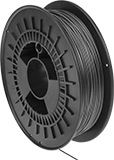

Parts made with these filaments remain strong and rigid in temperatures that would soften most plastics. They are a lightweight alternative to machined metal parts. Use with a fused filament fabrication (FFF) 3D printer to make parts that will be used near ovens, engines, and other hot machinery. These filaments require an all-metal extruder to reach the recommended printing temperatures. Print parts onto a heated bed to keep them from warping as they cool.
Parts printed from PEEK filaments hold up to wear from repeated use and do not degrade when exposed to most chemicals. They are often used to print parts for chemical processing applications.
Fiberglass-filled PEEK filaments produce parts that are stronger, shrink less, and are less likely to warp than unfilled PEEK. They also take nearly twice as much heat without deforming. To reach their full heat resistance and strength, parts printed with fiberglass-filled PEEK must be annealed.
Tensile strength is the best measure of a filament's overall strength. Similar to the stress applied on a rope during a game of tug-of-war, it's the amount of pulling force a material can handle before breaking. A higher rating means a stronger filament. A tensile strength of 5,000 psi and above is considered good; 12,000 psi and above is excellent.
Maximum exposure temperature is the point at which a printed part will begin to deform. Above this temperature, your printed parts will start to lose structural integrity.
Annealing is the process of heating prints to a specific annealing temperature and then slowly allowing them to cool. This makes the finished print harder, stronger, and more heat tolerant. Maximum temperature after annealing replaces the maximum exposure temperature once this process has been completed.
Spool | |||||||||||||
|---|---|---|---|---|---|---|---|---|---|---|---|---|---|
| Dia., mm | Printing Temp. | For Printer Bed Temp. | Tensile Strength | Max. Exposure Temp. | Max. Annealing Temp. | Max. Temp. After Annealing | For Min. Nozzle Dia., mm | Dia., mm | Dp., mm | Wt., g | Color | Each | |
PEEK Plastic | |||||||||||||
| 1.75 | 375° to 410° C 707° to 770° F | 130° to 145° C 266° to 293° F | 14,500 psi (Excellent) | 140° C 284° F | 140° C 284° F | 230° C 446° F | 0.4 | 195 | 40 | 500 | Opaque Beige | 0000000 | 0000000 |
Fiberglass-Filled PEEK Plastic | |||||||||||||
| 1.75 | 375° to 410° C 707° to 770° F | 130° to 145° C 266° to 293° F | 13,050 psi (Excellent) | 260° C 500° F | 140° C 284° F | 315° C 599° F | 0.4 | 195 | 40 | 500 | Opaque Beige | 0000000 | 000000 |