



Container Type Container Type |
|---|
 | Spool |
Material Material | Show |
|---|
|
Material Material | Hide |
|---|
|
Performance Properties Performance Properties |
|---|
|
Flexibility Flexibility |
|---|
 | Flexible |
For Minimum Nozzle Opening Diameter For Minimum NozzleOpening Diameter |
|---|
|

Weight Weight |
|---|
|
Color Color |
|---|
 | White |
Density Density |
|---|
|

Hardness Hardness |
|---|
|
Hardness Rating Hardness Rating |
|---|
|
DFARS (Defense Acquisition Regulations Supplement) DFARS (Defense AcquisitionRegulations Supplement)  |
|---|
Flexural Modulus Flexural Modulus |
|---|
|
For Printer Speed For Printer Speed |
|---|
|
REACH (Registration, Evaluation, Authorization and Restriction of Chemicals) REACH (Registration,Evaluation, Authorization and Restriction of Chemicals) |
|---|
|
RoHS (Restriction of Hazardous Substances) RoHS (Restriction ofHazardous Substances) |
|---|
|
Tensile Strength Tensile Strength |
|---|
|
Tensile Strength Rating Tensile Strength Rating |
|---|
|
Foam-Forming 3D Printer Filaments
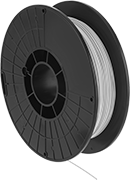
Print these polypropylene filaments into filters, gaskets, and other lightweight, foam-like parts that let air and gas pass through but repel water. They contain a filler that dissolves in water, forming hollow spaces that make up 45% of the part. Polypropylene is known for being rigid yet flexible, so it absorbs impacts and bounces back to shape after bending, making these filaments good for compressible seals and living hinges. It also resists hydrocholoric and phosphoric acids, as well as other nonoxidizing acids and bases.
These filaments work with fused filament fabrication (FFF) 3D printers. If using a glass print surface, apply an adhesive to prevent the filament from detaching. The recommended print speed is 25 mm/s. While polypropylene is likely to shrink, the filler in these filaments supports your design, preventing it from losing shape as it prints. Submerge your part in hot water for about 24 hours after printing to dissolve the filler and expose the pores.
For extra support when printing complex designs, use structural support 3D printer filaments. They dissolve in water at the same time as this filament’s filler.
Spool | |||||||||||||
|---|---|---|---|---|---|---|---|---|---|---|---|---|---|
| Dia., mm | Printing Temp. | For Printer Bed Temp. | Tensile Strength | Hardness | Max. Exposure Temp. | For Min. Nozzle Opening Dia., mm | Dia., mm | Dp., mm | Material | Wt., g | Color | Each | |
Polypropylene Plastic | |||||||||||||
| 1.75 | 190° to 240° C 374° to 464° F | 95° C to 125° C 203° F to 257° F | 1,000 psi (Poor) | Shore A90 (Medium Soft) | 140° C 284° F | 0.4 | 200 | 55 | Plastic | 500 | White | 0000000 | 0000000 |
| 2.85 | 190° to 240° C 374° to 464° F | 95° C to 125° C 203° F to 257° F | 1,000 psi (Poor) | Shore A90 (Medium Soft) | 140° C 284° F | 0.4 | 200 | 55 | Plastic | 500 | White | 0000000 | 000000 |