


Performance Properties Performance Properties | Show |
|---|
|
Performance Properties Performance Properties | Hide |
|---|
|
Container Type Container Type |
|---|
 | Spool |
Material Material |
|---|
|
Minimum Printing Temperature Minimum PrintingTemperature |
|---|
|
|
|


Maximum Exposure Temperature Maximum ExposureTemperature |
|---|
|
|
|
For Printer Bed Temperature For Printer Bed Temperature |
|---|
|
|
Maximum Printing Temperature Maximum PrintingTemperature |
|---|
|
|
|
Flexibility Flexibility |
|---|
 |  |
| Flexible | Semi-Rigid |

Hardness Hardness |
|---|
|

RoHS (Restriction of Hazardous Substances) RoHS (Restriction ofHazardous Substances) |
|---|
|
For Printer Speed For Printer Speed |
|---|
|
|
Flexural Modulus Flexural Modulus |
|---|
|
|
REACH (Registration, Evaluation, Authorization and Restriction of Chemicals) REACH (Registration,Evaluation, Authorization and Restriction of Chemicals) |
|---|
|
Flame-Retardant Impact-Resistant 3D Printer Filaments
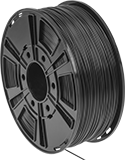
Absorbing blows and resisting fire, these ABS filaments produce holders, guards, housings, and other parts that protect sensitive, flammable equipment and machinery. They’re rated UL 94 V-0, which means they meet strict flammability standards. Print them on a fused filament fabrication (FFF) 3D printer. Because they have a high melting point, they require a heated print surface and may warp as they cool. They also emit fumes, so you need direct ventilation, such as a fume exhauster, to print safely.
ABS filaments have a lower printing temperature than polycarbonate ABS filaments, so they’re easier to print. You don’t need to store them with a desiccant to keep them dry, since they resist absorbing moisture from the air.
Polycarbonate ABS filaments are about 33% stronger and handle slightly higher temperatures than standard ABS filaments.
Tensile strength is the best measure of a filament’s overall strength. Similar to the stress applied on a rope during a game of tug-of-war, it’s the amount of pulling force a material can handle before breaking. A higher rating means a stronger filament. A tensile strength of 5,000 psi and above is considered good; 12,000 psi and above is excellent.
Maximum exposure temperature is the point at which a printed part will begin to deform. Above this temperature, your part will start to lose structural integrity.
Spool | |||||||||||||
|---|---|---|---|---|---|---|---|---|---|---|---|---|---|
| Dia., mm | Printing Temp. | For Printer Bed Temp. | Tensile Strength  | Hardness | Max. Exposure Temp. | Specifications Met | For Min. Nozzle Opening Dia., mm | Dia., mm | Dp., mm | Wt., g | Color | Each | |
ABS Plastic | |||||||||||||
| 1.75 | 220° to 240° C 428° to 464° F | 100° to 110° C 212° to 230° F | 6,520 psi (Good) | Rockwell R120 (Hard) | 95° C 203° F | UL 94 V-0 | 0.4 | 200 | 75 | 750 | Black | 00000000 | 000000 |
| 2.85 | 220° to 240° C 428° to 464° F | 100° to 110° C 212° to 230° F | 6,520 psi (Good) | Rockwell R120 (Hard) | 95° C 203° F | UL 94 V-0 | 0.4 | 200 | 75 | 750 | Black | 00000000 | 00000 |
Polycarbonate ABS Plastic | |||||||||||||
| 2.85 | 250° to 270° C 482° to 518° F | 100° C 212° F | 8,700 psi (Good) | Not Rated | 104° C 219° F | UL 94 V-0 | 0.4 | 200 | 55 | 500 | Black | 0000000 | 00000 |
Flame-Retardant Wear-Resistant 3D Printer Filaments
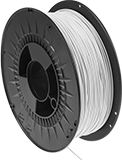
Create gears, bearings, washers and other hard-working parts that may be used in or near flammable machinery. These filaments meet UL 94V0, so if they catch fire they will self-extinguish within 10 seconds and any drips that fall won’t cause other fires. In addition, these filaments won’t easily scratch or wear out from friction, or crack when they’re drilled or tapped. Made of blended thermoplastic, they have three times the wear resistance of standard nylon. They also handle higher temperatures.
Because of their high melting point, you must use a heated printer bed when using these filaments with your fused filament fabrication (FFF) printer. Remove fumes during printing with a fume exhauster. Store unused filaments in a sealed container with a desiccant.
Tensile strength is the best measure of a filament's overall strength. Similar to the stress applied on a rope during a game of tug-of-war, it's the amount of pulling force a material can handle before breaking. A higher rating means a stronger filament. A tensile strength of 5,000 psi and above is considered good; 12,000 psi and above is excellent.
Maximum exposure temperature is the point at which a printed part will begin to deform. Above this temperature, your printed parts will start to lose structural integrity.
Spool | ||||||||||||
|---|---|---|---|---|---|---|---|---|---|---|---|---|
| Dia., mm | Printing Temp. | For Printer Bed Temp. | Tensile Strength | Hardness | Max. Exposure Temp. | For Min. Nozzle Opening Dia., mm | Dia., mm | Dp., mm | Wt., g | Color | Each | |
Thermoplastic Blend | ||||||||||||
| 1.75 | 360° to 365° C 680° to 689° F | 190° to 210° C 374° to 410° F | 7,970 psi (Good) | Durometer 80D (Medium) | 180° C 356° F | 0.4 | 200 | 55 | 250 | Beige | 0000000 | 0000000 |
Chemical-Resistant 3D Printer Filaments
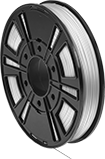

Fabricate custom bottles, packaging, and other parts for chemical processing. Made of PPS, these filaments won’t break down even after prolonged exposure to virtually any acid, base, or solvent. They also stand up to oil and fuel, so they’re sometimes made into automotive parts. Because they have a low density and won’t transfer electricity, they make parts that are lightweight and protect components from electric currents. These filaments are easy to store too, since they resist absorbing water. Rated UL 94 V-0, they meet flammability standards.
Print these filaments on a fused filament fabrication (FFF) 3D printer. Due to its high melting point, PPS is more difficult to print than most other materials. You need an all-metal extruder and a heated printer bed to reach its minimum printing temperature. After printing, anneal your part in an oven for 2 to 4 hours to reach its maximum strength, temperature, and ability to resist chemicals.
Tensile strength is the best measure of a filament’s overall strength. Similar to the stress applied on a rope during a game of tug-of-war, it’s the amount of pulling force a material can handle before breaking. A higher rating means a stronger filament. A tensile strength of 5,000 psi and above is considered good; 12,000 psi and above is excellent.
Maximum exposure temperature is the point at which a printed part will begin to deform. Above this temperature, your part will start to lose structural integrity.
Spool | ||||||||||||
|---|---|---|---|---|---|---|---|---|---|---|---|---|
| Dia., mm | Printing Temp. | For Printer Bed Temp. | Tensile Strength | Annealing Temp. | Max. Exposure Temp. | Specifications Met | For Min. Nozzle Opening Dia., mm | Dia., mm | Dp., mm | Wt., g | Each | |
PPS Plastic | ||||||||||||
Off-White | ||||||||||||
| 1.75 | 315° to 345° C 599° to 653° F | 120° to 160° C 248° to 320° F | 7,250 psi (Good) | 80° to 130° C 176° to 266° F | 85° C 185° F | UL 94 V-0 | 0.4 | 200 | 40 | 500 | 000000 | 0000000 |
Flexible 3D Printer Filaments
 |  |
 |
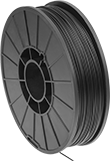
Stretchy, soft, and sturdy, these filaments make durable parts that resist wear and breakage despite repeated use. Stronger than ABS and PLA filaments, they create long-lasting, wear-resistant parts, such as seals, sleeves, and gaskets, as well as components that take on high-impact forces, such as springs and snap-fit parts.
These filaments don't require a heated printer bed, and they won't shrink or warp when cooling. Use them with a fused filament fabrication (FFF) 3D printer. In general, these flexible filaments require a slow feed rate so they don't jam. Store them in a sealed container with a desiccant, or use a dehumidifying cabinet, since ambient humidity will cause the plastic to degrade and weaken.
With nylon as an additive, PCTPE filaments are not only flexible, they're wear resistant and inherently slippery, so they're good for components that move and rub against other objects. They're also UL rated 94 HB and 94 V-2 for their ability to prevent the spread of flames both horizontally and vertically.
Tensile strength is the best measure of a filament's overall strength. Similar to the stress applied on a rope during a game of tug-of-war, it's the amount of pulling force a material can handle before breaking. A higher rating means a stronger filament. A tensile strength of 5,000 psi and above is considered good; 12,000 psi and above is excellent.
Maximum exposure temperature is the point at which a printed part will begin to deform. Above this temperature, your printed parts will start to lose structural integrity.
Spool | |||||||||||
|---|---|---|---|---|---|---|---|---|---|---|---|
| Dia., mm | Printing Temp. | For Printer Bed Temp. | Tensile Strength | Max. Exposure Temp. | For Min. Nozzle Opening Dia., mm | Dia., mm | Dp., mm | Wt., g | Choose a Color | Each | |
PCTPE Plastic—UL 94 HB, UL 94 V-2 | |||||||||||
| 1.75 | 235° to 242° C 455° to 468° F | 50° C 122° F | 5,040 psi (Good) | 165° F 74° C | 0.2 | 200 | 70 | 1,000 | 00000000 | 000000 | |
| 2.85 | 235° to 242° C 455° to 468° F | 50° C 122° F | 5,040 psi (Good) | 165° F 74° C | 0.2 | 200 | 70 | 1,000 | 00000000 | 00000 | |
High-Temperature 3D Printer Filaments
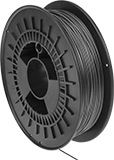

Parts made with these filaments remain strong and rigid in temperatures that would soften most plastics. They are a lightweight alternative to machined metal parts. Use with a fused filament fabrication (FFF) 3D printer to make parts that will be used near ovens, engines, and other hot machinery. These filaments require an all-metal extruder to reach the recommended printing temperatures. Print parts onto a heated bed to keep them from warping as they cool.
To skip the annealing process, use carbon-fiber-filled PEKK filaments. Once they are printed, they tolerate the same amount of heat as unfilled, annealed PEKK, while producing parts that are stiffer and more impact resistant. These filaments also meet UL 94 V-0, which means they self-extinguish within 10 seconds if they catch fire, and won’t cause additional fires by dripping.
Tensile strength is the best measure of a filament's overall strength. Similar to the stress applied on a rope during a game of tug-of-war, it's the amount of pulling force a material can handle before breaking. A higher rating means a stronger filament. A tensile strength of 5,000 psi and above is considered good; 12,000 psi and above is excellent.
Maximum exposure temperature is the point at which a printed part will begin to deform. Above this temperature, your printed parts will start to lose structural integrity.
Spool | ||||||||||||
|---|---|---|---|---|---|---|---|---|---|---|---|---|
| Dia., mm | Printing Temp. | For Printer Bed Temp. | Tensile Strength | Max. Exposure Temp. | Specifications Met | For Min. Nozzle Dia., mm | Dia., mm | Dp., mm | Wt., g | Color | Each | |
Carbon-Fiber-Filled PEKK Plastic | ||||||||||||
| 1.75 | 350° to 390° C 662° to 734° F | 110° to 150° C 230° to 302° F | 5,670 psi (Good) | 260° C 500° F | UL 94 V-0 | 0.4 | 200 | 55 | 500 | Opaque Gray | 0000000 | 0000000 |