


Length Length |
|---|
|
|
|
Performance Properties Performance Properties | Show |
|---|
|
Performance Properties Performance Properties | Hide |
|---|
|
Color Color |
|---|
 | Black |
Electrical Properties Electrical Properties |
|---|
|
Container Type Container Type |
|---|
 | Spool |
Maximum Printing Temperature Maximum PrintingTemperature |
|---|
|
|
|
Flexibility Flexibility |
|---|
|
Hardness Hardness |
|---|
|

Filler Material Filler Material |
|---|
|
Hardness Rating Hardness Rating |
|---|
|
|
For Printer Bed Temperature For Printer Bed Temperature |
|---|
Tensile Strength Tensile Strength |
|---|
|
Maximum Exposure Temperature Maximum ExposureTemperature |
|---|
|
|
|
For Printer Speed For Printer Speed |
|---|
|
|
RoHS (Restriction of Hazardous Substances) RoHS (Restriction ofHazardous Substances) |
|---|
|

REACH (Registration, Evaluation, Authorization and Restriction of Chemicals) REACH (Registration,Evaluation, Authorization and Restriction of Chemicals) |
|---|
|
Static-Dissipative Easy-to-Print 3D Printer Filaments
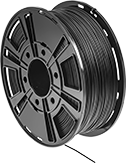
Make parts that protect equipment from electrostatic shocks without clogging your nozzle, warping your part, or needing a heated printer bed. These filaments have a base of PLA, the most common filament thanks to its low melting point, with a compound that diverts electrostatic discharges in a controlled way. PLA is also unlikely to drip and produce plastic strings for clean, detailed parts. However, it’s not as strong or as heat resistant as ABS, so it’s better for prototypes over load-bearing equipment. Since these filaments won’t produce toxic fumes, you can safely print them without ventilation. Print them on a fused filament fabrication (FFF) 3D printer.
To make sure your part dissipates static properly, use an electrical resistance tester to measure the surface resistivity. The target surface resistivity for PLA is 107 to 109 ohms. To adjust resistivity, change the temperature of your printer’s extruder. As the extruder’s temperature increases, so will the printed part’s resistivity.
Tensile strength is the best measure of a filament’s overall strength. Similar to the stress applied on a rope during a game of tug-of-war, it’s the amount of pulling force a material can handle before breaking. A higher rating means a stronger filament. A tensile strength of 5,000 psi and above is considered good; 12,000 psi and above is excellent.
Maximum exposure temperature is the point at which a printed part will begin to deform. Above this temperature, your part will start to lose structural integrity.
Spool | |||||||||||
|---|---|---|---|---|---|---|---|---|---|---|---|
| Dia., mm | Printing Temp. | For Printer Bed Temp. | Tensile Strength | Max. Exposure Temp. | For Min. Nozzle Opening Dia., mm | Dia., mm | Dp., mm | Wt., g | Color | Each | |
PLA Plastic | |||||||||||
| 1.75 | 210° to 220° C 410° to 430° F | 23° to 60° C 73° to 140° F | 7,970 psi (Good) | 55° C 131° F | 0.25 | 200 | 70 | 750 | Black | 0000000 | 0000000 |
| 2.85 | 210° to 220° C 410° to 430° F | 23° to 60° C 73° to 140° F | 7,970 psi (Good) | 55° C 131° F | 0.25 | 200 | 70 | 750 | Black | 0000000 | 000000 |
Conductive Easy-to-Print 3D Printer Filaments
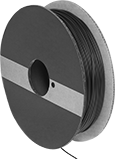
Create circuit prototypes and other conductive pathways with these low-maintenance PLA filaments. They combine a conductive additive with PLA, the most commonly used filament material. Their low melting temperature means they rarely clog nozzles and won’t warp while cooling, so they don’t need a heated printer bed. They produce clean, string-free parts that capture the details of intricate designs. PLA should primarily be used to print prototypes, as it isn’t strong or heat resistant enough to create parts for repeated use. Unlike other materials, PLA filaments won’t produce toxic fumes while printing, so they don’t require ventilation. These filaments are for use in fused filament fabrication (FFF) 3D printers.
To ensure your part conducts electricity properly, use an electrical resistance tester, which measures surface resistivity. In general, the target surface resistivity for printed parts is 101 to 106 ohms. To adjust, change the temperature of your printer’s extruder. As the extruder’s temperature increases, so will the printed part’s conductivity.
Maximum exposure temperature is the point at which a printed part will begin to deform. Above this temperature, your printed parts will start to lose structural integrity.
Spool | ||||||||||
|---|---|---|---|---|---|---|---|---|---|---|
| Dia., mm | Printing Temp. | For Printer Bed Temp. | Max. Exposure Temp. | For Min. Nozzle Dia., mm | Dia., mm | Dp., mm | Wt., g | Color | Each | |
PLA Plastic | ||||||||||
| 1.75 | 195° to 225° C 383° to 437° F | 21° to 60° C 70° to 140° F | 60° C 140° F | 0.4 | 200 | 50 | 500 | Black | 0000000 | 000000 |
| 1.75 | 195° to 225° C 383° to 437° F | 21° to 60° C 70° to 140° F | 60° C 140° F | 0.4 | 300 | 100 | 2,000 | Black | 0000000 | 000000 |
| 2.85 | 195° to 225° C 383° to 437° F | 21° to 60° C 70° to 140° F | 60° C 140° F | 0.4 | 200 | 50 | 500 | Black | 0000000 | 00000 |
| 2.85 | 195° to 225° C 383° to 437° F | 21° to 60° C 70° to 140° F | 60° C 140° F | 0.4 | 300 | 100 | 2,000 | Black | 0000000 | 000000 |
Static-Dissipative Impact-Resistant 3D Printer Filaments
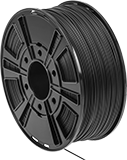
Create tool handles, tote trays, enclosures, and other parts that are banged or dropped often and used near sensitive electronics. These filaments are made of durable ABS or polycarbonate—roughly four times tougher than PLA—with a compound that diverts electrostatic discharges away from equipment. Print them on a fused filament fabrication (FFF) 3D printer. Due to their high melting point, they require a heated printer bed and tend to warp as they cool. They also emit an odor as they print, so you’ll need an enclosed printer or fume exhauster.
ABS filaments are a good place to start if you’re printing impact-resistant parts.
Polycarbonate filaments are nearly twice as impact resistant and stand up to heat better than ABS filaments. However, their higher melting point makes them more difficult to print, since they need more heat and are more likely to warp.
To make sure your part dissipates static properly, use an electrical resistance tester to measure the surface resistivity. The target surface resistivity for these filaments is 107 to 109 ohms. To adjust the resistivity, change the temperature of your printer’s extruder. As the extruder’s temperature increases, so will the printed part’s resistivity.
Tensile strength is the best measure of a filament’s overall strength. Similar to the stress applied on a rope during a game of tug-of-war, it’s the amount of pulling force a material can handle before breaking. A higher rating means a stronger filament. A tensile strength of 5,000 psi and above is considered good; 12,000 psi and above is excellent.
Maximum exposure temperature is the point at which a printed part will begin to deform. Above this temperature, your part will start to lose structural integrity.
Spool | ||||||||||||
|---|---|---|---|---|---|---|---|---|---|---|---|---|
| Dia., mm | Printing Temp. | For Printer Bed Temp. | Tensile Strength | Hardness | Max. Exposure Temp. | For Min. Nozzle Opening Dia., mm | Dia., mm | Dp., mm | Wt., g | Color | Each | |
ABS Plastic | ||||||||||||
| 1.75 | 220° to 240° C 428° to 464° F | 100° to 110° C 212° to 230° F | 8,410 psi (Good) | Rockwell R120 (Hard) | 97° C 207° F | 0.4 | 200 | 75 | 750 | Black | 0000000 | 0000000 |
| 2.85 | 220° to 240° C 428° to 464° F | 100° to 110° C 212° to 230° F | 8,410 psi (Good) | Rockwell R120 (Hard) | 97° C 207° F | 0.4 | 200 | 75 | 750 | Black | 0000000 | 000000 |
Polycarbonate Plastic | ||||||||||||
| 1.75 | 260° to 300° C 500° to 572° F | 110° to 120° C 230° to 248° F | 9,860 psi (Good) | Rockwell R125 (Hard) | 135° C 275° F | 0.4 | 200 | 75 | 750 | Black | 0000000 | 000000 |
Conductive Flexible 3D Printer Filaments
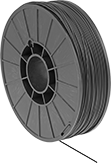
Made of pliable TPU with a conductive compound, these filaments produce wire, circuits, and other components that direct the flow of electricity in wearable and flexible devices, from watches to grippers. Combine them with an insulating material so the electricity flows only through the filament’s pathways and not the rest of the device. In addition to being flexible, TPU is also durable and handles stresses better than ABS and PLA.
Print these filaments on a fused filament fabrication (FFF) 3D printer. You don’t need a heated printer bed, and printed parts resist shrinking and warping as they cool. Because they’re flexible, these filaments print best at a slow, consistent rate; high print speeds could cause them to jam. They don’t stand up well to moisture, so store them in a dehumidifying cabinet or other sealed container with a desiccant to keep them dry.
To make sure your part conducts electricity properly, use an electrical resistance tester to measure the surface resistivity. The target surface resistivity for TPU is 101 to 106 ohms. To adjust, change the temperature of your printer’s extruder. As the extruder’s temperature increases, so will the printed part’s conductivity.
Tensile strength is the best measure of a filament’s overall strength. Similar to the stress applied on a rope during a game of tug-of-war, it’s the amount of pulling force a material can handle before breaking. A higher rating means a stronger filament. A tensile strength of 5,000 psi and above is considered good; 12,000 psi and above is excellent.
Spool | ||||||||||||
|---|---|---|---|---|---|---|---|---|---|---|---|---|
| Dia., mm | Printing Temp. | For Printer Bed Temp. | Tensile Strength | Hardness | Max. Exposure Temp. | For Min. Nozzle Opening Dia., mm | Dia., mm | Dp., mm | Wt., g | Color | Each | |
TPU Plastic | ||||||||||||
| 1.75 | 220° to 230° C 428° to 446° F | 45° C 113° F | 1,700 psi (Poor) | Durometer 90A (Medium Soft) | Not Rated | 0.4 | 200 | 50 | 1,000 | Black | 0000000 | 0000000 |
| 2.85 | 220° to 230° C 428° to 446° F | 45° C 113° F | 1,700 psi (Poor) | Durometer 90A (Medium Soft) | Not Rated | 0.4 | 200 | 50 | 1,000 | Black | 0000000 | 000000 |
Static-Dissipative Flexible 3D Printer Filaments
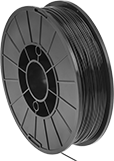
TPU blended with a static-dissipative compound, these filaments make gaskets, springs, grippers, and other pliable parts that divert electrostatic shocks in a controlled way, protecting nearby electronics and sensitive equipment. They meet ANSI/ESD and IEC standards for manufacturing, packaging, transporting, and storing items that can be damaged by electrostatic shocks. In addition to being flexible, TPU is also durable and withstands stresses better than ABS and PLA.
Print these filaments on a fused filament fabrication (FFF) 3D printer. You don’t need a heated printer bed, and printed parts resist shrinking and warping as they cool. Because they’re flexible, these filaments print best at a slow, consistent rate; high print speeds could cause them to jam. They don’t stand up well to moisture, so store them in a dehumidifying cabinet or other sealed container with a desiccant to keep them dry.
Durometer 80A filaments are more flexible than durometer 95A and 74D filaments. Durometer 95A filaments have a balance of flexibility and strength. Durometer 74D filaments are tough and durable. Similar to a tire tread, they can bend repeatedly without cracking.
To make sure your part dissipates static properly, use an electrical resistance tester to measure the surface resistivity. The target surface resistivity for TPU is 106 to 108 ohms. To adjust the resistivity, change the temperature of your printer’s extruder. As the extruder’s temperature increases, so will the printed part’s resistivity.
Tensile strength is the best measure of a filament’s overall strength. Similar to the stress applied to a rope during a game of tug-of-war, it’s the amount of pulling force a material can handle before breaking. A higher rating means a stronger filament. A tensile strength of 5,000 psi and above is considered good; 12,000 psi and above is excellent.
Maximum exposure temperature is the point at which a printed part will begin to deform. Above this temperature, your printed part will start to lose structural integrity.
Spool | ||||||||||||
|---|---|---|---|---|---|---|---|---|---|---|---|---|
| Dia., mm | Printing Temp. | For Printer Bed Temp. | Tensile Strength | Max. Exposure Temp. | Specifications Met | For Min. Nozzle Opening Dia., mm | Dia., mm | Dp., mm | Wt., g | Color | Each | |
TPU Plastic | ||||||||||||
Durometer 80A (Soft) | ||||||||||||
| 1.75 | 230° to 250° C 446° to 482° F | 50° to 80° C 122° to 176° F | 3,100 psi (Poor) | Not Rated | ANSI/ESD S541, IEC 61340 | 0.4 | 200 | 60 | 750 | Black | 00000000 | 0000000 |
| 2.85 | 230° to 250° C 446° to 482° F | 50° to 80° C 122° to 176° F | 3,100 psi (Poor) | Not Rated | ANSI/ESD S541, IEC 61340 | 0.4 | 200 | 60 | 750 | Black | 00000000 | 000000 |
Durometer 95A (Medium Soft) | ||||||||||||
| 1.75 | 230° to 250° C 446° to 482° F | 50° to 80° C 122° to 176° F | 4,900 psi (Poor) | Not Rated | ANSI/ESD S541, IEC 61340 | 0.4 | 200 | 60 | 750 | Black | 00000000 | 000000 |
| 2.85 | 230° to 250° C 446° to 482° F | 50° to 80° C 122° to 176° F | 4,900 psi (Poor) | Not Rated | ANSI/ESD S541, IEC 61340 | 0.4 | 200 | 60 | 750 | Black | 00000000 | 000000 |
Durometer 74D (Medium) | ||||||||||||
| 1.75 | 230° to 250° C 446° to 482° F | 50° to 80° C 122° to 176° F | 4,700 psi (Poor) | 160° C 320° F | ANSI/ESD S541, IEC 61340 | 0.25 | 200 | 60 | 750 | Black | 00000000 | 000000 |
| 2.85 | 230° to 250° C 446° to 482° F | 50° to 80° C 122° to 176° F | 4,700 psi (Poor) | 160° C 320° F | ANSI/ESD S541, IEC 61340 | 0.25 | 200 | 60 | 750 | Black | 00000000 | 000000 |
Moisture-Resistant 3D Printer Filaments
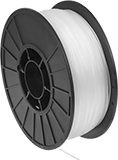

Parts printed with these filaments absorb less moisture than other types of plastic, making them ideal for use in wet or humid environments. They are more durable and flexible than PLA, and easier to print than ABS. Use these filaments with fused filament fabrication (FFF) 3D printers, and print onto a heated print bed. Printing onto a cool surface causes the molten filament to change temperature rapidly, which can warp your designs. Although finished parts are moisture-resistant, these filaments are sensitive to humidity, and should be stored in a dehumidifying cabinet or a sealed container with desiccant.
Carbon-fiber-filled PETG is more than twice as rigid as unfilled PETG, which makes finished parts more stable and helps them hold their shape. While it is easier to print than unfilled PETG, it is also more abrasive. Use a hardened steel nozzle to print, as this filament will wear out copper and brass nozzles.
Tensile strength is the best measure of a filament's overall strength. Similar to the stress applied on a rope during a game of tug-of-war, it's the amount of pulling force a material can handle before breaking. A higher rating means a stronger filament. A tensile strength of 5,000 psi and above is considered good; 12,000 psi and above is excellent.
Maximum exposure temperature is the point at which a printed part will begin to deform. Above this temperature, your printed parts will start to lose structural integrity.
Spool | |||||||||||
|---|---|---|---|---|---|---|---|---|---|---|---|
| Dia., mm | Printing Temp. | For Printer Bed Temp. | Tensile Strength | Hardness | Max. Exposure Temp. | For Min. Nozzle Opening Dia., mm | Dia., mm | Dp., mm | Wt., g | Each | |
Carbon-Fiber-Filled PETG Plastic | |||||||||||
Opaque Black | |||||||||||
| 1.75 | 230° to 260° C 446° to 500° F | 60° C 140° F | 8,120 psi (Good) | Not Rated | 77° C 170° F | 0.4 | 200 | 60 | 750 | 000000 | 000000 |
| 2.85 | 230° to 260° C 446° to 500° F | 60° C 140° F | 8,120 psi (Good) | Not Rated | 77° C 170° F | 0.4 | 200 | 60 | 750 | 0000000 | 00000 |
Static-Dissipative Moisture-Resistant 3D Printer Filaments
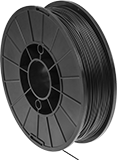
Print water-resistant packaging or other parts that will be used near sensitive electronics with these filaments. They combine polyester with a static-dissipative compound, which keeps static from building up and reduces the risk that a sudden shock will damage equipment. Parts made from these filaments can be splashed with water or stored in humid areas without degrading. Designed for use with fused filament fabrication (FFF) 3D printers, they are more durable than PLA and easier to print than ABS.
To prevent parts from warping while they cool, these filaments must be printed onto a heated print bed. Although finished parts are moisture resistant, the filaments themselves are sensitive to humidity. Store them in a sealed container with desiccant or in a dehumidifying cabinet.
PCTG holds up to a wide range of acids and bases without breaking down. It is often used for printing parts that will be exposed to chemicals and oils.
Use an electrical resistance tester to make sure your part meets proper resistivity levels. In general, the target surface resistivity for printed parts is 107 to 109 ohms. To adjust your measurements, change the temperature of your printer's extruder. As the extruder's temperature increases, so will the printed part's resistivity.
Tensile strength is the best measure of a filament's overall strength. Similar to the stress applied on a rope during a game of tug-of-war, it's the amount of pulling force a material can handle before breaking. A higher rating means a stronger filament. A tensile strength of 5,000 psi and above is considered good; 12,000 psi and above is excellent.
Maximum exposure temperature is the point at which a printed part will begin to deform. Above this temperature, your printed parts will start to lose structural integrity.
Spool | ||||||||||||
|---|---|---|---|---|---|---|---|---|---|---|---|---|
| Dia., mm | Printing Temp. | For Printer Bed Temp. | Tensile Strength | Hardness | Max. Exposure Temp. | For Min. Nozzle Opening Dia., mm | Dia., mm | Dp., mm | Wt., g | Color | Each | |
PCTG Plastic | ||||||||||||
| 1.75 | 250° to 270° C 482° to 518° F | 70° to 80° C 158° to 176° F | 6,600 psi (Good) | Not Rated | 70° C 158° F | 0.25 | 200 | 60 | 750 | Black | 0000000 | 0000000 |
| 2.85 | 250° to 270° C 482° to 518° F | 70° to 80° C 158° to 176° F | 6,600 psi (Good) | Not Rated | 70° C 158° F | 0.25 | 200 | 60 | 750 | Black | 0000000 | 000000 |
PETG Plastic | ||||||||||||
| 1.75 | 230° to 260° C 446° to 500° F | 60° to 90° C 140° to 194° F | 7,250 psi (Good) | Rockwell R110 (Hard) | 75° C 167° F | 0.4 | 200 | 75 | 750 | Black | 0000000 | 000000 |
| 2.85 | 230° to 260° C 446° to 500° F | 60° to 90° C 140° to 194° F | 7,250 psi (Good) | Rockwell R110 (Hard) | 75° C 167° F | 0.4 | 200 | 75 | 750 | Black | 0000000 | 000000 |