
We will reply to your message within two hours.
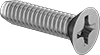
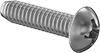
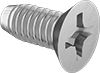
These metric screws have a triangular shank that presses tightly as it forms threads, so screws resist loosening in soft metals such as brass, aluminum, and copper.
The triangular shank presses tightly as it forms threads, so screws resist loosening in soft metals such as brass, aluminum, and copper.
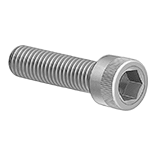
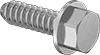
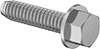
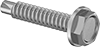
These screws have a hex head for a secure grip with a wrench.
Also known as Swageform screws, threads at the tip are designed to grab material for a fast start with low torque in a wide range of materials.
These steel screws are zinc plated to resist corrosion in wet environments.
A Torx drive has more points of contact than a Phillips drive, allowing you to apply extra force with less slippage or damage to the recess.
These steel screws cut threads in drilled holes as they’re turned, so they require less driving torque and cause less stress on your material than thread forming screws.
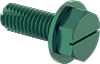
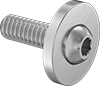
The green color identifies these as grounding screws. They have a flange that provides a wide flat surface for making solid electrical connections.
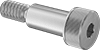
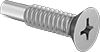
Commonly used with door hinge hardware, these screws cut threads in material such as aluminum and brass.
Known for their strength, these alloy steel screws are coated to provide corrosion resistance in wet environments.
One-third the weight of steel, aluminum screws resist corrosion in wet environments.
Made from 18-8 stainless steel, these screws have good chemical resistance.
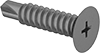
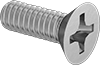
Beveled under the head for use in countersunk holes.
Made from stainless steel to resist galvanic corrosion, use these screws to fasten aluminum to aluminum and steel framing. They save you time and effort by drilling their own holes and fastening in a single operation.
Drill a pilot hole, cut threads, and fasten in one motion with these metric-threaded screws. Made of steel, they’re strong and wear resistant.
Made from stainless steel, these screws are more corrosion resistant than steel, and almost as strong.
Aluminum screws are one-third the weight of steel and have good corrosion resistance.
These aluminum screws are lightweight and resist corrosion in wet environments. They have a flange that is wider and thicker than our other flanged screws, so they distribute pressure the best.
Made from aluminum, these metric screws are lightweight and resist corrosion in wet environments. The flange is wider and thicker than our other flanged screws, so they distribute pressure the best.
Aluminum screws are lightweight and have good corrosion resistance.
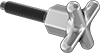
Arms provide a flat surface to push your fingers against.
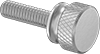
Aluminum thumb screws are lightweight and resist corrosion in wet environments.
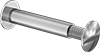
One-third the weight of steel, aluminum binding barrels and screws resist corrosion in wet environments.
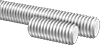
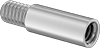
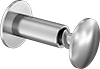
Add length to a binding barrel.
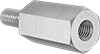
These barrels and caps are corrosion resistant in wet environments.
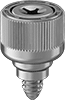
Install in soft material such as aluminum and low-carbon steel at least 0.036" thick with an arbor press or similar pressure tool.
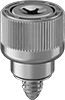
Snap these screws into panels up to 0.125" thick—no tools are required for installation.
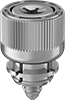
The base flares out during installation, creating a backside flange in hard materials and near edges in panels up to 0.312" thick. Install with a flare-in installation tool and an arbor press.
One-third the weight of steel, aluminum shoulder screws are lightweight and have good corrosion resistance.
One-third the weight of steel, aluminum threaded rods resist corrosion in wet environments.
Change thread sizes or types, such as fine to coarse threads, on parts without changing gender.
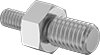
Change inch threads to metric with these adapters, or swap metric threads for inch. An external hex lets you tighten or loosen them with a wrench.
In addition to joining male- and female-threaded parts, these adapters can increase or decrease metric thread sizes and change the thread pitch.
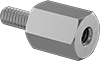
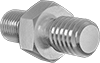
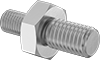
One side inch, one side metric, and a hex in the middle—these handy fasteners connect two female-threaded parts, such as coupling nuts, adapting from inch threads to metric. Tighten with a standard wrench.
Twist these adapters onto female metric threads to change pitch or switch thread sizes.
Need to join two female-threaded parts, such as coupling nuts, with dissimilar inch thread sizes? Attach them to these adapters and tighten the exterior hex nut for a secure connection.
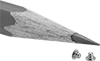
Often used in cell phones and laptops, these pins attach thin panels such as printed circuit boards to metal and plastic bases. Also known as PEM® TA and T4 TackPins.
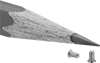
The grooves in these pins grip plastics and other soft materials. Press them in to hold panels together. Also known as PEM® TKA and TK4 TackSert pins.
Use these stud-style anchors with nuts.
Noses are up to four times longer than standard long-nose press-fit spring plungers.
Designed for use with right-hand, internally threaded rod ends, these rods have right-hand threads on both ends. Use them for remote valve operators, throttle controllers, shifting mechanisms, and virtually any push/pull assembly.
Designed for use with right-hand, externally threaded rod ends, these rods have right-hand threads on both ends. Use them for remote valve operators, throttle controllers, shifting mechanisms, and virtually any push/pull assembly.
Similar to turnbuckles, these rods have right-hand threads on one end and left-hand threads on the other so you can make a linkage that adjusts for tension.
Similar to turnbuckles, these rods have right-hand threads on one end and left-hand threads on the other so you can make a linkage that adjusts for tension. Add right- and left-hand threaded rod ends to build your linkages.
These anodized aluminum rod ends are lighter than stainless steel rod ends and have good corrosion resistance.
These anodized aluminum rod ends are lighter than stainless steel rod ends and have good corrosion resistance. Internal threads mate with rod end bolts, threaded rods, and other components with male threads.
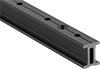
Build test fixtures, prototypes, and other small structures with this miniature version of T-slotted framing and fittings.
Give open-ended standoffs a finished look and protect them from dirt and debris.
Built to withstand corrosive marine environments, track is anodized aluminum and hangers are 316 stainless steel.
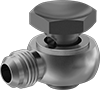
The external hex bolt on these fittings allows for easy installation in cramped spaces. They are also known as banjo-style fittings and JIC (Joint Industrial Council) fittings. They provide a tight seal on tubing that is flared to 37°.
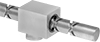
A crisscross thread pattern allows you to drive the nut back and forth without changing the lead screw's direction of rotation. When the nut reaches one end of the lead screw, it changes direction and travels back to the other end.
The mounting plate provides a flat surface for supporting loads.
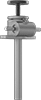
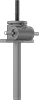
Broad, strong Acme threads make these screw jacks better than ball screw jacks for heavy loads, intermittent positioning applications, and where vibration is present.
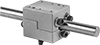
Install these nuts on a rotary shaft to create a linear positioning system without a lead screw. Instead of threads, a set of angled ball bearings drives the nut along a shaft as it spins.
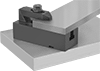
Mount these versatile blocks to any flat surface for machine table-style T-slot clamping. They can also be used on a machine table to clamp parts at specific angles or add more total clamping points.
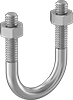
Mount these general purpose U-bolts into an existing bracket, or combine with a mounting plate for a secure hold at the mounting surface.
Choose between two lifting points—use the toe for lifting loads low to the ground, or use the saddle when you need a higher, more stable lifting point.
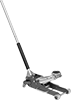
Roll from job to job and under hard-to-reach places.