We will reply to your message in the morning.
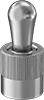
As the workpiece pushes against the pin head in one direction, the internal spring pushes back to hold it in place for clamping.
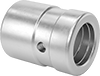
Sealed at the top to prevent debris from getting inside and making them seize up, these guide pins are a good choice for machining fixtures.
Thread in a screw, handle, or other part to create the right size and shape guide pin for your application.
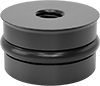
As the face of these plungers is pushed in, the internal spring applies outward pressure to hold a workpiece in position against stops and rails.
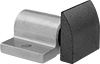
Set the tang in a slot below the work surface to prevent thin material from sliding underneath the face.
Use the handle on these retractors to extend and retract a locating pin, protecting the pin from damage in applications where fixtures move through a process, such as along a conveyor belt.
A good choice for automated clamping, these retractors use compressed air to extend and retract a locating pin, protecting the pin from damage in applications where fixtures move through a process, such as along a conveyor belt.
Use these components in coordinate measuring machine (CMM) applications to raise a workpiece and reliably position it on a fixture plate with ¼"-20 holes.
Build these components into fixture plates, machine subplates, and tombstones for quick changes. The system clamps and locates at the same time for accurate positioning with repeatability of ±0.0005".
Noses are up to four times longer than standard long-nose press-fit spring plungers.
Insert the nose into a panel; then thread on the nut and tighten using an installation wrench.
Lock the nose in the retracted position by pulling the knob and rotating it 90°.
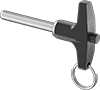
For a more secure hold than standard quick-release pins, these pins lock in place until you push the button to release the spring-loaded retaining balls.
The extra height and smaller width of the grip make the button more accessible in tight spaces. For a more secure hold than standard quick-release pins, these pins lock in place until you push the button to release the spring-loaded retaining balls.
When there isn't enough room for a T-handle, an L-handle saves space but is still easy to grip. For a more secure hold than standard quick-release pins, these pins lock in place until you push the button to release the spring-loaded retaining balls.
These pins adjust to take up play in a system or hold parts in holes of varying thicknesses. Spin the handle up or down, then tighten the locknut to change the length by up to ½”. Pins lock in place until you push the button to release the spring-loaded retaining balls.
Flip the handle 180° to expand and contract the shaft for a tight, vibration-resistant fit.
The smooth ring handle on these pins won't catch on parts. A spring-loaded, nonlocking retaining ball pops out when the pin is pushed through a hole, and retracts when the pin is pulled out.
Use these metal dowel pins as pivots, hinges, shafts, jigs, and fixtures to locate or hold parts.
Made from aluminum-bronze that is Factory Mutual approved, these nonmagnetic, corrosion-resistant tools inhibit sparking. They satisfy OSHA requirements for nonsparking tools.
When one side wears out, use the other one.
Line up two pipe flanges and determine pipe angle with the included nut-and bolt pins, level, and protractor.