McMaster-Carr logo
    Enter e-mail addresses in the fields below
    Message
    Cancel
    Comments
    E-mail address (if you would like a response)
    148 Products

    Roller Chain and Links
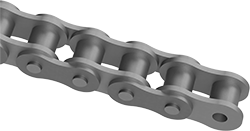
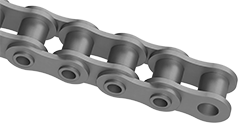
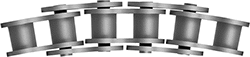
    Image of Product. Front orientation. Roller Chain and Links. Roller Chain and Links, Chain.

    Chain

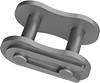
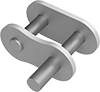
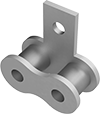
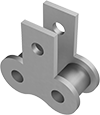
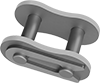
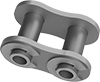
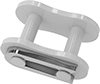
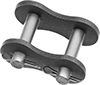
    Image of Product. Front orientation. Roller Chain and Links. Roller Chain and Links, Connecting Links.

    Connecting Links

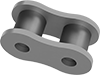
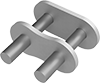
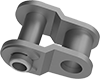
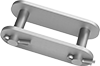
    Image of Product. Front orientation. Roller Chain and Links. Roller Chain and Links, Adding Links.

    Adding Links

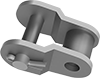
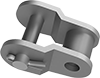
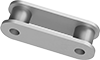
    Image of Product. Front orientation. Roller Chain and Links. Roller Chain and Links, Adding-and-Connecting Links.

    Adding-and-Connecting

    Links

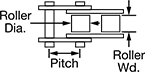
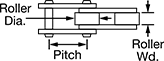
    Image of Attribute. Front orientation. Contains Annotated.
    Pair this chain with sprockets to transmit power between rotating shafts. Like the chain on a bike, the side plates have a figure-eight shape that grips the sprockets without slipping.
    Lubrication is key to smooth operation and long chain life. Routinely apply oil by hand or install an oil dispenser for continuous lubrication.
    Steel—The go-to for roller chain, steel is strong and economical. While proper lubrication helps prevent rusting, it’s not as corrosion resistant as coated or stainless steel.
    Corrosion-Resistant-Coated Steel—Combines the strength of steel with the corrosion resistance of stainless steel. The coating has been tested to withstand 500 hours of salt spray, so it holds up well in wet and outdoor conditions.
    Corrosion-Resistant 304 Stainless Steel—Won't corrode from frequent washdowns and mild chemicals, including ammonia often found in cleaning solutions.
    Highly Corrosion-Resistant 316 Stainless Steel—Our most corrosion resistant roller chain won’t degrade when exposed to salt water and harsh chemicals.
    Connecting Link—Use a single link to join both ends of your chain. Start by removing the spring clip or cotter pin from the link’s side plate. Then, slide the link pins into the mating rollers at each end of your chain and snap the clip back on. Also known as master links.
    Adding Link—Attach with a connecting link to extend the length of your chain. Each link adds a length equal to the chain’s pitch. Also known as roller links.
    Adding-and-Connecting Link—An all-in-one link for adding and connecting. It adds a half-pitch length at the roller end, allowing finer length adjustments than full-pitch links. The pin end connects to your chain—except for trade number 25, which requires a separate connecting link. Remove the side plate to install. Also known as half links and offset links.
    Chain
    Connecting Links
    Adding Links
    Adding-and-Connecting
    Links
    Roller
    Chain
    Trade
    No.
    Std.
    Pitch
    Roller
    Dia.
    Roller
    Wd.
    Working
    Load, lb.
    Per
    Ft.
    Each
    Each
    Each
    Single Strand
     
    Steel
    50ANSI5/8"0.400"3/8"1,6206261K175000006261K194000006261K244000006261K26400000
     
    Corrosion-Resistant-Coated Steel
    50ANSI5/8"0.400"3/8"1,6007210K3000007210K32500007210K72900007210K3260000
     
    Corrosion-Resistant 304 Stainless Steel
    50ANSI5/8"0.400"3/8"1506264K86000006264K5300006264K6300006264K7300000
     
    Highly Corrosion-Resistant 316 Stainless Steel
    50ANSI5/8"0.400"3/8"1505960K20000005960K1200000———05960K2200000
     

    Heavy Duty Roller Chain and Links

    Image of Product. Front orientation. Roller Chain and Links. Heavy Duty Roller Chain and Links, Chain.

    Chain

    Image of Product. Front orientation. Roller Chain and Links. Heavy Duty Roller Chain and Links, Connecting Links.

    Connecting Links

    Image of Product. Front orientation. Roller Chain and Links. Heavy Duty Roller Chain and Links, Adding Links.

    Adding Links

    Image of Product. Front orientation. Roller Chain and Links. Heavy Duty Roller Chain and Links, Adding-and-Connecting Links.

    Adding-and-Connecting

    Links

    Image of Attribute. Front orientation. Contains Annotated.
    Minimize shock loads—the thick side plates on this chain absorb jolts from motor startups, emergency braking, and sudden reversing. Like the chain on a bike, the side plates have a figure-eight shape that grips sprockets to transmit power between rotating shafts without slipping.
    Lubrication is key to smooth operation and long chain life. Routinely apply oil by hand or install an oil dispenser for continuous lubrication.
    Steel—The go-to for roller chain, steel is strong and economical. While proper lubrication helps prevent rusting, it’s not as corrosion resistant as coated or stainless steel.
    Steel with Through-Hardened Pins—Even stronger than standard steel chain, the pins in this chain are treated to withstand the most extreme shock loads.
    Connecting Link—Use a single link to join both ends of your chain. Start by removing the spring clip or cotter pin from the link’s side plate. Then, slide the link pins into the mating rollers at each end of your chain and snap the clip back on. Also known as master links.
    Adding Link—Attach with a connecting link to extend the length of your chain. Each link adds a length equal to the chain’s pitch. Also known as roller links.
    Adding-and-Connecting Link—An all-in-one link for adding and connecting. It adds a half-pitch length at the roller end, allowing finer length adjustments than full-pitch links. The pin end connects to your chain. Remove the side plate to install. Also known as half links and offset links.
    Chain
    Connecting Links
    Adding Links
    Adding-and-Connecting
    Links
    Roller
    Chain
    Trade
    No.
    Std.
    Pitch
    Roller
    Dia.
    Roller
    Wd.
    Working
    Load, lb.
    Per
    Ft.
    Each
    Each
    Each
    Single Strand
     
    Steel
    50HANSI5/8"0.400"3/8"1,6207265K40000007265K424000007265K426000007265K42500000
     
    Steel with Through-Hardened Pins
    50HANSI5/8"0.400"3/8"1,8705522N89000005522N820000———05522N8300000
     

    Attachment Roller Chain Links

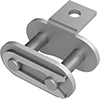
    Image of Product. Front orientation. Roller Chain and Links. Attachment Roller Chain Links, Connecting Link, A-1 Attachment.
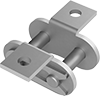
    Image of Product. Front orientation. Roller Chain and Links. Attachment Roller Chain Links, Connecting Link, K-1 Attachment.
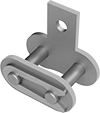
    Image of Product. Front orientation. Roller Chain and Links. Attachment Roller Chain Links, Connecting Link, SA-1 Attachment.
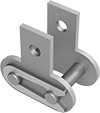
    Image of Product. Front orientation. Roller Chain and Links. Attachment Roller Chain Links, Connecting Link, SK-1 Attachment.
    Image of Product. Front orientation. Roller Chain and Links. Attachment Roller Chain Links, Connecting Link, WA-2 Attachment.

    Connecting Link

    A-1 Attachment

    Connecting Link

    K-1 Attachment

    Connecting Link

    SA-1 Attachment

    Connecting Link

    SK-1 Attachment

    Connecting Link

    WA-2 Attachment

    Image of Product. Front orientation. Roller Chain and Links. Attachment Roller Chain Links, Connecting Link, WK-2 Attachment.
    Image of Product. Front orientation. Roller Chain and Links. Attachment Roller Chain Links, Connecting Link, WSA-2 Attachment.
    Image of Product. Front orientation. Roller Chain and Links. Attachment Roller Chain Links, Connecting Link, WSK-2 Attachment.
    Image of Product. Front orientation. Roller Chain and Links. Attachment Roller Chain Links, Connecting Link, D-1 Attachment.
    Image of Product. Front orientation. Roller Chain and Links. Attachment Roller Chain Links, Connecting Link, D-3 Attachment.

    Connecting Link

    WK-2 Attachment

    Connecting Link

    WSA-2 Attachment

    Connecting Link

    WSK-2 Attachment

    Connecting Link

    D-1 Attachment

    Connecting Link

    D-3 Attachment

    Image of Product. Front orientation. Roller Chain and Links. Attachment Roller Chain Links, Adding Link, A-1 Attachment.
    Image of Product. Front orientation. Roller Chain and Links. Attachment Roller Chain Links, Adding Link, K-1 Attachment.
    Image of Product. Front orientation. Roller Chain and Links. Attachment Roller Chain Links, Adding Link, SA-1 Attachment.
    Image of Product. Front orientation. Roller Chain and Links. Attachment Roller Chain Links, Adding Link, SK-1 Attachment.

    Adding Link

    A-1 Attachment

    Adding Link

    K-1 Attachment

    Adding Link

    SA-1 Attachment

    Adding Link

    SK-1 Attachment

    Image of Attribute. Front orientation. Contains Annotated.
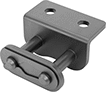
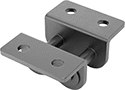
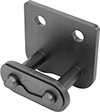
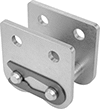
    Add these links to your roller chain to attach brackets and guides, move items directly, or trip switches in conveying, timing, and aligning setups. Like the chain on a bike, the side plates have a figure-eight shape that grips sprockets to transmit power between rotating shafts without slipping. We offer compatible chain for your convenience. When using your own chain, make sure the trade numbers match. Do not use these links with our Low-Maintenance Roller Chain.
    Lubrication is key to smooth operation and long chain life. Routinely apply oil by hand or install an oil dispenser for continuous lubrication.
    Steel—The go-to for roller chain, steel is strong and economical. While proper lubrication helps prevent rusting, it’s not as corrosion resistant as coated or stainless steel.
    Corrosion-Resistant-Coated Steel—Combines the strength of steel with the corrosion resistance of stainless steel. The coating has been tested to withstand 500 hours of salt spray, so it holds up well in wet and outdoor conditions.
    Connecting Link—Use a single link to join both ends of your chain. Start by removing the spring clip or cotter pin from the link’s side plate. Then, slide the link pins into the mating rollers at each end of your chain and snap the clip back on. Also known as master links.
    Adding Link—Attach with a connecting link to extend the length of your chain. Each link adds a length equal to the chain’s pitch. Also known as roller links.
    Pin—The pins are extended to trip switches.
    Tab—The tabs have holes to mount parts and hang hooks.
    Links
    Chain
    Attachment
    Roller
    Chain
    Connecting Link
    Adding Link
    Style
    Type
    Trade
    No.
    Std.
    Pitch
    Roller
    Dia.
    Roller
    Wd.
    Working
    Load, lb.
    Each
    Each
    Per
    Ft.
    Steel
    A-1Tab50ANSI5/8"0.400"3/8"1,6007321K11000007321K12000006261K17500000
    K-1Tab50ANSI5/8"0.400"3/8"1,6007321K1300007321K1400006261K1750000
    SA-1Tab50ANSI5/8"0.400"3/8"1,6007321K3900007321K4100006261K1750000
    SK-1Tab50ANSI5/8"0.400"3/8"1,6007321K4200007321K4300006261K1750000
    WA-2Tab50ANSI5/8"0.400"3/8"1,6007321K28200000———06261K1750000
    WK-2Tab50ANSI5/8"0.400"3/8"1,6007321K28600000———06261K1750000
    WSA-2Tab50ANSI5/8"0.400"3/8"1,6007321K29100000———06261K1750000
    WSK-2Tab50ANSI5/8"0.400"3/8"1,6007321K29500000———06261K1750000
    D-1Pin50ANSI5/8"0.400"3/8"1,6007321K650000———06261K1750000
    D-3Pin50ANSI5/8"0.400"3/8"1,6007321K660000———06261K1750000
     
    Corrosion-Resistant-Coated Steel
    A-1Tab50ANSI5/8"0.400"3/8"1,6002452K120000———07210K300000
    K-1Tab50ANSI5/8"0.400"3/8"1,6002452K320000———07210K300000
    SA-1Tab50ANSI5/8"0.400"3/8"1,6002452K220000———07210K300000
    SK-1Tab50ANSI5/8"0.400"3/8"1,6002452K420000———07210K300000
    D-1Pin50ANSI5/8"0.400"3/8"1,6002452K920000———07210K300000
    D-3Pin50ANSI5/8"0.400"3/8"1,6002452K960000———07210K300000
     

    ANSI Roller Chain Spring Clips

    Image of ProductInUse. Clip Shown Installed. Front orientation. Roller Chain Spring Clips. ANSI Roller Chain Spring Clips.

    Clip Shown

    Installed

    Image of Product. Front orientation. Roller Chain Spring Clips. ANSI Roller Chain Spring Clips.
    Replace lost or damaged spring clips to secure the pins on your connecting links. Face the opening away from the direction of travel to maintain a snug fit.
    For Roller
    Chain Trade No.
    Lg.
    Ht.
    Pkg.
    Qty.
    Pkg.
    Steel
    501"3/8"55501N1500000
     

    Low-Maintenance Roller Chain and Links
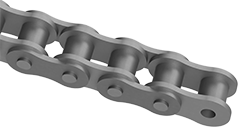
    Image of Product. Front orientation. Roller Chain and Links. Low-Maintenance Roller Chain and Links, Chain.

    Chain

    Image of Product. Front orientation. Roller Chain and Links. Low-Maintenance Roller Chain and Links, Connecting Links.

    Connecting Links

    Image of Product. Front orientation. Roller Chain and Links. Low-Maintenance Roller Chain and Links, Adding-and-Connecting Links.

    Adding-and-Connecting

    Links

    Image of Attribute. Front orientation. Contains Annotated.
    Forget the mess and the stress, this chain has bearings that run reliably with little or no need for lubrication. Like the chain on a bike, the side plates have a figure-eight shape that grips sprockets to transmit power between rotating shafts without slipping.
    Oil-Embedded Open Bearings—Made from porous bronze saturated with oil, these bearings don’t require lubrication.
    Sealed Bearings—These bearings come with seals to retain the grease you add and reduce the need for additional lubrication. They also keep grease off your equipment and prevent dirt from sticking to the chain.
    Steel—The go-to for roller chain, steel is strong and economical. It’s best for dry environments since moisture will cause it to rust.
    Corrosion-Resistant Nickel-Plated Steel—A step up from plain steel, the nickel plating adds a layer of rust protection in wet environments. However, if scratched, the underlying steel may still rust. The plating may also hinder welding.
    Connecting Link—Use a single link to join both ends of your chain. Start by removing the spring clip or cotter pin from the link’s side plate. Then, slide the link pins into the mating rollers at each end of your chain and snap the clip back on. Also known as master links.
    Adding-and-Connecting Link—An all-in-one link for adding and connecting. It adds a half-pitch length at the roller end, allowing finer length adjustments than full-pitch links. The pin end connects to your chain. Remove the side plate to install. Also known as half links and offset links.
    Chain
    Connecting Links
    Adding-and-Connecting
    Links
    Roller
    Chain
    Trade
    No.
    Std.
    Pitch
    Roller
    Dia.
    Roller
    Wd.
    Working
    Load, lb.
    Lubrication
    Per
    Ft.
    Each
    Each
    Oil-Embedded Open Bearings
     
    Steel
    50ANSI5/8"0.400"23/64"1,400Lubricated7311K30000007311K325000007311K326000000
     
    Corrosion-Resistant Nickel-Plated Steel
    50ANSI5/8"0.400"23/64"1,200Lubricated2336K2000002336K1300002336K1400000
     
    Sealed Bearings
     
    Steel
    50ANSI5/8"0.400"3/8"1,500Required60125K210000060125K622000060125K91500000
     

    Hollow-Pin Roller Chain and Links

    Image of Product. Front orientation. Roller Chain and Links. Hollow-Pin Roller Chain and Links, Chain.

    Chain

    Image of Product. Front orientation. Roller Chain and Links. Hollow-Pin Roller Chain and Links, Connecting Links.

    Connecting Links

    Image of Product. Adding-and-Connecting Link. Front orientation. Roller Chain and Links. Hollow-Pin Roller Chain and Links, Adding-and-Connecting Links.

    Adding-and-Connecting

    Link

    Image of Attribute. Front orientation. Contains Annotated.
    Slide rods or other attachments straight through the rollers. With hollow pins, there’s no need to take this chain apart or add attachment links like you would with standard roller chain. Pair the chain with sprockets to transmit power between rotating shafts. It’s commonly used in conveying applications.
    Lubrication is key to smooth operation and long chain life. Routinely apply oil by hand or install an oil dispenser for continuous lubrication.
    Steel—The go-to for roller chain, steel is strong and economical. While proper lubrication helps prevent rusting, it’s not as corrosion resistant as coated or stainless steel.
    Corrosion-Resistant 304 Stainless Steel—Won't corrode from frequent washdowns and mild chemicals, including ammonia often found in cleaning solutions.
    Connecting Link—Use a single link to join both ends of your chain. Start by removing the spring clip or cotter pin from the link’s side plate. Then, slide the link pins into the mating rollers at each end of your chain and snap the clip back on. Also known as master links.
    Adding-and-Connecting Link—An all-in-one link for adding and connecting. It adds a half-pitch length at the roller end, allowing finer length adjustments than full-pitch links. The pin end connects to your chain. Remove the side plate to install. Also known as half links and offset links.
    Chain
    Connecting Links
    Adding-and-Connecting
    Links
    Roller
    Chain
    Trade
    No.
    Std.
    Pitch
    Roller
    Dia.
    Roller
    Wd.
    Working
    Load, lb.
    Pinhole
    Dia.
    Per
    Ft.
    Each
    Each
    Single Strand
     
    Steel
    50ANSI5/8"0.400"3/8"7000.202"7272K40000007272K425000007272K426000000
     
    Corrosion-Resistant 304 Stainless Steel
    50ANSI5/8"0.400"3/8"1500.202"2326K20000002326K13000002326K1400000
     

    Dry-Running Roller Chain and Links

    Image of Product. Chain. Front orientation. Roller Chain and Links. Dry-Running Roller Chain and Links, Chain.

    Chain

    Image of Product. Connecting Link. Front orientation. Roller Chain and Links. Dry-Running Roller Chain and Links, Connecting Links.

    Connecting Link

    Image of Attribute. Front orientation. Contains Annotated.
    Say goodbye to messy grease and time-consuming maintenance. This chain has plastic bearings that run smoothly without lubrication. Paired with stainless steel pins and side plates, it’s lightweight, quiet-running, and resistant to mild chemicals. The chain withstands starts and stops better than all-plastic chain, but it handles only a fraction of the load of all-metal chain. Like the chain on a bike, the side plates have a figure-eight shape that grips sprockets to transmit power between rotating shafts without slipping.
    Connecting Link—Use a single link to join both ends of your chain. Start by removing the spring clip or cotter pin from the link’s side plate. Then, slide the link pins into the mating rollers at each end of your chain and snap the clip back on. Also known as master links.
    Chain
    Connecting Links
    Roller
    Chain
    Trade
    No.
    Std.
    Pitch
    Roller
    Dia.
    Roller
    Wd.
    Working
    Load, lb.
    Lubrication
    Per
    Ft.
    Each
    Single Strand
     
    Plastic with 304 Stainless Steel Pins and Side Plates
    50ANSI5/8"0.400"3/8"150Not Required6228K140000006228K2400000
     

    Flexible Roller Chain and Links

    Image of Product. Front orientation. Roller Chain and Links. Flexible Roller Chain and Links, Chain.

    Chain

    Image of Product. Front orientation. Roller Chain and Links. Flexible Roller Chain and Links, Connecting Links.

    Connecting Links

    Image of Attribute. Front orientation. Contains Annotated.
    Thanks to extra space between components, this chain flexes side to side to take on misaligned sprockets or curved conveyor paths. Like the chain on a bike, the side plates have a figure-eight shape that grips sprockets to transmit power between rotating shafts without slipping. Also known as bow chain.
    Lubrication is key to smooth operation and long chain life. Routinely apply oil by hand or install an oil dispenser for continuous lubrication.
    Steel—The go-to for roller chain, steel is strong and economical. While proper lubrication helps prevent rusting, it’s not as corrosion resistant as coated or stainless steel.
    Connecting Link—Use a single link to join both ends of your chain. Start by removing the spring clip or cotter pin from the link’s side plate. Then, slide the link pins into the mating rollers at each end of your chain and snap the clip back on. Also known as master links.
    Chain
    Connecting Links
    Roller
    Chain
    Trade
    No.
    Std.
    Pitch
    Roller
    Dia.
    Roller
    Wd.
    Working
    Load, lb.
    Bend
    Radius
    Per
    Ft.
    Each
    Single Strand
     
    Steel
    50ANSI5/8"0.400"3/8"70015.748"7274K30000007274K32500000
     

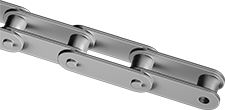
    Flat-Edge Roller Chain and Links

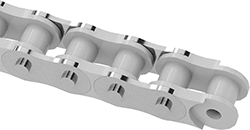
    Image of Product. Front orientation. Roller Chain and Links. Flat-Edge Roller Chain and Links, Chain.

    Chain

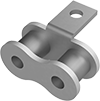
    Image of Product. Front orientation. Roller Chain and Links. Flat-Edge Roller Chain and Links, Connecting Links.

    Connecting Links

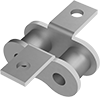
    Image of Product. Front orientation. Roller Chain and Links. Flat-Edge Roller Chain and Links, Adding Links.

    Adding Links

    Image of Attribute. Front orientation. Contains Annotated. Flat-Edge Roller Chain and Links.
    No more hang-ups thanks to the flat, oblong side plates that create a level surface to keep items moving along conveyor lines. Unlike standard roller chain, there are no divots to snag products. Pair this chain with sprockets to transmit power between rotating shafts.
    Lubrication is key to smooth operation and long chain life. Routinely apply oil by hand or install an oil dispenser for continuous lubrication.
    Steel—The go-to for roller chain, steel is strong and economical. While proper lubrication helps prevent rusting, it’s not as corrosion resistant as coated or stainless steel.
    Connecting Link—Use a single link to join both ends of your chain. Start by removing the spring clip or cotter pin from the link’s side plate. Then, slide the link pins into the mating rollers at each end of your chain and snap the clip back on. Also known as master links.
    Adding Link—Attach with a connecting link to extend the length of your chain. Each link adds a length equal to the chain’s pitch. Also known as roller links.
    Chain
    Connecting Links
    Adding Links
    Roller
    Chain
    Trade
    No.
    Std.
    Pitch
    Roller
    Dia.
    Roller
    Wd.
    Working
    Load, lb.
    Per
    Ft.
    Each
    Each
    Single Pitch
     
    Steel
    50ANSI5/8"0.400"3/8"1,6205853N380000005853N31000005853N3200000
     

    ANSI Roller Chain Wear-Indicating Inserts

    Image of Product. Front orientation. Chain Wear Gauges. ANSI Roller Chain Wear-Indicating Inserts.
    Place these steel inserts between two roller links. If they can be inserted past your ANSI number, the chain is worn out.
    Overall
    For Roller Chain Trade No.
    Lg.
    Wd.
    Material
    Each
    For Single- and Double-Strand ANSI Roller Chain
    35, 40, 41, 50, 60, 80, 100, 35-2, 40-2, 50-2, 60-2, 80-2, 100-28 3/4"5/8"Steel2370K20000000
     

    ANSI Roller Chain Wear-Indicating Rulers

    Image of Product. Front orientation. Chain Wear Gauges. ANSI Roller Chain Wear-Indicating Rulers.
    Place this plastic ruler on links to measure chain wear.
    Overall
    For Roller Chain Trade No.
    Lg.
    Wd.
    Material
    Each
    For Single- and Double-Strand ANSI Roller Chain
    40, 41, 50, 60, 80, 100, 120, 140, 160, 180, 200, 240, 40-2, 50-2, 60-2, 80-2, 100-2, 120-2, 140-2, 160-2, 180-2, 200-2, 240-215"2 5/8"Plastic2370K400000
     

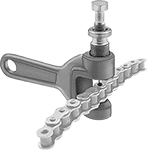
    Roller Chain Breakers

    Image of Product. Front orientation. Roller Chain Breakers. Roller Chain Breakers.
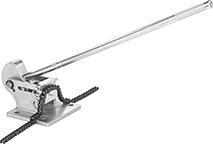
    Drive out chain pins with a twist of the handle. Breakers allow you to disassemble chain in order to remove or add links.
    Roller Chain Breakers
    Replacement
    Points
    Overall
    For Roller Chain
    Trade No.
    For Roller Chain
    Pitch Range
    Lg.
    Wd.
    Material
    Each
    Each
    For Single-Strand ANSI Roller Chain
    25, 35, 40, 41, 50, 601/4" to 3/4"10"0.8"Steel6051K350000006051K42000000
     

    Wrench-Drive Roller Chain Breakers

    Image of ProductInUse. Front orientation. Roller Chain Breakers. Wrench-Drive Roller Chain Breakers.
    Tighten the hex head screw with a wrench to remove chain pins without damaging side plates. Breakers allow you to disassemble chain in order to remove or add links.
    Roller Chain Breakers
    Replacement
    Points
    Overall
    For Roller Chain
    Trade No.
    For Roller Chain
    Pitch Range
    Lg.
    Wd.
    Material
    Features
    Each
    Each
    For Single-Strand ANSI Roller Chain
    35, 40, 41, 503/8" to 5/8"4 1/2"3"SteelClamping Sleeve6669K110000006669K21000000
    50, 60, 805/8" to 1"6 1/2"4 1/4"SteelClamping Sleeve6669K12000006669K2200000
     

    Bench-Mount Roller Chain Breakers

    Image of ProductInUse. Front orientation. Roller Chain Breakers. Bench-Mount Roller Chain Breakers.
    Push both chain pins out of your roller chain with the pull of a handle. These chain breakers make it easy to disassemble your chain to add or remove links. Since they mount to a work surface, they give you extra leverage and are convenient for frequent jobs.
    Base
    For Roller Chain
    Trade No.
    For Roller Chain
    Pitch Range
    Overall
    Ht.
    Handle
    Lg.
    Material
    Lg.
    Wd.
    Mounting
    Hole Dia.
    Each
    For Single-Strand ANSI Roller Chain
    35, 40, 50, 60, 80, 1003/8" to 1 1/4"5 3/4"28 1/2"Steel6"7"9/16"5519N11000000000
     
    Dies

    Jaw-End Roller Chain Pullers

    Image of ProductInUse. Front orientation. Roller Chain Pullers. Knob Handle.
    Image of ProductInUse. Front orientation. Roller Chain Pullers. T-Handle.

    Knob Handle

    T-Handle

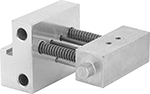
    Hook into your roller chain and use the handle to tighten the jaw until the chain ends are close enough to add or remove a link.
    Overall
    For Roller Chain
    Trade No.
    Handle
    Style
    For Roller Chain
    Pitch
    Max. Jaw
    Cap.
    Lg.
    Wd.
    Material
    Each
    For Single-Strand ANSI Roller Chain
    35, 40, 41, 50, 60Knob3/8" to 3/4"2"4 1/4"2 3/4"Steel6052K14000000
    40, 50, 60, 80T-Handle1/2" to 1"3 1/2"6 5/8"4"Steel6052K1800000
     

    Roller Chain Breaker/Riveters

    Image of ProductInUse. Front orientation. Roller Chain Breaker/Riveters.
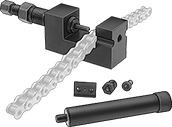
    In addition to breaking chain, this tool can also rivet chain to increase strength for better performance on high-speed drives. It can break ANSI numbers 50 and 60 roller chain and rivet ANSI number 50 chain. Attach the removable handle and clamp the breaker/riveter in a vise or bolt it to a workbench.
    Roller Chain Breaker/Riveters
    Replacement
    Points
    Overall
    Mounting
    Hole
    For Roller
    Chain Trade No.
    For Roller Chain
    Pitch
    Lg.
    Wd.
    Material
    Mounting Fasteners
    Included
    No.
    of
    Thread
    Size
    Includes
    Each
    Each
    For Single-Strand ANSI Roller Chain
    50, 605/8" to 3/4"6"1 3/4"SteelNo23/8"-24
    Press Plate, Removable Handle, Rivet Anvil, Steel Rivet Set8186K1100000008186K21000000
     

    Attachment Roller Chain

    Image of Product. Front orientation. Roller Chain and Links. Attachment Roller Chain, K-1 Attachment.
    Image of Attribute. Front orientation. Contains Annotated.

    K-1 Attachment

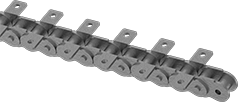
    Skip the hassle of adding attachment links, this chain arrives with them already installed. No disassembly required, just pick your length and get moving. Use this chain to mount brackets and guides, move items directly, or trip switches with tabs or pins in conveying, timing, and aligning setups. Like the chain on a bike, the side plates have a figure-eight shape that grips sprockets to transmit power between rotating shafts without slipping.
    Lubrication is key to smooth operation and long chain life. Routinely apply oil by hand or install an oil dispenser for continuous lubrication.
    Steel—The go-to for roller chain, steel is strong and economical. While proper lubrication helps prevent rusting, it’s not as corrosion resistant as coated or stainless steel.
    Tab—The tabs have holes to mount parts and hang hooks.
    Connecting Link—Use a single link to join both ends of your chain. Start by removing the spring clip or cotter pin from the link’s side plate. Then, slide the link pins into the mating rollers at each end of your chain and snap the clip back on. Also known as master links.
    Adding Link—Attach with a connecting link to extend the length of your chain. Each link adds a length equal to the chain’s pitch. Also known as roller links.
    Chain
    Connecting Links
    Adding Links
    Attachment
    Roller
    Chain
    Style
    Type
    Trade
    No.
    Std.
    Pitch
    Roller
    Dia.
    Roller
    Wd.
    Working
    Load, lb.
    Per
    Ft.
    Each
    Each
    Steel
    K-1Tab50ANSI5/8"0.400"3/8"1,4004709N390000007321K13000006261K24400000
     

    High-Accuracy Roller Chain Wear-Indicating Gauges
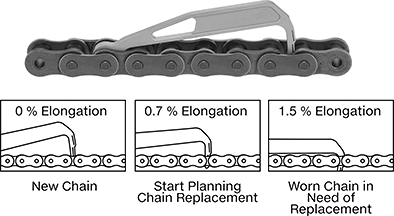
    Image of ProductInUse. Front orientation. Contains Annotated, MultipleImages. Chain Wear Gauges. High-Accuracy Roller Chain Wear-Indicating Gauges.
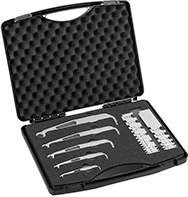
    Precisely measure chain elongation to see if you need to replace your chain. These gauges give a more accurate reading than alternatives because they’re designed to anchor to a roller and extend across several links. A color indicator helps you quickly measure the space between rollers. If the gauge rests on top of the chain and you see green markings, your chain doesn't need to be replaced. If it slips between two rollers and you only see red markings, it’s time for a replacement.
    Chain Wear Gauges with Plastic Case
    Image of Product. Front orientation. Chain Wear Gauges. High-Accuracy Roller Chain Wear-Indicating Gauges, Chain Wear Gauges with Plastic Case.
    No. of
    Gauges
    For Roller Chain
    Trade No.
    Material
    Includes
    Each
    For Single-, Double-, and Triple-Strand ANSI Roller Chain
    535, 40, 50, 60, 80SteelChain Indentification Tool5576N34000000000
     

    Channel-Guided Roller Chain Tensioners
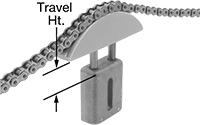
    Image of ProductInUse. Front orientation. Contains Annotated. Chain and Belt Tensioners. Channel-Guided Roller Chain Tensioners.
    Built-in springs put constant tension on roller chain to absorb and buffer shock, reduce vibration, and improve drive performance.
    Overall
    Mounting
    Holes
    For Roller
    Chain Trade No.
    Tension Force,
    lbf
    Travel
    Ht.
    Ht.
    Wd.
    Dp.
    Material
    Housing
    Material
    Dia.
    No.
    of
    Mounting Fasteners
    Included
    Max. Temp.,
    ° F
    Each
    For Single-Strand ANSI Roller Chain
     
    Vertical Mount/Horizontal Mount
    5020 to 601.2"6 13/32"2 15/16"1 3/16"PlasticAluminum
    7/16"1No1806233K350000000
    5020 to 601.2"6 15/32"2 15/16"1 3/16"PlasticAluminum
    7/16"1No1806233K64000000
     

    Low-Profile Channel-Guided Roller Chain Tensioners
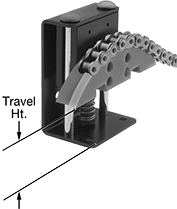
    Image of ProductInUse. Front orientation. Contains Annotated. Chain and Belt Tensioners. Low-Profile Channel-Guided Roller Chain Tensioners.
    At less than 4" in height, these tensioners are good for use on low-clearance drives. Built-in springs put constant tension on roller chain to absorb and buffer shock, reduce vibration, and improve drive performance.
    Overall
    Mounting
    Holes
    For Roller
    Chain Trade No.
    Tension Force,
    lbf
    Travel
    Ht.
    Ht.
    Wd.
    Dp.
    Material
    Housing
    Material
    Dia.,
    mm
    No.
    of
    Mounting Fasteners
    Included
    Max. Temp.,
    ° F
    Each
    For Single-Strand ANSI Roller Chain
     
    Vertical Mount/Horizontal Mount
    507 to 131.6"3 25/32"2 25/32"1 1/4"PlasticSteel62No1407332K30000000
    5013 to 291.6"3 25/32"2 25/32"1 1/4"PlasticSteel62No1407332K7000000
     

    Open-Channel Roller Chain Guides

    Image of ProductInUse. Front orientation. Roller Chain Guides. Open-Channel Roller Chain Guides.
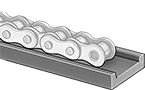
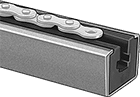
    Minimize friction, reduce noise, and prolong the life of your roller chain. Guides can be cut to the exact length you need.
    PTFE—PTFE guides withstand higher temperatures than polyethylene guides. They’re also FDA compliant for direct contact with food.
    Overall
    For Roller
    Chain Trade No.
    Ht.
    Wd.
    Max. Temp.,
    ° F
    Food Industry Std.
    Choose a Length, ft.
    Per
    Ft.
    For Single-Strand ANSI Roller Chain
     
    Polyethylene
    500.38"1.25"1751, 2, 3, 4, 5, 6, 7, 893095K2000000
     
    PTFE
    500.38"1.25"450FDA Compliant 21 CFR 177.1550
    1, 493095K52300000
     

    Roller Chain Tensioning Rings

    Image of ProductInUse. Front orientation. Chain and Belt Tensioners. Roller Chain Tensioning Rings.
    Install these rings between strands of chain to absorb slack without the need for realignment, lubrication, or tools—good for use in confined spaces where maintenance may be difficult.
    For Roller
    Chain Trade No.
    Tension
    Force, lbf
    OD
    Material
    Max. Speed,
    fpm
    Max. Temp.,
    ° F
    Each
    For Single-Strand ANSI, ISO Roller Chain
    50, 10B65.055"Plastic8201555896K40000000
    50, 10B106.693"Plastic1,7301555896K18000000
     

    Deep-Channel Roller Chain Guides

    Image of ProductInUse. Guide. Front orientation. Roller Chain Guides. Deep-Channel Roller Chain Guides, 304 Stainless Steel Frame.
    Image of ProductInUse. Guide with Flanged Frame. Front orientation. Roller Chain Guides. Deep-Channel Roller Chain Guides, Flanged Frame.

    Guide

    Guide with Flanged

    Frame

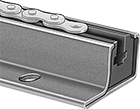
    Also known as captured guides, deep-channel guides prevent chain from slipping off track. Use them to minimize friction, reduce noise, and prolong the life of your roller chain. They can be cut to the exact length you need.
    Flanged Frame—Guides with flanged frame allow easy mounting. Stainless steel frames are more corrosion resistant than steel frames.
    Overall
    For Roller
    Chain Trade No.
    Ht.
    Wd.
    Channel
    Dp.
    Mounting Fasteners
    Included
    Mounting
    Hole Dia.
    Max. Temp.,
    ° F
    Choose a Length, ft.
    Per
    Ft.
    For Single-Strand ANSI Roller Chain
     
    Polyethylene with 304 Stainless Steel Frame
    500.94"1.18"0.65"1751, 2, 3, 4, 5, 6, 7, 893095K24000000
     
    Polyethylene with Steel Flanged Frame
    500.98"2.09"0.64"No5/16"1751, 2, 3, 4, 5, 6, 7, 893095K2900000
     
    Polyethylene with 304 Stainless Steel Flanged Frame
    500.98"2.09"0.64"No5/16"1751, 3, 4, 6, 893095K38000000
     

    Floating Roller Chain Tensioners

    Image of ProductInUse. Front orientation. Contains MultipleImages. Chain and Belt Tensioners. Floating Roller Chain Tensioners.
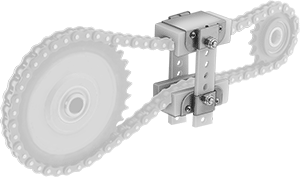
    Mount these tensioners directly onto your chain drive. They have adjustable straps that take up slack and apply constant tension. Because they engage with the side plates instead of the rollers, they increase the life of your roller chain.
    UHMW Polyethylene—UHMW polyethylene tensioners are stronger and more durable than PTFE tensioners.
    PTFE—PTFE tensioners handle temperatures up to 450° F, more than twice as high as UHMW and titanium models.
    Titanium—Titanium tensioners stand up to harsh and dirty environments. They're stronger and more durable than plastic tensioners. And with a low coefficient of friction, they work with chain that has little or no lubrication.
    Overall
    For Roller
    Chain Trade No.
    For Strand
    Type
    Ht.
    Wd.
    Dp.
    Housing Material
    Strap Material
    Max. Temp.,
    ° F
    Each
    For ANSI Chain
     
    UHMW Polyethylene
    50Single12"3 1/2"2 7/8"304 Stainless Steel
    HDPE1805973K40000000
     
    PTFE
    50Single12"3 1/2"2 7/8"304 Stainless Steel
    Galvanized Steel4505973K213000000
     
    Titanium
    50Single12"3 1/2"2 7/8"304 Stainless Steel
    HDPE1805973K227000000
     

    Center-Channel Roller Chain Guides

    Image of ProductInUse. Front orientation. Roller Chain Guides. Center-Channel Roller Chain Guides.
    Image of Specification. Front orientation. Style A. Center-Channel Roller Chain Guides.

    Style A

    Image of Specification. Front orientation. Style B.

    Style B

    Image of Specification. Front orientation. Style C.

    Style C

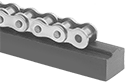
    These guides align chain more precisely than open-channel guides. Use them to minimize friction, reduce noise, and prolong the life of your roller chain. They can be cut to the exact length you need.
    PTFE—PTFE guides withstand higher temperatures than polyethylene guides. They’re also FDA compliant for direct contact with food.
    Overall
    Style
    For Roller
    Chain Trade No.
    Ht.
    Wd.
    Ctr. Channel
    Wd.
    Max. Temp.,
    ° F
    Food Industry Std.
    Choose a Length, ft.
    Per
    Ft.
    For Single-Strand ANSI Roller Chain
     
    Polyethylene
    A500.38"1.25"0.31"1751, 2, 3, 4, 5, 6, 7, 893095K6000000
    B500.31"1.25"0.31"1751, 3, 4, 5, 6, 893095K4600000
    C500.59"0.79"0.35"1751, 3, 4, 5, 6, 893095K1900000
     
    PTFE
    A500.38"1.25"0.31"450FDA Compliant 21 CFR 177.1550
    1, 493095K82300000
     
    back to top