We will reply to your message within two hours.
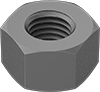
These nuts are comparable in strength to Grade 9 bolts.
Comparable in strength to Class 12.9 bolts.
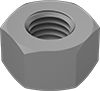
These nuts have good chemical resistance.
More corrosion resistant than 18-8 stainless steel nuts, these nuts have excellent resistance to chemicals and salt water.
Able to maintain their strength in high-pressure and high temperature environments, these nuts are used with ASTM A193 bolts to fasten pressure tanks, valves, and flanges.
These nuts have good chemical resistance and may be mildly magnetic.
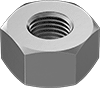
These nuts have excellent chemical resistance and can be used in saltwater environments.
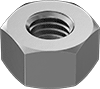
Hardened for added strength, these nuts are more corrosion resistant to chemicals and salt water than 18-8 stainless steel nuts.
These nuts tighten when turned to the left; once fastened, they resist loosening from counterclockwise motion. Made of Grade 2 and Class 04 steel, these nuts can be used for fastening panels and other light duty fastening applications.
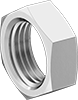
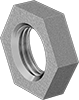
These nuts are often used in conjunction with an extra-wide hex nut to fasten Grade 9 bolts in heavy machinery, such as earth-moving equipment.
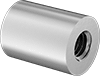
A smooth rounded body provides a finished look.
About half the strength of medium-strength steel coupling nuts, these nuts are for light duty fastening applications.
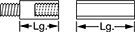
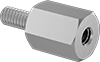
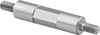
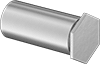
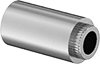
Choose these standoffs for their adherence to NAS 1831 specifications.
These standoffs are made to NAS specifications.
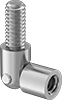
These standoffs are designed to fit in the limited space of compact electronics such as laptops and hand-held devices.
Also known as captive spacers, the splines on these bite into a panel for a permanent hold.
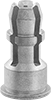
With the end clinched in place, the prongs allow you to quickly snap a panel on and off these supports.
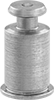
Once the end is clinched in place, panels with keyholes easily slide on and off these supports.
Often called swage standoffs because you permanently crimp them into a panel.
Change thread sizes or types, such as fine to coarse threads, on parts without changing gender.
In addition to joining male- and female-threaded parts, these adapters can increase or decrease metric thread sizes and change the thread pitch.
Change inch threads to metric with these adapters, or swap metric threads for inch. An external hex lets you tighten or loosen them with a wrench.
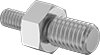
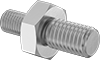
Connect two differently sized male-threaded parts, such as threaded rods, and tighten with a standard wrench.
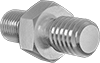
Increase or decrease metric thread size from one male-threaded part to another. Commonly used to connect two differently sized threaded rods, they have a hex-shaped body, so you can tighten them with a standard wrench.
Adapt threaded rods from inch to metric. These adapters connect two male-threaded fasteners, so you can change the gender of a mating part or increase or decrease its thread size. The hex-shaped body fits into the head of a standard wrench.
Need to join two female-threaded parts, such as coupling nuts, with dissimilar inch thread sizes? Attach them to these adapters and tighten the exterior hex nut for a secure connection.
Twist these adapters onto female metric threads to change pitch or switch thread sizes.
One side inch, one side metric, and a hex in the middle—these handy fasteners connect two female-threaded parts, such as coupling nuts, adapting from inch threads to metric. Tighten with a standard wrench.
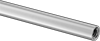
Connect and separate threaded rods, studs, and other components. These hollow rods have internal threads on both ends, so you can make connections and still pass wiring and other objects through the center of the rod.
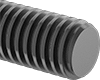
Found in hand-powered clamps, vises, grates, doors, and work tables, lead screws and nuts have broad, square threads that are well suited for quick assembly, high clamping forces, and lifting and lowering heavy objects.
These metric lead screws and nuts have broad, square threads that are well suited for quick assembly, high clamping forces, and lifting and lowering heavy objects. They're commonly found in hand-powered clamps, vises, grates, doors, and work tables.
Used in low-pressure pipe lines, these brass fittings have a plating that makes them shiny and improves corrosion resistance.
Use these fittings in low-pressure flow applications. They have good corrosion resistance.
Use these corrosion-resistant fittings in a low-pressure pipe line.
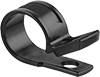
Compared to metal loop clamps, plastic loop clamps reduce wear on soft materials, such as tubing and cable. Clamps are nonconductive and noncorrosive.