We will reply to your message within two hours.
More
These steel ball bearings handle higher loads than stainless steel and plastic bearings.
A solid polymer lubricant surrounds the balls, eliminating the need for additional lubrication. Because it's solid, the lubricant blocks out water and dust, extending the life of the bearing.
Bearings are 440C stainless steel for good corrosion resistance.
Made to tight tolerances, these 440C stainless steel bearings combine speed and accuracy with corrosion resistance.
A solid polymer lubricant surrounds the balls, eliminating the need for additional lubrication. Bearings are 440C stainless steel.
Good for applications with incidental food contact, these 440C stainless steel bearings have a food-grade, solid polymer lubricant between the balls and race that eliminates the need for additional lubrication.
These 316 stainless steel bearings are more corrosion resistant than our other stainless steel bearings, but they have a lower load capacity.
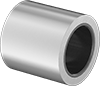
Made of slippery plastic, these bearings do not require lubrication and have excellent corrosion and chemical resistance.
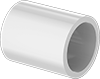
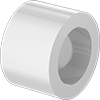
With two rows of balls, these lightweight bearings have greater durability and load capacity—and a wider profile—than single-row plastic bearings.
Made of PVDF, these bearings resist moisture absorption, so they won’t warp in underwater applications.
These PEEK bearings operate in temperatures almost twice as high as our other plastic ball bearings.
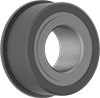
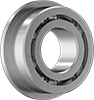
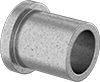
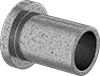
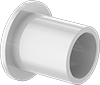
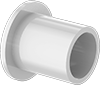
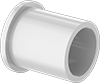
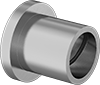
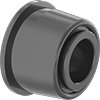
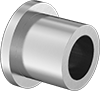
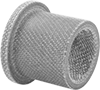
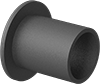
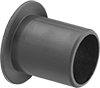
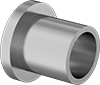
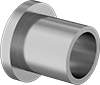
The flange ensures proper positioning inside a tube or housing.
No need to worry about precisely aligning these bearings—they swivel to compensate for up to 5° of shaft misalignment.
When speed and accuracy matter most, opt for these bearings. They’re made to tighter tolerances than standard flanged ball bearings.
Install these acetal bearings in caustic environments and where lubrication can’t be used. They have good all-around corrosion and chemical resistance.
Also known as Oilite® bearings.
For applications with frequent starts and stops, the oil in these bearings contains particles of slippery PTFE that lubricate the bearing during startup.
Increased iron content makes these bearings stronger and more resistant to shock loads than standard oil-embedded bearings; however they operate at lower speeds.
The oil in these bearings is suitable for incidental contact with food.
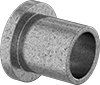
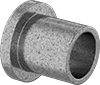
Support heavy loads that are often found in bottling and filling lines in food plants—these bearings contain extra iron and FDA-compliant oil. They’re flanged, so they handle loads both parallel and perpendicular to the shaft.
These bearings come with a traceable lot number and material test report. They are also known as Oilite® bearings.
Use where high loads and speeds are not required.
Use these bearings in applications with frequent starts and stops because they operate with very little friction.
Made of FDA listed materials for use in food applications, these bearings also withstand caustic and washdown environments.
Graphite provides a layer of dry lubrication that operates in high-temperature environments.
Compensating for minor shaft misalignment and not requiring lubrication, these sleeve bearings swivel to self-align and are dry running. They don’t need a housing and you can install and replace them without any tools because they’re slip fit.
An aluminum shell adds strength.
Reinforced with polyester fabric, these plastic bearings have load and speed capabilities comparable to metal bearings.
Good for underwater applications, these bearings won’t swell or warp when wet.
These bearings stand up to a wider range of chemicals than other dry-running flanged sleeve bearings.
These bronze bearings are strong, wear resistant, and excellent at handling shock loads.
The addition of iron and aluminum gives these aluminum-bronze bearings high strength and excellent corrosion resistance—making them suitable for use in marine and mining applications.
Furnished with a traceable lot number and material test report, these bronze bearings are strong, wear resistant, and excellent at handling shock loads.
Embedded with oil that is safe for incidental contact with food, these bearings are suitable for use in high-load applications such as bottling and filling lines in food processing plants. They are also known as Super Oilite® bearings.
A metal shell adds strength.
Made of FDA-listed materials or FDA compliant, these bearings are for use in food applications. They also withstand caustic and washdown environments.
Graphite provides a layer of dry lubrication that can operate in high-temperature environments.
These bearings stand up to a wider range of chemicals than other dry-running sleeve bearings.
A figure-8-shaped groove provides a flow path for lubricant, distributing it evenly along the bearing’s surface.
Grooves on the inside of the bearing provide a flow path for lubricant, distributing it evenly along the bearing’s surface.
Also known as drawn-cup roller bearings, these are our thinnest roller bearings. The outer ring is drawn out to form a lip that holds the bearing together.
The needles in these bearings roll freely in one direction, but lock to transmit torque when the rotation of the shaft is reversed. Also known as drawn-cup roller clutches.