We will reply to your message within two hours.
More
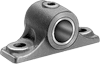
Found anywhere from machine tool spindles to conveyor rollers, these bearings have a two-piece design that allows for adjustment.
Also known as drawn-cup roller bearings, these are our thinnest roller bearings. The outer ring is drawn out to form a lip that holds the bearing together.
These bearings have higher radial load capacity, speed, and accuracy than standard needle-roller bearings.
Thinner rollers allow these bearings to fit in tighter spaces than tapered-roller thrust bearings.
Adapt needle-roller thrust bearings to use on unhardened, unground surfaces.
Also known as Oilite® bearings.
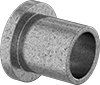
Increased iron content makes these bearings stronger and more resistant to shock loads than standard oil-embedded bearings; however they operate at lower speeds.
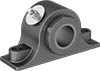
A metal shell adds strength.
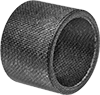
Reinforced with polyester fabric, these plastic bearings have load and speed capabilities comparable to metal bearings.
Graphite provides a layer of dry lubrication that can operate in high-temperature environments.
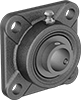
These bronze bearings are strong, wear resistant, and excellent at handling shock loads.
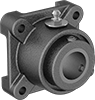
A figure-8-shaped groove provides a flow path for lubricant, distributing it evenly along the bearing’s surface.
Grooves on the inside of the bearing provide a flow path for lubricant, distributing it evenly along the bearing’s surface.
For applications with frequent starts and stops, the oil in these bearings contains particles of slippery PTFE that lubricate the bearing during startup.
Graphite provides a layer of dry lubrication that operates in high-temperature environments.
The addition of iron and aluminum gives these aluminum-bronze bearings high strength and excellent corrosion resistance—making them suitable for use in marine and mining applications.
Use where high loads and speeds are not required.
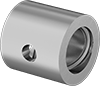
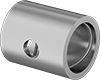
Slip these bearings onto a shaft and secure with the included set screws, no special tools required.
Secure these bearings in washdown areas, such as food, beverage, pharmaceutical, and chemical plants, by tightening the set screw onto a shaft—no additional collar needed.
In addition to handling higher loads than three-piece ball bearings, one-piece bearings are easier to handle. They have an outer band that holds the bearing together and acts as a shield against dust and other contaminants.
Ball bearings operate with less friction than other bearings, so they can run at higher speeds.
A solid polymer lubricant surrounds the balls, eliminating the need for additional lubrication.
These bearings have the highest speed ratings of any mounted ball bearing that we offer.
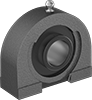
Also known as tapped-base bearings, these ball bearings mount to surfaces from the bottom through threaded holes. Because of their narrow profile, they’re commonly used in tight-clearance spaces, including systems where multiple shafts are mounted close together.
Meeting IP69K for washdown environments, these mounted ball bearings are used in food, beverage, pharmaceutical, and chemical plants.
A reliable classic—these babbitt bearings are strong and corrosion resistant.
Roller bearings have a thinner profile and larger contact area than ball bearings, making them stronger and more space-efficient than ball bearings.
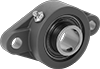
A bolt in each corner makes for a secure, even hold.
The tapered rollers in these bearings support large shafts at high static loads.
Ball bearings operate with less friction than other bearings, so you can run them at higher speeds.
Swap out worn inserts instead of replacing the entire mounted unit.
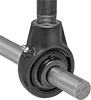
Combine with threaded pipe to mount these bearings in a variety of positions without the need for a flat mounting surface.
Insert these bushings into the bore of your sprocket for flush or recessed mounting.
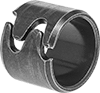
A toothed slot lets these bushings contract for insertion into the bore of your sprocket or pulley and then expand for a snug fit.
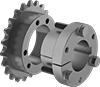
The screw connections on these bushings easily mate to compatible quick-disconnect sprockets and pulleys.
The tapered barrel on these bushings is split on both sides, allowing them to contract more tightly around the shaft than quick-disconnect and taper-lock bushings.
Mount these hubless bushings flush into your sprocket or pulley for a slim profile with no protruding screws.
Use on a conveyor pulley with a conveyor belt tensioner to adjust the tension on a conveyor belt.
Be prepared with shims in a variety of thicknesses. Also known as arbor spacers, these shims are notched to fit over keyed shafts.