
We will reply to your message in the morning.
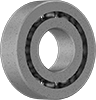
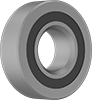
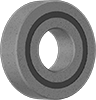
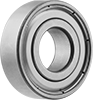
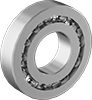
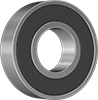
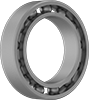
These steel ball bearings handle higher loads than stainless steel and plastic bearings.
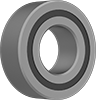
A solid polymer lubricant surrounds the balls, eliminating the need for additional lubrication. Because it's solid, the lubricant blocks out water and dust, extending the life of the bearing.
For greater accuracy and higher speeds, these bearings are made to tighter tolerances than standard ball bearings.
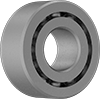
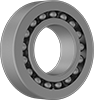
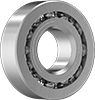
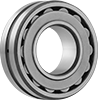
With a spherical raceway and two rows of balls, these bearings compensate for shaft misalignment.
Good for use in electric motors and power generators, these bearings have ceramic balls that insulate against stray current to prevent damage to the bearing.
For use on tapered shafts and round shafts with adapter sleeves, these ball-bearings have a spherical raceway to compensate for shaft misalignment.
Internal locking elements (sprags) lock to transmit torque in one direction while turning freely in the other direction.
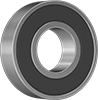
A solid polymer lubricant surrounds the balls, eliminating the need for additional lubrication. Bearings are 440C stainless steel.
Bearings are 440C stainless steel for good corrosion resistance.
Good for applications with incidental food contact, these 440C stainless steel bearings have a food-grade, solid polymer lubricant between the balls and race that eliminates the need for additional lubrication.
These 316 stainless steel bearings are more corrosion resistant than our other stainless steel bearings, but they have a lower load capacity.
With two rows of balls, these lightweight bearings have greater durability and load capacity—and a wider profile—than single-row plastic bearings.
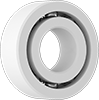
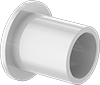
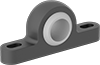
Made of slippery plastic, these bearings do not require lubrication and have excellent corrosion and chemical resistance.
Flanged and creating twice as many contact points as angular-contact ball bearings, these bearings ensure correct positioning within a tube or housing and resist radial loads.
Slip these bearings onto a shaft and secure with the included set screws, no special tools required.
Quickly secure these bearings onto shafts with the clamp-on collar for a concentric, mar-free hold.
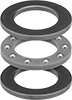
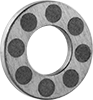
Install these bearings for use with combined radial and thrust loads. They are often used in spindle applications and can be combined with cylindrical roller bearings to better handle radial loads.
These bearings have twice as many contact points as angular-contact ball bearings.
Steel balls and washers allow these bearings to handle higher loads than bearings with stainless steel components.
Found anywhere from machine tool spindles to conveyor rollers, these bearings have a two-piece design that allows for adjustment.
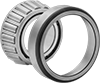
Two rows of rollers give these bearings load capacities over five times higher than comparably sized tapered-roller bearings.
With a considerably larger ID than our Face-Mount Crossed-Roller Bearings, use these to run hydraulic lines, electrical wiring, and other components through the inside of the bearing.
A built-in thrust ball bearing reduces wear from adjacent shaft components, while the needle-roller bearing supports radial loads.
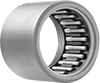
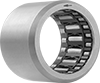
Also known as drawn-cup roller bearings, these are our thinnest roller bearings. The outer ring is drawn out to form a lip that holds the bearing together.
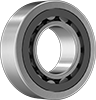
With cylindrical rollers to distribute load over a large surface area, these bearings are often used to support heavy loads at high speeds in applications such as power generation and metal recycling.
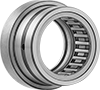
These bearings have higher radial load capacity, speed, and accuracy than standard needle-roller bearings.
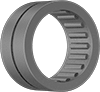
The needles in these bearings roll freely in one direction, but lock to transmit torque when the rotation of the shaft is reversed. Also known as drawn-cup roller clutches.
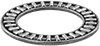
Thinner rollers allow these bearings to fit in tighter spaces than tapered-roller thrust bearings.
Adapt needle-roller thrust bearings to use on unhardened, unground surfaces.
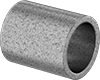
Also known as Oilite® bearings.
Increased iron content makes these bearings stronger and more resistant to shock loads than standard oil-embedded bearings; however they operate at lower speeds.
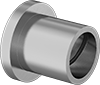
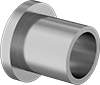
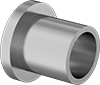
Unlike other sleeve bearings, these do not need to be fully inserted into a housing. Their unique shape creates a permanent, secure hold in thin panels.
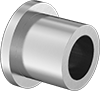
With extra iron and filled with oil containing slippery PTFE, these bearings support heavy loads that frequently start and stop along shafts. They’re sleeve bearings, so they handle loads parallel to the shaft.
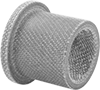
For applications with frequent starts and stops, the oil in these bearings contains particles of slippery PTFE that lubricate the bearing during startup.
The oil in these bearings is suitable for incidental contact with food.
Use these bearings in applications with frequent starts and stops because they operate with very little friction.
Made of FDA-listed materials or FDA compliant, these bearings are for use in food applications. They also withstand caustic and washdown environments.
Use where high loads and speeds are not required.
Graphite provides a layer of dry lubrication that can operate in high-temperature environments.
Good for underwater applications, these bearings won’t swell or warp when wet.
A metal shell adds strength.
A figure-8-shaped groove provides a flow path for lubricant, distributing it evenly along the bearing’s surface.
These bronze bearings are strong, wear resistant, and excellent at handling shock loads.
With oil for reduced friction and iron for added strength, these bearings handle frequent stops and starts in high-load applications.
Made of FDA listed materials for use in food applications, these bearings also withstand caustic and washdown environments.
Reinforced with polyester fabric, these plastic bearings have load and speed capabilities comparable to metal bearings.
Graphite provides a layer of dry lubrication that operates in high-temperature environments.
An aluminum shell adds strength.
The addition of iron and aluminum gives these aluminum-bronze bearings high strength and excellent corrosion resistance—making them suitable for use in marine and mining applications.
Handle heavy loads that frequently start and stop along shafts—these bearings contain extra iron and slippery PTFE lubricant. They’re thrust bearings, which means they support loads parallel to the shaft.
Ball bearings operate with less friction than other bearings, so they can run at higher speeds.
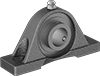
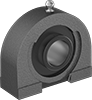
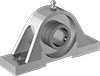
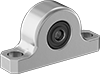
Also known as tapped-base bearings, these ball bearings mount to surfaces from the bottom through threaded holes. Because of their narrow profile, they’re commonly used in tight-clearance spaces, including systems where multiple shafts are mounted close together.
Meeting IP69K for washdown environments, these mounted ball bearings are used in food, beverage, pharmaceutical, and chemical plants.
These nylon bearings swivel inside their housing to compensate for over 20° of shaft misalignment.
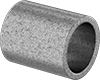
Startup friction causes these porous bronze bearings to release a thin layer of oil on the bearing’s surface.
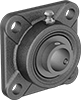
A bolt in each corner makes for a secure, even hold.
Ball bearings operate with less friction than other bearings, so you can run them at higher speeds.
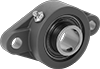
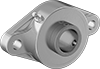
Used in food, beverage, pharmaceutical, and chemical plants, these mounted ball bearings are IP69K certified for washdown environments and have a two-bolt flange for mounting.
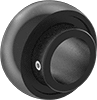
Swap out worn inserts instead of replacing the entire mounted unit.
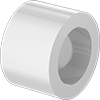
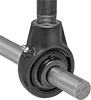
Combine with threaded pipe to mount these bearings in a variety of positions without the need for a flat mounting surface.
Use ball bearings in debris-free environments and when speed is a necessity. They operate with less friction than sleeve bearings, so you can run them at higher speeds.
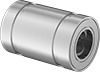
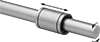
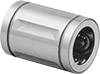
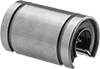
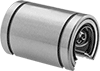
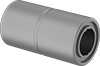
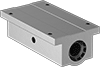
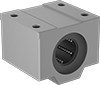
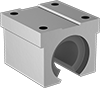
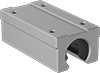
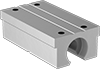
Engineered for simultaneous linear and rotary motion, these bearings are used with round end-supported shafts.
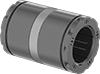
Designed to handle heavy loads, these bearings have higher load capacities than comparable standard linear ball bearings.
The choice for low-friction motion in high-temperature environments.
Made of FDA-listed materials for use in food applications, these bearings also have excellent chemical and corrosion resistance.
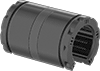
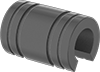
Because they usually do not require lubrication, linear sleeve bearings outperform linear ball bearings in dirty environments.
Ridges on the inside of these bearings wipe away dust and debris as the bearing travels on a shaft.
A ceramic liner makes high speeds as well as rapid acceleration and deceleration possible.
Ball bearings create less friction than sleeve bearings, so they require less force to operate.
Designed to handle heavy loads, these bearings have higher load capacities than comparable standard linear ball bearings for support rail shafts.
Sleeve bearings outperform ball bearings in dirty environments. Use them for low speed applications.
Grooved on the inside, these bearings rotate with your spline shaft as they move loads up and down its length.
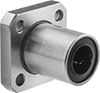
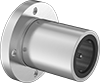
The flanged housing makes these bearings a good solution for vertical linear motion applications.
The shell, housing, and balls of these bearings are stainless steel for excellent corrosion resistance.
Choose ball bearings for debris-free environments and when speed is a necessity. They operate with less friction than sleeve bearings, so you can run them at higher speeds.
Designed to handle heavy loads, these bearings have the highest load capacities of any mounted linear ball bearings we offer.
Outdoor as well as mild chemical environments are no problem for these bearings. They have stainless steel balls for corrosion resistance.
Virtually maintenance free, these bearings have slippery, chemical-resistant liners that don't require added lubrication.
With two bearings mounted in a single housing, these bearings have higher load capacities than standard ones. A ceramic liner helps them achieve high speeds as well as rapid acceleration and deceleration.
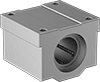
With two bearings mounted in one housing, these sleeve bearings withstand heavy loads. Use them on round support rail shafts for applications that require maximum rigidity.
Mount these bearings on a support rail shaft for applications requiring maximum rigidity.
Designed to handle heavy loads, these bearings have higher load capacities than comparable standard mounted linear ball bearings for support rail shafts.
Ready to mount on your linear motion spline shaft, these bearings come installed in a housing and have grooves that match up with the splines on your shaft.
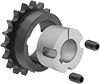
The screw connections on these bushings easily mate to compatible quick-disconnect sprockets and pulleys.
Mount these hubless bushings flush into your sprocket or pulley for a slim profile with no protruding screws.
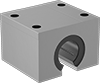
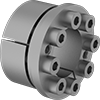
The tapered barrel on these bushings is split on both sides, allowing them to contract more tightly around the shaft than quick-disconnect and taper-lock bushings.
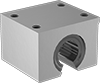
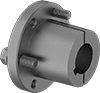
A mounting flange prevents movement during tightening, so it's easy to center these bushings in your sprocket.
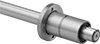
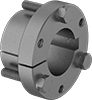
Also known as Trantorque bushings, these tighten with a twist of the collar nut—no screws needed.
Insert these bushings into the bore of your sprocket for flush or recessed mounting.
With a double row of cylindrical roller bearings, these rollers provide the highest combination of speed and dynamic radial load ratings of any shaft-mount track roller we offer.
Also known as yoke-style cam followers, these rollers have more mounting flexibility than threaded track rollers. They're typically mounted onto a shaft or clevis rod end.
Suitable for use in washdown applications, these plastic collars also offer good chemical resistance.