We will reply to your message within two hours.
More
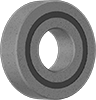
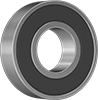
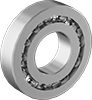
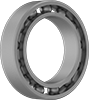
These steel ball bearings handle higher loads than stainless steel and plastic bearings.
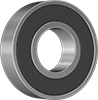
A solid polymer lubricant surrounds the balls, eliminating the need for additional lubrication. Because it's solid, the lubricant blocks out water and dust, extending the life of the bearing.
For greater accuracy and higher speeds, these bearings are made to tighter tolerances than standard ball bearings.
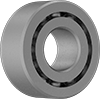
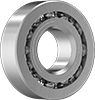
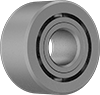
With a spherical raceway and two rows of balls, these bearings compensate for shaft misalignment.
Internal locking elements (sprags) lock to transmit torque in one direction while turning freely in the other direction.
A solid polymer lubricant surrounds the balls, eliminating the need for additional lubrication. Bearings are 440C stainless steel.
Bearings are 440C stainless steel for good corrosion resistance.
Good for applications with incidental food contact, these 440C stainless steel bearings have a food-grade, solid polymer lubricant between the balls and race that eliminates the need for additional lubrication.
These 316 stainless steel bearings are more corrosion resistant than our other stainless steel bearings, but they have a lower load capacity.
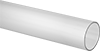
With two rows of balls, these lightweight bearings have greater durability and load capacity—and a wider profile—than single-row plastic bearings.
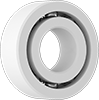
Made of slippery plastic, these bearings do not require lubrication and have excellent corrosion and chemical resistance.
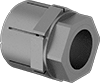
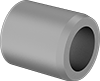
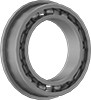
Flanged and creating twice as many contact points as angular-contact ball bearings, these bearings ensure correct positioning within a tube or housing and resist radial loads.
Install these bearings for use with combined radial and thrust loads. They are often used in spindle applications and can be combined with cylindrical roller bearings to better handle radial loads.
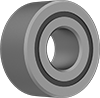
These bearings have twice as many contact points as angular-contact ball bearings.
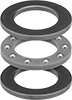
Steel balls and washers allow these bearings to handle higher loads than bearings with stainless steel components.
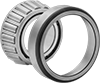
Found anywhere from machine tool spindles to conveyor rollers, these bearings have a two-piece design that allows for adjustment.
With a considerably larger ID than our Face-Mount Crossed-Roller Bearings, use these to run hydraulic lines, electrical wiring, and other components through the inside of the bearing.
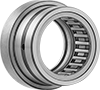
A built-in thrust ball bearing reduces wear from adjacent shaft components, while the needle-roller bearing supports radial loads.
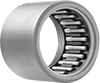
Also known as drawn-cup roller bearings, these are our thinnest roller bearings. The outer ring is drawn out to form a lip that holds the bearing together.
Adapt high-precision needle-roller bearings to use on unhardened, unground shafts.
These bronze bearings are strong, wear resistant, and excellent at handling shock loads.
Use where high loads and speeds are not required.
Use these bearings in applications with frequent starts and stops because they operate with very little friction.
Good for underwater applications, these bearings won’t swell or warp when wet.
With oil for reduced friction and iron for added strength, these bearings handle frequent stops and starts in high-load applications.
Also known as Oilite® bearings.
Increased iron content makes these bearings stronger and more resistant to shock loads than standard oil-embedded bearings; however they operate at lower speeds.
For applications with frequent starts and stops, the oil in these bearings contains particles of slippery PTFE that lubricate the bearing during startup.
The oil in these bearings is suitable for incidental contact with food.
These roller bearings handle extremely high speeds for their small size.
A set of ball bearings reduces friction and secures the end of a metric ball or lead screw.
Also known as yoke-style cam followers, these rollers have more mounting flexibility than threaded track rollers. They're typically mounted onto a shaft or clevis rod end.
At only half the weight of glass, polycarbonate maintains excellent impact resistance across a wide temperature range. It's comparable to Lexan, Hyzod, Tuffak, and Makrolon.
Also known as Trantorque bushings, these tighten with a twist of the collar nut—no screws needed.
Also known as jig bushings, these metric drill bushings fit inside fixture plate holes to guide drill bits, counterbores, reamers, and other cutting tools. They improve accuracy so that your drilled holes and cuts are consistent from part to part.
Even under extreme drilling pressure, these metric bushings won't press through your jig plate. A flanged head on the top of the bushing acts as a stop, preventing it from moving as you push down your drill bit, reamer, or other cutting bit.