
We will reply to your message within two hours.
These steel ball bearings handle higher loads than stainless steel and plastic bearings.
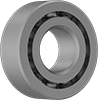
Wider than our standard ball bearings, these rugged bearings are good for handling heavy loads at low speeds.
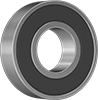
A solid polymer lubricant surrounds the balls, eliminating the need for additional lubrication. Because it's solid, the lubricant blocks out water and dust, extending the life of the bearing.
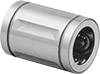
Use these bearings where high speed and precision are not required.
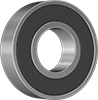
A solid polymer lubricant surrounds the balls, eliminating the need for additional lubrication. Bearings are 440C stainless steel.
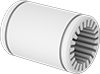
Good for applications with incidental food contact, these 440C stainless steel bearings have a food-grade, solid polymer lubricant between the balls and race that eliminates the need for additional lubrication.
These 316 stainless steel bearings are more corrosion resistant than our other stainless steel bearings, but they have a lower load capacity.
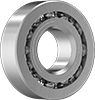
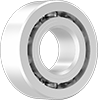
With two rows of balls, these lightweight bearings have greater durability and load capacity—and a wider profile—than single-row plastic bearings.
These PEEK bearings operate in temperatures almost twice as high as our other plastic ball bearings.
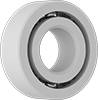
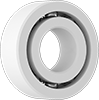
Made of slippery plastic, these bearings do not require lubrication and have excellent corrosion and chemical resistance.
Made of PVDF, these bearings resist moisture absorption, so they won’t warp in underwater applications.
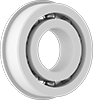
The flange ensures proper positioning inside a tube or housing.
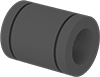
Install these acetal bearings in caustic environments and where lubrication can’t be used. They have good all-around corrosion and chemical resistance.
Slip these bearings onto a shaft and secure with the included set screws, no special tools required.
Also known as Oilite® bearings.
Increased iron content makes these bearings stronger and more resistant to shock loads than standard oil-embedded bearings; however they operate at lower speeds.
For applications with frequent starts and stops, the oil in these bearings contains particles of slippery PTFE that lubricate the bearing during startup.
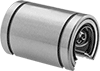
The oil in these bearings is suitable for incidental contact with food.
Made of 863 iron-copper and embedded with NSF registered H1 oil, these bearings can tackle high-load applications in food plants, such as bottling and filling lines.
Graphite provides a layer of dry lubrication that operates in high-temperature environments.
Use these bearings in applications with frequent starts and stops because they operate with very little friction.
Made of FDA listed materials for use in food applications, these bearings also withstand caustic and washdown environments.
Use where high loads and speeds are not required.
Good for underwater applications, these bearings won’t swell or warp when wet.
These bearings stand up to a wider range of chemicals than other dry-running thrust bearings.
These bronze bearings are strong, wear resistant, and excellent at handling shock loads.
The addition of iron and aluminum gives these aluminum-bronze bearings high strength and excellent corrosion resistance—making them suitable for use in marine and mining applications.
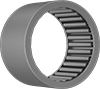
Also known as drawn-cup roller bearings, these are our thinnest roller bearings. The outer ring is drawn out to form a lip that holds the bearing together.
Use ball bearings in debris-free environments and when speed is a necessity. They operate with less friction than sleeve bearings, so you can run them at higher speeds.
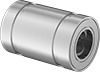
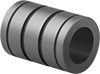
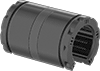
Engineered for simultaneous linear and rotary motion, these bearings are used with round end-supported shafts.
The choice for low-friction motion in high-temperature environments.
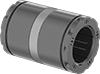
Designed to handle heavy loads, these bearings have higher load capacities than comparable standard linear ball bearings.
Because they usually do not require lubrication, linear sleeve bearings outperform linear ball bearings in dirty environments.
Ridges on the inside of these bearings wipe away dust and debris as the bearing travels on a shaft.
Made of FDA-listed materials for use in food applications, these bearings also have excellent chemical and corrosion resistance.
Ball bearings create less friction than sleeve bearings, so they require less force to operate.
Designed to handle heavy loads, these bearings have higher load capacities than comparable standard linear ball bearings for support rail shafts.
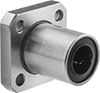
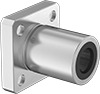
The flanged housing makes these bearings a good solution for vertical linear motion applications.
The shell, housing, and balls of these bearings are stainless steel for excellent corrosion resistance.
Powdered bronze is pressed and then impregnated with SAE 30 oil to make this material self-lubricating.
An excellent alternative to oil-filled bronze, graphite-filled bronze provides dry lubrication in temperatures as high as 700° F.
Offering excellent antifriction qualities, 932 bronze also offers good strength and wear resistance. It's also known as SAE 660 and is often used for bearings, bushings, and thrust washers.
954 bronze contains a minimum of 10% aluminum for strength and weldability. It is also known as aluminum bronze. It's widely used for bearings, bushings, valve bodies, and worm gears. The strength of this material increases with heat treating.
An easier-to-machine alternative to 932 bronze, 936 also has better corrosion resistance. It's also called modified SAE 64.
4130 alloy steel has a low carbon content that provides good weldability. It's often used for gears, fasteners, and structural applications.
Delrin® acetal resin, also known as acetal homopolymer, is stronger and stiffer than acetal copolymer.
The addition of MDS gives these tubes exceptional wear resistance along with a self-lubricating surface. They're made of cast nylon 6, making them easier to machine and better electrical insulators than other MDS-filled nylon tubes.
A good choice for making sprockets and pulleys, these cast nylon 6 tubes withstand higher temperatures and are easier to machine than standard nylon 6/6 tubes.
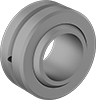
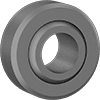
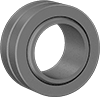
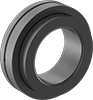
Also known as spherical bearings, swivel joints support angular misalignment. Press them into a hole or housing where a ball joint rod end won’t fit.
A slippery PTFE liner reduces wear and eliminates the need for lubrication.
Specially designed lubrication channels and integral seals allow these joints to last up to three times longer than other swivel joints.
A unique design allows these joints to support heavy one-direction thrust loads as well as combined radial/thrust loads.
Without changing the ID, these inserts handle some misalignment on rod ends.
Insert these bushings into the bore of your sprocket for flush or recessed mounting.
A mounting flange prevents movement during tightening, so it's easy to center these bushings in your sprocket.
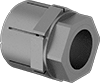
Also known as Trantorque bushings, these tighten with a twist of the collar nut—no screws needed.
A toothed slot lets these bushings contract for insertion into the bore of your sprocket or pulley and then expand for a snug fit.
Suitable for use in washdown applications, these plastic collars also offer good chemical resistance.
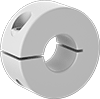
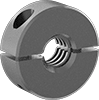
Mount these two-piece collars anywhere on an Acme lead screw without removing components.
Thread these one-piece collars onto an Acme lead screw.
Also known as machinery bushings, these shims have an oversized OD to create a larger bearing surface for reduced wear between moving parts.
Use these round shims as they are, or punch out the middle to create the ID you need.