
We will reply to your message within two hours.
More
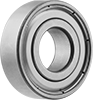
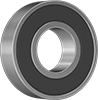
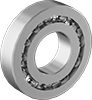
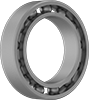
These steel ball bearings handle higher loads than stainless steel and plastic bearings.
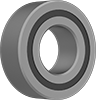
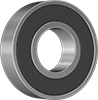
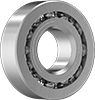
A solid polymer lubricant surrounds the balls, eliminating the need for additional lubrication. Because it's solid, the lubricant blocks out water and dust, extending the life of the bearing.
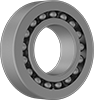
For greater accuracy and higher speeds, these bearings are made to tighter tolerances than standard ball bearings.
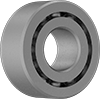
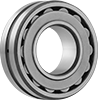
With a spherical raceway and two rows of balls, these bearings compensate for shaft misalignment.
Good for use in electric motors and power generators, these bearings have ceramic balls that insulate against stray current to prevent damage to the bearing.
Internal locking elements (sprags) lock to transmit torque in one direction while turning freely in the other direction.
For use on tapered shafts and round shafts with adapter sleeves, these ball-bearings have a spherical raceway to compensate for shaft misalignment.
A solid polymer lubricant surrounds the balls, eliminating the need for additional lubrication. Bearings are 440C stainless steel.
Bearings are 440C stainless steel for good corrosion resistance.
Good for applications with incidental food contact, these 440C stainless steel bearings have a food-grade, solid polymer lubricant between the balls and race that eliminates the need for additional lubrication.
These 316 stainless steel bearings are more corrosion resistant than our other stainless steel bearings, but they have a lower load capacity.
With two rows of balls, these lightweight bearings have greater durability and load capacity—and a wider profile—than single-row plastic bearings.
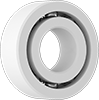
Made of slippery plastic, these bearings do not require lubrication and have excellent corrosion and chemical resistance.
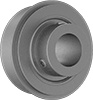
Slip these bearings onto a shaft and secure with the included set screws, no special tools required.
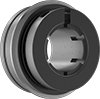
Quickly secure these bearings onto shafts with the clamp-on collar for a concentric, mar-free hold.
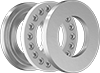
Install these bearings for use with combined radial and thrust loads. They are often used in spindle applications and can be combined with cylindrical roller bearings to better handle radial loads.
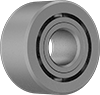
These bearings have twice as many contact points as angular-contact ball bearings.
Steel balls and washers allow these bearings to handle higher loads than bearings with stainless steel components.
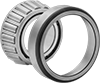
Found anywhere from machine tool spindles to conveyor rollers, these bearings have a two-piece design that allows for adjustment.
Two rows of rollers give these bearings load capacities over five times higher than comparably sized tapered-roller bearings.
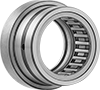
A built-in thrust ball bearing reduces wear from adjacent shaft components, while the needle-roller bearing supports radial loads.
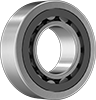
With cylindrical rollers to distribute load over a large surface area, these bearings are often used to support heavy loads at high speeds in applications such as power generation and metal recycling.
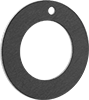
A metal backing adds strength.
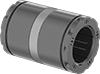
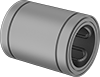
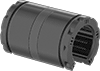
Designed to handle heavy loads, these bearings have higher load capacities than comparable standard linear ball bearings.
Use ball bearings in debris-free environments and when speed is a necessity. They operate with less friction than sleeve bearings, so you can run them at higher speeds.
The choice for low-friction motion in high-temperature environments.
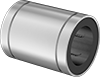
Thinner than standard linear sleeve bearings, these bearings fit where clearance is a concern.
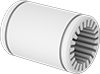
Ridges on the inside of these bearings wipe away dust and debris as the bearing travels on a shaft.
Designed to handle heavy loads, these bearings have higher load capacities than comparable standard linear ball bearings for support rail shafts.
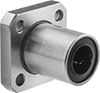
The flanged housing makes these bearings a good solution for vertical linear motion applications.
With a nylon insert that grips your threaded shaft or spindle without damaging its threads, these locknuts—also called shaft nuts—hold bearings, bushings, gears, and pulleys prone to vibration tightly in place.
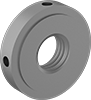
Used in pairs or with another bearing retaining nut, these jam nuts—often called shaft nuts—hold bearings, bushings, pulleys, and gears in place on your threaded shaft or spindle.
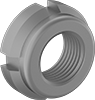
Often paired with spring lock washers to strengthen their hold, these retaining nuts—also known as shaft nuts—keep vibration from shifting bearings, bushings, pulleys, and gears on your threaded shaft or spindle.
Precisely align, level, and adjust spacing on fasteners and shafts with these shims.
Also known as jig bushings, these metric drill bushings fit inside fixture plate holes to guide drill bits, counterbores, reamers, and other cutting tools. They improve accuracy so that your drilled holes and cuts are consistent from part to part.
A mounting flange prevents movement during tightening, so it's easy to center these bushings in your sprocket.