We will reply to your message within two hours.
More
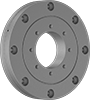
Mounting holes on the inner and outer rings allow for fastening onto hollow joints and shafts.
With a considerably larger ID than our Face-Mount Crossed-Roller Bearings, use these to run hydraulic lines, electrical wiring, and other components through the inside of the bearing.
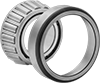
Found anywhere from machine tool spindles to conveyor rollers, these bearings have a two-piece design that allows for adjustment.
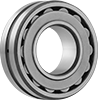
Two rows of rollers give these bearings load capacities over five times higher than comparably sized tapered-roller bearings.
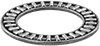
A built-in thrust ball bearing reduces wear from adjacent shaft components, while the needle-roller bearing supports radial loads.
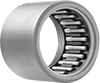
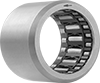
Also known as drawn-cup roller bearings, these are our thinnest roller bearings. The outer ring is drawn out to form a lip that holds the bearing together.
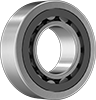
With cylindrical rollers to distribute load over a large surface area, these bearings are often used to support heavy loads at high speeds in applications such as power generation and metal recycling.
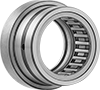
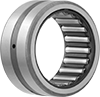
These bearings have higher radial load capacity, speed, and accuracy than standard needle-roller bearings.
The needles in these bearings roll freely in one direction, but lock to transmit torque when the rotation of the shaft is reversed. Also known as drawn-cup roller clutches.
Thinner rollers allow these bearings to fit in tighter spaces than tapered-roller thrust bearings.
Roller bearings have a thinner profile and larger contact area than ball bearings, making them stronger and more space-efficient than ball bearings.
These roller bearings handle extremely high speeds for their small size.
The tapered rollers in these bearings support large shafts at high static loads.
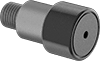
Also known as cam followers, track rollers support loads while guiding and positioning work. Thread the stud directly into a component or secure with a nut for through-hole mounting.
Because they never need to be relubricated, these rollers are a good choice for hard-to-reach places.
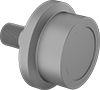
Also known as eccentric track rollers, the shoulder adjusts up or down to align to your track, enabling uniform alignment among rollers in a system.
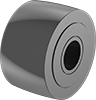
Also known as yoke-style cam followers, these rollers have more mounting flexibility than threaded track rollers. They're typically mounted onto a shaft or clevis rod end.
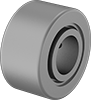
With a double row of cylindrical roller bearings, these rollers provide the highest combination of speed and dynamic radial load ratings of any shaft-mount track roller we offer.
Thread the stud directly into a component or secure with a nut for through-hole mounting.