

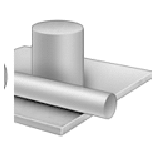
Shape Shape |
|---|
 |  |
| Sheet and Bar | Hex Ingot |
 | |
| Coil |
DFARS (Defense Acquisition Regulations Supplement) DFARS (Defense AcquisitionRegulations Supplement)  |
|---|
RoHS (Restriction of Hazardous Substances) RoHS (Restriction ofHazardous Substances) |
|---|
|
For Joining For Joining |
|---|
|
|
REACH (Registration, Evaluation, Authorization and Restriction of Chemicals) REACH (Registration,Evaluation, Authorization and Restriction of Chemicals) |
|---|
|
Casting Metals
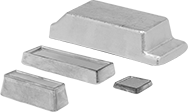
Melt and pour these alloys into molds to create metal parts and prototypes.
Bismuth and indium alloys expand slightly as they solidify, pushing into the crevices of a mold to produce detailed replicas. These alloys are useful for repairing dies, creating fusible links, and holding delicate parts for machining.
Material Composition | Approximate | ||||||||||
|---|---|---|---|---|---|---|---|---|---|---|---|
| Melting Temperature, °F | Bismuth | Lead | Tin | Cadmium | Thick. | Wd. | Lg. | Wt., lbs. | Shape | Each | |
| 158° | 50% | 27% | 13% | 10% | 1/2" | 3" | __ | 1 1/2 | Hex Ingot | 0000000 | 000000 |
| 160° | 43% | 38% | 11% | 8% | 5/8" | 1 1/2" | 4 1/2" | 1 1/2 | Sheet and Bar | 0000000 | 00000 |
| 203° | 53% | 32% | 15% | __ | 1" | 1" | 3" | 1 1/2 | Sheet and Bar | 0000000 | 00000 |
| 255° | 56% | 44% | __ | __ | 1/2" | 3" | 3" | 1 1/2 | Sheet and Bar | 0000000 | 00000 |
| 281° | 40% | __ | 60% | __ | 1/2" | 1 1/2" | 4 1/2" | 1 1/2 | Sheet and Bar | 0000000 | 00000 |
| 281° | 58% | __ | 42% | __ | 5/8" | 1 1/2" | 5 1/2" | 1 1/2 | Sheet and Bar | 0000000 | 00000 |
High-Density Low-Melting-Point Lead-Free Solder
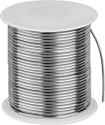
This bismuth-tin solder has similar performance properties to lead solder, but is also safe for use in food-processing equipment and copper water pipes. It has a lower melting point than most solders, so it’s good for sensitive assemblies, such as semiconductors and electronic components, as well as for step soldering with traditional solders. However, it’s less thermally conductive than other metals and more brittle than lead. Flux isn’t required, but for easier cleanup use it with no-clean soldering flux. Do not use this solder on drinking water pipes.
Solder with 1% silver forms stronger bonds than solder without silver. It’s also more malleable and ductile. However, it has a higher melting point, so it takes longer to solder.