We will reply to your message in the morning.
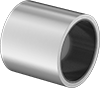
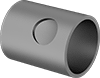
Also known as Oilite® bearings.
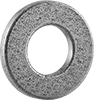
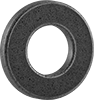
Increased iron content makes these bearings stronger and more resistant to shock loads than standard oil-embedded bearings; however they operate at lower speeds.
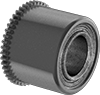
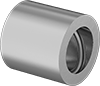
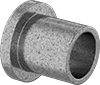
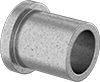
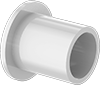
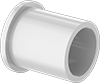
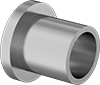
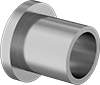
Unlike other sleeve bearings, these do not need to be fully inserted into a housing. Their unique shape creates a permanent, secure hold in thin panels.
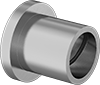
A metal shell adds strength.
Graphite provides a layer of dry lubrication that can operate in high-temperature environments.
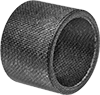
Reinforced with polyester fabric, these plastic bearings have load and speed capabilities comparable to metal bearings.
Use where high loads and speeds are not required.
These bearings stand up to a wider range of chemicals than other dry-running sleeve bearings.
Use these bearings in applications with frequent starts and stops because they operate with very little friction.
Made of FDA-listed materials or FDA compliant, these bearings are for use in food applications. They also withstand caustic and washdown environments.
Good for underwater applications, these bearings won’t swell or warp when wet.
These bronze bearings are strong, wear resistant, and excellent at handling shock loads.
The addition of iron and aluminum gives these aluminum-bronze bearings high strength and excellent corrosion resistance—making them suitable for use in marine and mining applications.
Grooves on the inside of the bearing provide a flow path for lubricant, distributing it evenly along the bearing’s surface.
For applications with frequent starts and stops, the oil in these bearings contains particles of slippery PTFE that lubricate the bearing during startup.
A slit running along the length of these bearings allows you to quickly slip them into a housing—no tools required.
Made of FDA listed materials for use in food applications, these bearings also withstand caustic and washdown environments.
Graphite provides a layer of dry lubrication that operates in high-temperature environments.
With a flexible layer of neoprene sandwiched between an oil-embedded bronze bearing and rigid steel shell, these bearings reduce wear and machinery noise.
Startup friction causes these porous bronze bearings to release a thin layer of oil on the bearing’s surface.
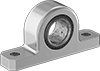
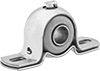
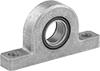
A strong steel housing allows these bearings to handle higher speeds than standard oil-embedded mounted sleeve bearings.
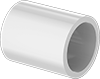
Made from slippery materials, these bearings reduce friction without the oily mess.
Use these UHMW bearings in wet, corrosive environments.
Embedded lubricant particles increase the load capacity of these bearings while also making them slippery.
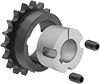
The screw connections on these bushings easily mate to compatible quick-disconnect sprockets and pulleys.
The tapered barrel on these bushings is split on both sides, allowing them to contract more tightly around the shaft than quick-disconnect and taper-lock bushings.
Mount these hubless bushings flush into your sprocket or pulley for a slim profile with no protruding screws.
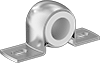
Reduce the ID of sprockets, pulleys, and gears in low-torque applications.
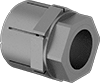
Also known as Trantorque bushings, these tighten with a twist of the collar nut—no screws needed.
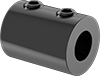
Each hub includes a set screw (unless noted), which bites into your shaft to hold the coupling in place.
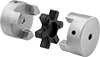
The thick split spider on these couplings takes on twice as much torque as standard split spiders, while a set screw holds the hubs in place on your shaft. Also known as jaw couplings, use them to connect motors to pumps, mixers, and other high-torque equipment.
Safely connect slightly misaligned shafts near food lines—the spider on these couplings contains metal, so it’ll trigger a metal detector if a piece frays off and contaminates your batch.
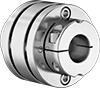
Able to handle high twisting forces as well as misalignment, these couplings are good for high-performance servomotor applications.
When one of your shafts is undersized from wear, oversized from coatings, or uncommonly sized, machine one end of these couplings to fit. They clamp around your shafts for a secure hold that won’t cause damage.
These couplings have the gripping strength to handle higher torque than most other couplings.
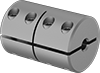
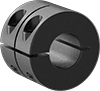
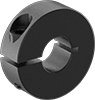
Designed to grip evenly around your shaft, clamping couplings provide more holding power than set screw couplings without marring the shaft.
Set screws bite into your shaft to hold these couplings in place.
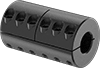
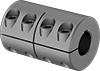
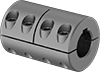
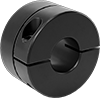
Install and remove these shaft couplings without disconnecting the shafts, motors, and other attached components—they’re made in two pieces so you don’t need to slide them onto shaft ends. They’re also useful when you have limited access to the ends of the shafts.
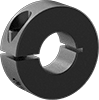
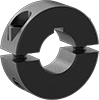
Keep these shaft collars in place by tightening their set screw into the shaft.
Made of chemical-resistant nylon, these collars are suitable for washdown applications.
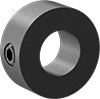
These metal collars are stronger than plastic shaft collars.
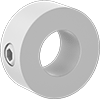
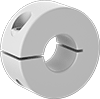
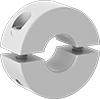
Suitable for use in washdown applications, these plastic collars also offer good chemical resistance.
Internal ball bearings allow you to slide a collar onto your shaft in one direction and then automatically lock the collar in place in the opposite direction.
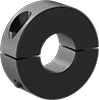
Wider than standard shaft collars with twice the number of clamping screws, these ensure a better grip for greater holding power.
One side of these collars locks down like a standard one-piece shaft collar; the other has a flush face that's flat to 0.0005", which lets you mount the collars on a shaft next to precision bearings, sprockets, and gears.
With larger clamping screws than those found on standard clamping collars, these provide a stronger grip on your shaft without using additional screws.
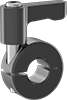
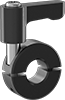
A threaded lever lets you tighten these collars with more torque than other quick-release styles, ensuring that they stay put on your shaft.
Installing and removing a collar is as easy as pushing down and lifting up a clamp lever.
Although these collars fit inch-sized shafts, they have a metric OD and width for use with metric equipment.
Make quick adjustments to these shaft collars with a lever on the side.
With larger screws than those found on standard clamping collars, these provide a stronger grip on your shaft without using additional screws.
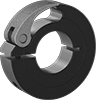
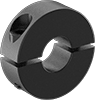
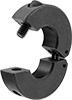
Offering the benefits of a two-piece collar in a one-piece design, these collars swing open for positioning then close anywhere on your shaft.
Install these collars anywhere on a shaft without removing components or having access to the ends of the shaft.
These collars have two different sides—one locks down like a standard clamping shaft collar; the other has a flush face that you can machine to add slots, holes, and grooves to match your special setups.
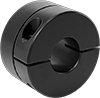
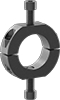
Secure items to either side of these collars—each half has a flat end with a tapped hole
Increase the diameter of your shaft while also making it longer.
Reduce the diameter of your shaft while adding length.
One side is unfinished for milling custom pulleys, threaded hubs, sprockets, collars, knobs, sensor targets, or just about anything imaginable; the other side is a one-piece clamping coupling for mounting whatever you’ve created to your shaft.
Be prepared with shims in a variety of thicknesses. Also known as arbor spacers, these shims are notched to fit over keyed shafts.
Precisely shaped to fit snugly on keyed shafts, these shims align, level, and space components. Because of their tight fit, they also help components rotate in unison with the shaft.