We will reply to your message within two hours.
More
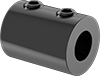
Each hub includes a set screw (unless noted), which bites into your shaft to hold the coupling in place.
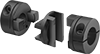
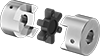
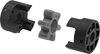
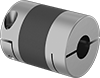
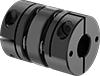
The thick split spider on these couplings takes on twice as much torque as standard split spiders, while a set screw holds the hubs in place on your shaft. Also known as jaw couplings, use them to connect motors to pumps, mixers, and other high-torque equipment.
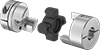
Designed to grip evenly around your shaft, these couplings provide more holding power than set screw couplings without marring the shaft.
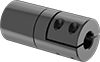
Each hub includes a set screw, which bites into your shaft to hold the coupling in place.
Also known as Schmidt couplings, these handle higher angular misalignment than other three-piece couplings. Good for applications with varying shaft misalignment, they're commonly used with conveyor rollers and roller feeds in printing and packaging machines.
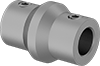
Safely connect slightly misaligned shafts near food lines—the spider on these couplings contains metal, so it’ll trigger a metal detector if a piece frays off and contaminates your batch.
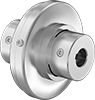
A strip of flexible spring steel wraps around the teeth of both hubs to absorb sharp, momentary load increases that can come from motor startups, emergency braking, or sudden impact with hard objects.
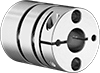
Also called double-loop couplings, these have a flexible center that reduces vibration and compensates for high parallel and angular shaft misalignment.
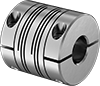
Able to handle high twisting forces as well as misalignment, these couplings are good for high-performance servomotor applications.
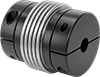
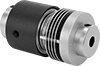
With a bellows between two hubs, these couplings handle all types of misalignment and are good for precision stepper and encoder motion-control applications.
Connect shafts and ball screws to high-speed servomotors and stepper motors—these shaft couplings handle four times more speed than standard servomotor couplings.
An acetal plastic spacer at the center of these couplings insulates bearings, encoders, and other shaft components from stray electric current. Use them with servomotors, which sometimes generate current that travels down the shaft and can damage circuit boards, interfere with readings, and cause wear on bearing raceways.
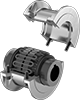
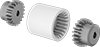
Made with lightweight nylon sleeves, these gear couplings require less energy to move than other high-torque flexible couplings. They compensate for parallel, angular, and axial misalignment.
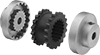
Use these gear-shaped couplings for high-speed and high-torque applications.
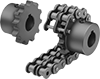
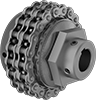
With a rugged roller-chain design, these couplings provide excellent torque and angular misalignment capacities.
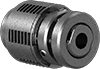
Magnetic force transfers torque from one half of these couplings to the other; there’s no contact between the parts, so they won’t wear. Couplings compensate for angular and parallel misalignment.
Designed to grip evenly around your shaft, clamping couplings provide more holding power than set screw couplings without marring the shaft.
When one of your shafts is undersized from wear, oversized from coatings, or uncommonly sized, machine one end of these couplings to fit. They clamp around your shafts for a secure hold that won’t cause damage.
These couplings have the gripping strength to handle higher torque than most other couplings.
Set screws bite into your shaft to hold these couplings in place.
Install and remove these shaft couplings without disconnecting the shafts, motors, and other attached components—they’re made in two pieces so you don’t need to slide them onto shaft ends. They’re also useful when you have limited access to the ends of the shafts.
Access one shaft without disconnecting the other. These rigid couplings have a solid bottom that connects the shafts and two top pieces that clamp the shafts independently.
Extend the life of your rigid shaft couplings by blocking out dirt, water, lubricants, and other contaminants. These two-piece covers twist together to form a shell around the coupling.
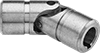
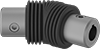
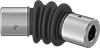
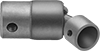
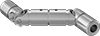
These U-joints are made of steel or plastic.
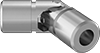
These U-joints are made of steel or zinc.
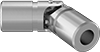
Made of stainless steel, these U-joints offer excellent corrosion resistance.
These joints are made of steel.
Stainless steel hubs allow these U-joints to handle harsh environments.
Connect misaligned shafts in sanitary environments such as food, cosmetic, and pharmaceutical plants.
These pin-and-block style U-joints work at lower speeds but transmit greater torque than needle-bearing joints.
Increase the diameter of your shaft while also making it longer.
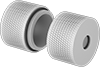
One side is unfinished for milling custom pulleys, threaded hubs, sprockets, collars, knobs, sensor targets, or just about anything imaginable; the other side is a one-piece clamping coupling for mounting whatever you’ve created to your shaft.
To protect power-transmission components from damage, these couplings will shear or tear in overtorque conditions (approximately 10-20 times the maximum rated torque) to sever connections between shafts.
If they exceed maximum torque, these couplings disengage, sound an alarm, and then automatically re-engage once the overtorque condition is eliminated.
Protect shafts, motors, and gear boxes from damage that’s caused by torque overload from machine jams and emergency stops.
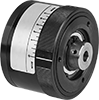
Adjust your system's torque limit by hand.
Often used in automated systems, these couplings are air actuated so you can adjust the torque during operation.
Also known as hysteresis clutches, these couplings use magnetic force to brake, control tension, and prevent torque overload. They have few moving parts, so they last longer than mechanical couplings.
Often used in automated systems, these couplings are both air actuated and remotely adjustable, so you can adjust the torque setting even during operation.
Prevent damage from overloading. When overloaded, these limiters cause your sprocket or pulley to slip. Once the overload is removed, the limiters automatically reset.