
We will reply to your message in the morning.
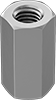
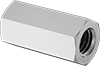
These metric-sized coupling nuts are Class 10 steel, so they’re about 25% stronger than medium-strength steel coupling nuts.
For light duty applications, choose these metric-sized coupling nuts.
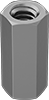
Choose these locknuts to fasten standard metric threads. They’re Class 8 steel, so they can be used in most fastening applications.
These metric coupling nuts have good chemical resistance.
More corrosion resistant than 18-8 stainless steel coupling nuts, these metric nuts have excellent resistance to chemicals and salt water.
One-third the weight of steel, aluminum coupling nuts resist corrosion in wet environments.
Brass coupling nuts are corrosion resistant in wet environments and electrically conductive.
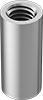
A smooth rounded body provides a finished look.
Stainless steel coupling nuts have excellent corrosion resistance in most environments.
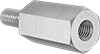
In addition to joining male- and female-threaded parts, these adapters can increase or decrease metric thread sizes and change the thread pitch.
Change inch threads to metric with these adapters, or swap metric threads for inch. An external hex lets you tighten or loosen them with a wrench.
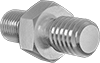
Increase or decrease metric thread size from one male-threaded part to another. Commonly used to connect two differently sized threaded rods, they have a hex-shaped body, so you can tighten them with a standard wrench.
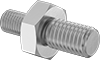
Adapt threaded rods from inch to metric. These adapters connect two male-threaded fasteners, so you can change the gender of a mating part or increase or decrease its thread size. The hex-shaped body fits into the head of a standard wrench.
Often called sleeve nuts, these thread adapters fasten parts with right-hand threads to parts with left-hand threads.
One side inch, one side metric, and a hex in the middle—these handy fasteners connect two female-threaded parts, such as coupling nuts, adapting from inch threads to metric. Tighten with a standard wrench.
Twist these adapters onto female metric threads to change pitch or switch thread sizes.
These fittings are strong enough to handle extreme pressures, yet small enough to fit into cramped spaces.
These brass fittings have the strength to handle high-pressure applications.
Use these fittings in extreme-pressure conditions up to 15,000 psi.
Instead of a metal sleeve (ferrule), these fittings have a rubber sleeve that cushions tubing and absorbs vibration to maintain a tight seal, even when connected to large pumps.
A single sleeve (ferrule) bites into tubing as you tighten the nut, creating a strong seal.
Also known as JIC (Joint Industrial Council) fittings, these provide a tight metal-to-metal seal on steel tubing that is flared to 37°.
Made of nickel-plated brass, these fittings have better corrosion resistance than unplated brass fittings.
Use at pressures up to 250 psi.
Use at pressures up to 150 psi.
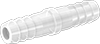
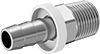
Barbs grip onto tubing.
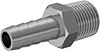
Metal hose fittings have better durability than plastic barbed hose fittings.
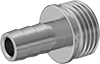
Attach these fittings to garden hose for a variety of water supply applications. They are metal for better durability than plastic garden hose fittings.
Fittings have sharp barbs that grip push-on hose with no clamps or ferrules required. The more you pull on the fittings, the tighter the hose will grip. Use in low-pressure hydraulic applications up to 350 psi.
These metal hose fittings have better durability than plastic barbed hose fittings. They are 316 stainless steel for excellent corrosion and chemical resistance. Slide the barbed end into hose and secure with a clamp.