We will reply to your message within two hours.
More
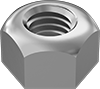
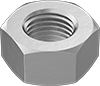
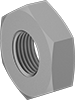
Class 8 nuts are comparable in strength to Class 8.8 bolts and are suitable for fastening most machinery and equipment.
These metric nuts tighten when turned to the left; once fastened, they resist loosening from counterclockwise motion.
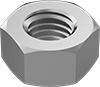
About 25% stronger than medium-strength steel nuts, these nuts are comparable in strength to class 10.9 bolts.
Closely spaced metric threads prevent these nuts from loosening due to vibration. About 25% stronger than medium-strength steel nuts, these nuts are comparable in strength to Class 10.9 bolts.
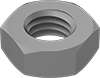
About half the strength of medium-strength steel nuts, these metric nuts are for light duty fastening applications.
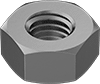
These metric nuts are about 20% stronger than high strength steel nuts and are often used in heavy machinery.
These nuts have good chemical resistance and may be mildly magnetic. Metric 18-8 stainless steel is also known as A2 stainless steel.
Tighten these nuts by turning them to the left; once fastened, they resist loosening from counterclockwise motion.
These metric nuts have good chemical resistance and may be mildly magnetic.
These metric nuts are corrosion resistant in wet environments, electrically conductive, and nonmagnetic.
These brass nuts resist rusting from water and have closely spaced threads to prevent loosening from vibration.
One-third the weight of steel, these metric aluminum nuts are corrosion resistant in wet environments and nonmagnetic.
These metric nuts are resistant to salt water, electrically conductive, and nonmagnetic.
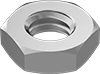
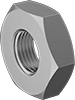
Half as thick as regular hex nuts, these nuts fit into spaces with low height clearances. They are about half as strong as medium-strength steel, and are often used for light duty applications, such as securing access panels.
These nuts are half the height of standard hex nuts, and have closely spaced threads to prevent loosening from vibration. Half as strong as medium-strength steel nuts, they are often used for light-duty applications, such as fastening signs in place.
These nuts should be used for light duty fastening applications, such as securing access panels.
These nuts tighten when turned to the left; once fastened, they resist loosening from counterclockwise motion. Made of Grade 2 and Class 04 steel, these nuts can be used for fastening panels and other light duty fastening applications.
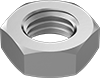
Useful in low-clearance applications, these metric nuts are roughly half the height of standard hex nuts, but aren’t as strong. All are 18-8 stainless steel, which is nearly as strong as steel but won’t rust in outdoor, washdown, and other corrosive environments.
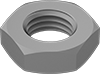
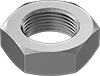
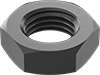
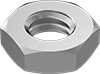
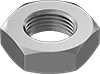
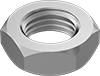
Made with fine-pitch threads, vibration is less likely to loosen these metric nuts than those with coarse-pitch threads since the threads sit closer together. Also called jam nuts, they are roughly half the height of standard hex nuts, so they’re good for applications with low clearance.
These nuts tighten when turned to the left; once fastened, they resist loosening from counterclockwise motion.
These metric nuts are made of 316 stainless steel and half as tall as regular hex nuts—use them around chemicals and salt water when space is limited.
With threads that tighten to the left and made of 316 stainless steel, these nuts won’t loosen from counterclockwise motion in saltwater and corrosive environments. They’re half the height of standard hex nuts, so they fit where there’s low clearance.
Made from brass, these metric nuts are corrosion resistant in wet environments, electrically conductive, and nonmagnetic. About half the height of standard hex nuts, they are useful in low-clearance applications but have less tensile strength.
These nuts tighten to the left and won’t loosen from counterclockwise motion.
Comparable in strength to Class 12.9 bolts.
These Class 10 nuts are about 25% stronger than medium-strength steel extra-wide hex nuts.
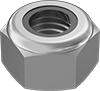
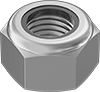
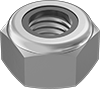
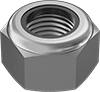
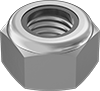
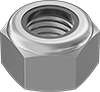
A nylon insert keeps metric bolt threads from coming loose due to vibration, wear, and temperature swings. About 25% stronger than medium-strength steel locknuts, these nuts are made of high-strength, Class 10 steel.
Closely spaced metric threads prevent loosening from vibration. These Class 10 steel locknuts are 25% stronger than our medium-strength steel nylon-insert locknuts.
Made from medium-strength steel with a nylon insert, these Class 8 metric locknuts are strong enough to use on most machinery and equipment that’s prone to vibration and temperature changes.
Get a grip on metric bolts exposed to vibration, wear, and changes in temperature. These metric locknuts have a nylon insert that holds onto bolts without damaging their threads.
These metric locknuts have good chemical resistance.
More corrosion resistant than 18-8 stainless steel locknuts, these metric locknuts have excellent resistance to chemicals and salt water.
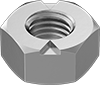
These metric locknuts have an irregularly shaped thread at the top of the nut that grips the bolt for a stronger hold than nylon-insert locknuts.
These locknuts have good chemical resistance.
Secure these metric nuts by inserting a cotter pin or safety wire through the slots and a drilled hole in your bolt for mild loosening resistance. Often referred to as castle nuts.

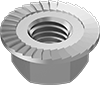
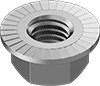
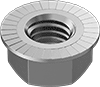
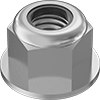
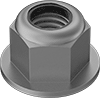
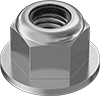
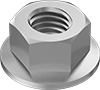
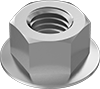
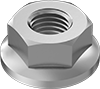
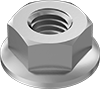
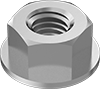
Strong enough for use in most machinery and equipment, these medium-strength metric nuts have serrations on the underside of the flange. The serrations prevent the nuts from loosening in applications with mild vibration.
They're about 25% stronger than medium-strength steel flange locknuts and comparable in strength to Class 10.9 bolts.
Metric 18-8 stainless steel is also known as A2 stainless steel. These flange locknuts have good chemical resistance and may be mildly magnetic.
Metric 316 stainless steel is also known as A4 stainless steel. These flange locknuts have excellent resistance to chemicals and salt water.
Grip metric bolts more securely than nylon-insert flange locknuts—the irregularly shaped threads on these locknuts hold extra tight. They resist vibration and sudden shocks, even after multiple uses.
Also known as collar nuts, these metric nuts have a flange that distributes pressure across the surface, so you don't need a washer. Made of high-strength Class 10 steel, they’re about 25% stronger than medium-strength steel flange nuts.
No need for a washer—these metric medium-strength steel nuts have a flange that distributes pressure across its surface the way a washer does. Made of medium-strength, Class 8 steel, they’re suitable for fastening most machinery and equipment.
Skip the washer—these metric stainless steel nuts have a flange that does the same job, spreading pressure across its surface for a strong hold.
More corrosion resistant than 18-8 stainless steel flange nuts, these nuts have excellent resistance to chemicals and salt water.
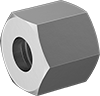
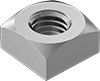
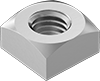
About half the strength of medium-strength steel square nuts, use these metric nuts in light duty fastening applications, such as securing access panels.
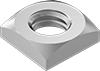
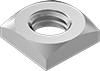
About half the strength and two-thirds the height of medium-strength steel square nuts, use these metric nuts in light duty, low-clearance applications.
Two-thirds the height of typical square nuts and made of stainless steel, these metric nuts are designed for use in low-clearance applications in humid, damp, and washdown environments.
Made from 18-8 stainless steel, these metric square nuts have good chemical resistance and may be mildly magnetic.
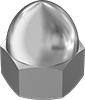
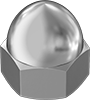
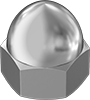
These metric cap nuts have good chemical resistance and may be mildly magnetic.
These metric cap nuts have excellent resistance to chemicals and salt water.
These metric nuts are about half the strength of medium-strength steel cap nuts. Use them in light duty fastening applications, such as securing access panels.
Comparable in strength to Class 10.9 bolts, these nuts are about 25% stronger than medium-strength steel cap nuts.
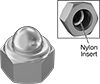
A nylon insert on these metric nuts prevents vibration from loosening them, and a domed head protects the threads at the end of the bolt from damage and debris.
These metric wing nuts provide more leverage for greater torque while tightening than knurled-head thumb nuts.
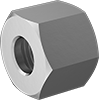
Made from 18-8 stainless steel, these metric nuts have good chemical resistance and may be mildly magnetic.
Made from 316 stainless steel, these metric wing nuts have excellent chemical resistance and can be used in saltwater environments.
Use these thumb nuts in low-clearance applications or jam one against another nut to hold it in place.
Made from 18-8 stainless steel, these metric thumb nuts have good chemical resistance and may be mildly magnetic.
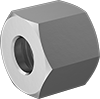
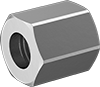
For light duty applications, choose these metric-sized coupling nuts.
Choose these locknuts to fasten standard metric threads. They’re Class 8 steel, so they can be used in most fastening applications.
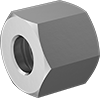
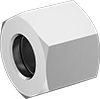
These metric-sized coupling nuts are Class 10 steel, so they’re about 25% stronger than medium-strength steel coupling nuts.
These metric coupling nuts have good chemical resistance.
More corrosion resistant than 18-8 stainless steel coupling nuts, these metric nuts have excellent resistance to chemicals and salt water.
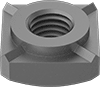
Weld these metric nuts to flat and uneven uncoated steel surfaces for a strong permanent hold.
You can weld these metric nuts to flat and uneven uncoated stainless steel surfaces for a strong permanent hold.
Square weld nuts have more weld points than hex weld nuts for a stronger hold. Use them on flat surfaces.
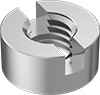
With a slim, round profile and a slotted drive, these metric nuts work in tight spots where there's no room for a wrench to turn. Instead, tighten them from the center of the nut with a slotted screwdriver.
Designed for use with bearing nuts, these lock washers have a conical shape that presses like a spring against bearings, bushings, gears, and pulleys to hold them in place on your threaded shaft or spindle.
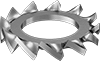
Teeth on the outside edge of these metric washers bite into the screw head and joint for a tight grip.
The teeth on these washers bite further into the screw head and joint than standard external-tooth washers to provide a stronger hold.
To keep 90° countersunk screws from loosening in vibration applications, the teeth on these washers bite further into the screw head and joint than standard external-tooth lock washers for a more secure hold.
Stainless steel thumb screws have excellent corrosion resistance in most environments.
These metric thumb screws have wings that provide more leverage than spade-head thumb screws for greater torque while tightening. A zinc plating provides corrosion resistance in wet environments.
Also known as E-style rings.
With teeth along the inside, these retaining rings hold chamfered shafts inside the housing of your equipment.
Often paired with spring lock washers to strengthen their hold, these retaining nuts—also known as shaft nuts—keep vibration from shifting bearings, bushings, pulleys, and gears on your threaded shaft or spindle.
Used in pairs or with another bearing retaining nut, these jam nuts—often called shaft nuts—hold bearings, bushings, pulleys, and gears in place on your threaded shaft or spindle.
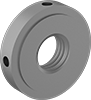
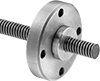
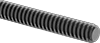
Also known as trapezoidal-thread lead screws and nuts.
These metric lead screws and nuts have broad, square threads that are well suited for quick assembly, high clamping forces, and lifting and lowering heavy objects. They're commonly found in hand-powered clamps, vises, grates, doors, and work tables.
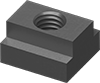
Designed to slide into T-slot tracks on machine tool tables, use these nuts to secure clamps and workpieces.
Secure setup clamps and fixtures to your machine table, or assemble heavy machines, such as engine mounts.
Also known as tap-end and fixture studs, these rods have friction-fit threads on one end to resist loosening and standard threads on the other side for attaching a nut.
For quicker setups than a separate T-slot nut and stud, slide these bolts into T-slot tracks on machine tool tables.
Use these corrosion-resistant fittings in a low-pressure pipe line.
Use these fittings in low-pressure flow applications. They have good corrosion resistance.
Use these fittings for low-pressure applications in noncorrosive environments.
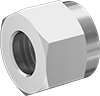
Pair these nuts with compression sleeves and high-pressure fittings. They withstand about twice as much pressure as nuts for standard compression fittings, so they’re good for hydraulic power applications.
Use these nuts with compression sleeves and fittings, also known as bite fittings, to create a strong seal on steel tubing.
Tighten these nuts onto high-pressure compression sleeves and fittings to create a strong seal on stainless steel tubing.
Use these nuts with compression sleeves and fittings to create a strong seal on stainless steel tubing.
Pair these nuts with vibration-resistant compression sleeves and fittings for a strong seal on stainless steel tubing.
Create a strong seal on copper tubing when you couple these nuts with compression sleeves and fittings.
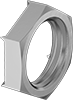
Secure threaded metal conduit fittings to a knockout in an outlet box or enclosure.
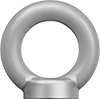
Create your own lifting eye by adding an eye nut to a stud or bolt.
Add push-in cable holder to this adapter to mount cable to DIN rail.