We will reply to your message within two hours.
Use these metal dowel pins as pivots, hinges, shafts, jigs, and fixtures to locate or hold parts.
Plastic pins are a nonconductive and nonmagnetic alternative to metal dowel pins. Use them as pivots, hinges, shafts, jigs, and fixtures to locate or hold parts.
Slip these pins in and out during maintenance or prototyping—they’re undersized to make alignment easier.
Oversized to fit worn and enlarged holes, these pins work well as repair and replacement parts.
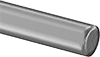
Cut this 12" stock to the length you need.
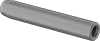
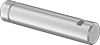
To remove these pins, thread a screw or tool into the tapped hole, then pull them out.
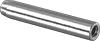
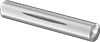
The flat side of these pins relieves trapped air, making them easier to insert in and remove from blind holes. To remove, thread a screw or tool into the tapped hole, then pull the pin out.
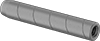
A spiral groove cut into these pins relieves trapped air but stays in 360° contact with the hole for a secure fit that's easy to insert in and remove from blind holes. To remove, thread a screw or tool into the tapped hole, then pull the pin out.
Join two pieces of wood with these dowel pins. When glued, they expand for a tight fit.
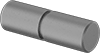
Use these as pivot or hinge pins. The knurled half locks pins in position, while the smooth half acts as a pivot.
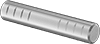
The full length of these pins is knurled for a tight grip that won't spin.
Center-knurled pins are often used in place of clevis pins or to create T-handles. The knurled center locks pins in position, while the smooth ends act as a pivot.
These pins make good hinges or pivots. The grooved half locks pins in position, while the smooth half can act as a pivot. Also known as type H pins.
Grooves run the full length of these pins for a firm hold that won't spin. Use them in place of standard dowel, spring, and taper pins to fasten parts. Also known as type A pins.
Quarter-groove pins are well suited for hinges or pivots. The grooved end locks pins in position, while the smooth portion can act as a pivot. Also known as type C pins.
These pins are commonly used as anchors for tension springs. The grooved half locks pins in position, and spring ends fit in to the notch. Also known as type G pins.
Center-groove pins are often used in place of clevis pins or to create T-handles. The grooved center locks pins in position, while the smooth ends act as a pivot. Also known as type E pins.
For use with Browning shear hubs, these pins are designed to fail at specific loads to protect heavy duty machinery from torque overload.
Use these pins to fasten components made of soft materials such as plastic or aluminum. Opposing barbs bite into each piece, pulling them together for a tight, secure fit.
Choose a material, head type, end type, and size to create a custom pin.
Create a custom headed pin with your choice of material, dimensions, and end type.
Also known as roll, tension, split, and expansion pins, these pins have a slot along one side that you squeeze closed to install them into unthreaded holes.
For tough jobs, these spiral pins are 30% stronger than our standard coiled spring pins. They remain flexible after installation to absorb shock and vibration, and work well in holes that are out of round.
These spiral pins remain flexible after installation, so they absorb shock and vibration better than slotted spring pins. They work well in holes that are out of round.
Position, pivot, and align components. Also known as pilot pins and PEM® TP4, TPS, and MPP pins.
Push parts out of molds with these hardened pins. Also known as knockout and forged pins.
Use these pins with a die to punch 1/8" and larger holes. Pins can be modified to fit your application.
These pins have a flat head to fit into a counterbored hole.
Support and position workpieces and fixtures from the bottom or side. These buttons press into a drilled hole for permanent installation.
Support rounded or irregularly shaped workpieces from the bottom or side with minimal contact.
Line up holes by driving these pins through existing rivet, pin, and bolt holes in multiple pieces of metal. Alternatively known as lineup taper punches.
These brass tools reduce marring on metal surfaces because they're softer than steel punches.