We will reply to your message within two hours.
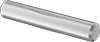
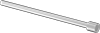
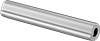
Use these metal dowel pins as pivots, hinges, shafts, jigs, and fixtures to locate or hold parts.
Slip these pins in and out during maintenance or prototyping—they’re undersized to make alignment easier.
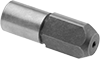
To remove these pins, thread a screw or tool into the tapped hole, then pull them out.
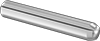
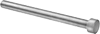
The flat side of these pins relieves trapped air, making them easier to insert in and remove from blind holes. To remove, thread a screw or tool into the tapped hole, then pull the pin out.
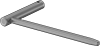
Center-groove pins are often used in place of clevis pins or to create T-handles. The grooved center locks pins in position, while the smooth ends act as a pivot. Also known as type E pins.
These pins make good hinges or pivots. The grooved half locks pins in position, while the smooth half can act as a pivot. Also known as type H pins.
Grooves run the full length of these pins for a firm hold that won't spin. Use them in place of standard dowel, spring, and taper pins to fasten parts. Also known as type A pins.
Join two pieces of wood with these dowel pins. When glued, they expand for a tight fit.
Pass wires and other components through these hollow pins.
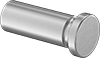
These pins have a flat head to fit into a counterbored hole.
Push parts out of molds with these hardened pins. Also known as knockout and forged pins.
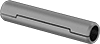
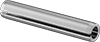
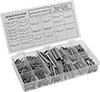
Also known as roll, tension, split, and expansion pins, these pins have a slot along one side that you squeeze closed to install them into unthreaded holes.
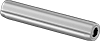
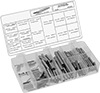
These spiral pins remain flexible after installation, so they absorb shock and vibration better than slotted spring pins. They work well in holes that are out of round.
For tough jobs, these spiral pins are 30% stronger than our standard coiled spring pins. They remain flexible after installation to absorb shock and vibration, and work well in holes that are out of round.
Position, pivot, and align components. Also known as pilot pins and PEM® TP4, TPS, and MPP pins.
To remove these pins, hit the small end with a punch to drive the pin out.
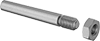
Threads on these pins stick out for easy removal from blind holes. Tighten the hex nut to draw the pin out.
Screw the threaded end of these metric studs into a tapped hole and use the unthreaded end as a pivot point, hinge, shaft, or locator pin.
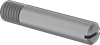
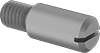
Without a head to get in the way, these screws fit in tight spaces where standard shoulder screws cannot. Either thread them in a countersunk hole for a flush mount, or install them with the shoulder sticking out to use them as pins or dowels for aligning and locating components.
Dowel pins are commonly used as pivots, hinges, shafts, jigs, and fixtures to locate or hold parts. They're slightly oversized for a tight fit.
Slotted spring pins are also known as roll, tension, split, and expansion pins. Because the slot is pressed closed when the pins are inserted, they don't flex after installation.
Coiled spring pins are flexible after installation, so they absorb shock and vibration better than slotted spring pins. They also have higher dynamic load capacities and accommodate wider hole tolerances.
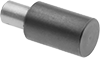
Support and position workpieces and fixtures from the bottom or side. These buttons press into a drilled hole for permanent installation.
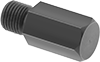
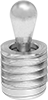
Use these buttons to support and position workpieces and fixtures from the bottom or side. Their hex shape lets you screw them into a threaded hole with a wrench or socket.
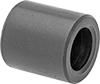
Mount through the counterbored hole with a socket head cap screw to support and position workpieces and fixtures from the bottom or side.
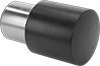
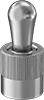
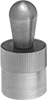
Support rounded or irregularly shaped workpieces from the bottom or side with minimal contact.
Install these pins in a plate or table and mate with holes in a workpiece for precise alignment.
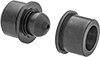
Maintain consistent alignment in mating parts by installing a pin in one part and a liner in the other.
Precisely align drilled holes in two parts.
Threading makes these guide pins easier to remove and replace than press fit, so they're useful for high-wear applications.
As the workpiece pushes against the pin head in one direction, the internal spring pushes back to hold it in place for clamping.
Sealed at the top to prevent debris from getting inside and making them seize up, these guide pins are a good choice for machining fixtures.
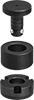
Build these components into fixture plates, machine subplates, and tombstones for quick changes. The system clamps and locates at the same time for accurate positioning with repeatability of ±0.0005".
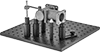
Use these components in coordinate measuring machine (CMM) applications to raise a workpiece and reliably position it on a fixture plate with ¼"-20 holes.