
We will reply to your message in the morning.
More

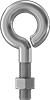
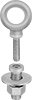
Also known as nut eyebolts, these are designed for through-hole applications.
Use these eyebolts for routing wire and for other light duty applications.
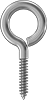
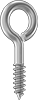
Also known as screw eyes, use the sharp point of these eyebolts to mount directly into wood.
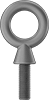
Also known as machinery eyebolts.
Create your own lifting eye by adding an eye nut to a stud or bolt.
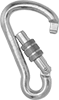
Lock by screwing the latch into the body.
To open, lift and twist the latch 90°.
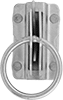
Anchor these ringbolts where you need them, then remove the ring when not in use. Once installed, the mounting bolt stays in place. Insert the ring by threading into the mounting bolt; remove by unthreading it.
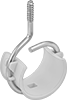
Also known as bridle rings, routing rings have an open-eye design that allows you to quickly install wire and cable.
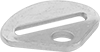
Sew webbing onto these plates for a permanent anchor point or run webbing through to use them as guides.
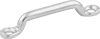
Also known as footman's loops, use these guides to prevent webbing from twisting, or as anchor points in tie-down applications.
Use these plates where full lengths of track won't fit to create one anchor point.
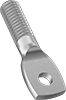
You can use these versatile hangers in a threaded hole (as you would a screw), or secure them with a nut (as you would a bolt).
These hangers have internal threads for use with threaded rods, bolts, and anchors.
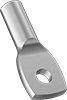
Wedge these hangers in concrete and other solid materials.
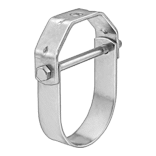
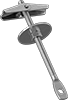
These hangers are a popular choice for overhead applications.
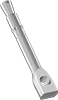
Drive these hangers into wood with an adjustable wrench, pliers, or a special driver bit.
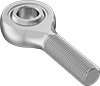
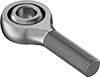
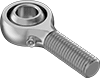
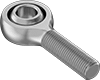
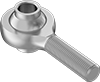
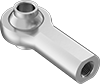
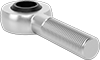
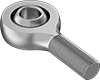
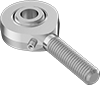
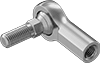
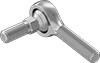
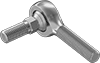
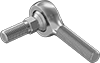
Also known as rod‐end bearings, ball joint rod ends have an eyelet and a ball that swivels to support angular misalignment.
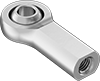
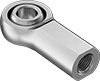
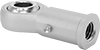
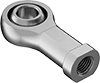
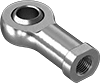
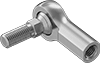
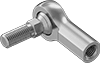
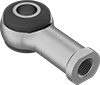
These internally threaded rod ends have an eyelet and a ball that swivels to support angular misalignment. Also known as rod-end bearings.
A carbon fiber-reinforced insert or PTFE liner reduces wear, handles shock loads, and eliminates the need for lubrication.
An oil-embedded bronze insert slowly releases lubricant throughout the life of these internally threaded rod ends.
An oil-embedded bronze insert slowly releases lubricant throughout the life of the rod end.
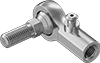
These internally threaded rod ends have an oil-embedded bronze insert that slowly releases lubricant over time. Connect your grease gun to the fitting to relubricate.
An oil-embedded bronze insert slowly releases lubricant to the rod end. Connect your grease gun to the fitting to relubricate.
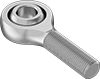
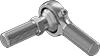
Made to extremely tight tolerances, these externally threaded rod ends are for applications that require positioning accuracy, such as accelerators and other types of control linkages.
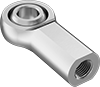
Made to extremely tight tolerances, these internally threaded rod ends are for applications that require positioning accuracy, such as accelerators and other types of control linkages.
With at least 55° of ball swivel, these externally threaded rod ends accommodate greater misalignment than any other we offer.
With at least 55° of ball swivel, these rod ends accommodate greater misalignment than any other internally threaded rod end we offer.
These internally threaded rod ends have an innovative body design that keeps the ball from being pushed out when supporting thrust loads.
An innovative body design keeps the ball from being pushed out when supporting thrust loads.
These externally threaded steel rod ends handle loads that are at least 25% higher than other comparably sized rod ends.
These internally threaded steel rod ends handle loads that are at least 25% higher than other comparably sized rod ends.
A double row of precision ball bearings allows high speeds and smooth operation.
With a ball joint at the top of the shank, these rod ends pivot in the middle of the body instead of in the eyelet. Use them for linear push applications that require movement along the length of the connecting rod.
Without changing the ID, these inserts handle some misalignment on rod ends.
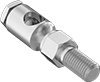
To reduce noise and vibration, these bolts have a rubber bushing—connect them to rods, pipes, tubes, and cable linkages that have female threading. They’re also known as isolated rod ends.
With a rubber bushing, these bolts reduce noise and vibration—attach them to rods, pipes, tubes, and cable linkages that have male threading. They’re commonly known as isolated rod ends.
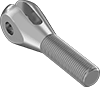
Made of zinc-plated steel or stainless steel, these clevis rod ends offer more corrosion resistance than standard steel clevis rod ends.
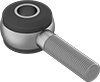
A male-threaded shank lets you build a linkage with a tapped tube or any female-threaded connection.
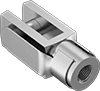
Make quick adjustments to these rod ends by inserting and releasing the clevis pins without the need to bend them into place.
These linkages offer excellent wear resistance. They consist of internally threaded ball joint rod ends with a ball stud attached to simplify mounting.
Able to stand up to frequent use, these linkages offer excellent wear resistance. They consist of ball joint rod ends with a ball stud attached to simplify mounting.
Along with excellent wear resistance, these linkages have a grease fitting for easy lubrication. An internally threaded rod end connects to threaded rods, studs, and other parts with male threads.
Along with excellent wear resistance, these linkages have a grease fitting for easy lubrication.
An oil-embedded bronze insert slowly releases lubricant throughout the life of the joint.
These internally threaded linkages have an oil-embedded bronze insert that slowly releases lubricant throughout the life of the joint.
A slippery PTFE liner reduces wear and eliminates the need for lubrication.
These internally threaded linkages have a slippery PTFE liner that reduces wear and eliminates the need for lubrication.
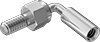
Use these bent linkages for light duty applications.
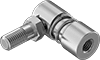
These ball joint linkages are made of steel.
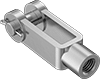
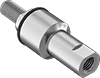
Use these linkages to create inline pivoting connections. They have internal threads on one end and external threads on the other.
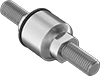
Use these externally threaded linkages to create inline pivoting connections.
With threads on one end, screw eyes can be easily screwed into wood. They are often used with wire to hang pictures.