
We will reply to your message within two hours.
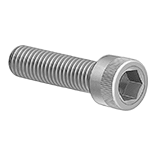
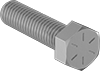
Made from Grade 8 steel, these screws can be used in high-stress applications, such as valves, pumps, motors, and automotive suspension systems. They are at least 25% stronger than medium-strength steel screws.
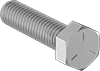
Twice as strong as low-strength steel screws, these screws are suitable for fastening most machinery and equipment.
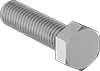
Use these general purpose 18-8 stainless steel screws for a variety of fastening applications. They have good chemical resistance.
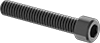
The standard for high-strength fastening.
Made from alloy steel, these inch size set screws have a thin edge that digs into hard surfaces for a secure hold.
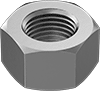
These nuts are suitable for fastening most machinery and equipment.
These nuts tighten when turned to the left; once fastened, they resist loosening from counterclockwise motion.
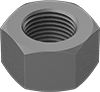
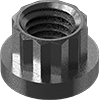
These nuts are about 25% stronger than medium-strength steel nuts.
Choose these nuts for their adherence to strict military standards for material and construction.
Tighten these nuts by turning them to the left; once fastened, they resist loosening from counterclockwise motion.
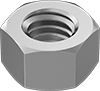
About half the strength of medium-strength steel nuts, these nuts are for light duty fastening applications.
One-third the weight of steel, these aluminum nuts are corrosion resistant in wet environments and nonmagnetic.
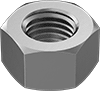
These nuts have good chemical resistance and may be mildly magnetic.
These nuts have excellent chemical resistance and can be used in saltwater environments.
With threads that tighten to the left and made of 316 stainless steel, these nuts won’t loosen from counterclockwise motion in saltwater and corrosive environments. They’re half the height of standard hex nuts, so they fit where there’s low clearance.
Made from Grade 5 steel, these inch-sized nuts are suitable for most fastening applications.
These nuts tighten when turned to the left; once fastened, they resist loosening from counterclockwise motion. They’re Grade 5 steel, so you can used these inch-sized nuts for most fastening applications.
These nuts are about 25% stronger than medium-strength steel thin hex nuts. Available in inch thread sizes.
These nuts should be used for light duty fastening applications, such as securing access panels.
These nuts are corrosion resistant in wet environments, electrically conductive, and nonmagnetic.
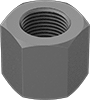
Taller than standard hex nuts, these nuts provide a larger gripping area for installation with a wrench.
These coupling nuts have good chemical resistance.
About half the strength of medium-strength steel coupling nuts, these nuts are for light duty fastening applications.
Brass coupling nuts are corrosion resistant in wet environments and electrically conductive.
Stainless steel coupling nuts have excellent corrosion resistance in most environments.
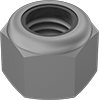
Includes inch thread sizes. These Grade 8 steel locknuts are 25% stronger than our medium-strength steel nylon-insert locknuts.
Made from Grade 5 steel, these inch-sized locknuts are suitable for fastening most machinery and equipment.
Made from low-strength steel, these locknuts should be used for light duty fastening applications, such as securing.access panels.
More corrosion resistant than 18-8 stainless steel locknuts, these locknuts have excellent resistance to chemicals and salt water.
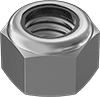
These locknuts have good chemical resistance.
These locknuts have good chemical resistance and may be mildly magnetic.
These locknuts are about half the height of standard nylon-insert locknuts. Use them in light duty low clearance applications or jam one against a hex nut to hold it in place.
Comparable in strength to Grade 8 bolts, these locknuts are about 25% stronger than medium-strength steel locknuts.
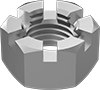
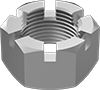
Also known as castle nuts, secure these nuts by inserting a cotter pin or safety wire through the slots and a drilled hole in your bolt for mild loosening resistance.
About half the strength of medium-strength steel locknuts, these are for light duty fastening applications, such as securing access panels.
Choose these locknuts for their adherence to strict military standards for material and construction.
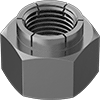
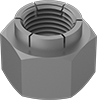
Threads at the top of these locknuts expand to grip the bolt on all sides for a stronger hold than distorted thread locknuts.
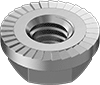
Stainless steel nuts have excellent corrosion resistance in most environments.
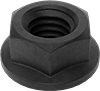
These flange nuts have a black-oxide finish for mild corrosion resistance in dry environments.
Made from Grade 8 steel, these nuts are about 25% stronger than medium-strength steel flange nuts.
About half the strength of medium-strength steel flange locknuts, these are for light duty fastening applications, such as securing access panels.
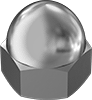
These cap nuts have good chemical resistance and may be mildly magnetic.
These cap nuts have excellent resistance to chemicals and salt water.
These Grade B7 threaded rods meet the pressure and temperature requirements of ASTM A193 and are often used to secure pressure tanks, valves, and flanges.
About half the strength of medium-strength steel threaded rods, use these for light duty hanging, mounting, and fastening.
18-8 stainless steel threaded rods have good chemical resistance.
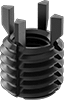
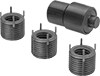
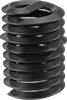
The strongest key-locking inserts we offer, these inserts are made to stringent military specifications.
A black-phosphate finish provides mild corrosion resistance.
These inserts are made to stringent military specifications.
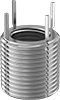
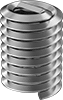
Made of 18-8 stainless steel, these inserts have good corrosion resistance.
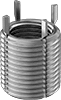
These inserts come with an installation tool. Drive the keys into the surrounding material for a more secure hold than thread-locking inserts.
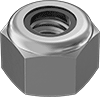
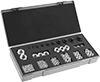
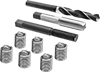
Inserts come with a through-hole tap and installation tool.
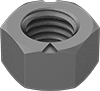
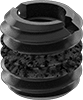
A distorted thread grips the screw to resist loosening.
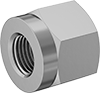
These nuts attach to high-pressure nipples for compressed gas so you can connect your tank to the inlet of a pressure regulator.
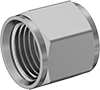
Also known as CGA nuts, these are designed for low-pressure welding applications downstream of your pressure regulator. Attach them to barbed hose fittings for compressed gas to make a threaded connection to torches or pressure regulators.
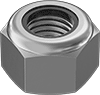
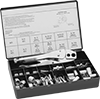
Sets contain a crimping tool and a variety of CGA fittings, nuts, and ferrules so you can connect pressure regulators, torches, and other components of your welding system.
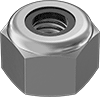
Use these nuts with a sleeve and fitting to provide a tight metal-to-metal seal on steel tubing that is flared to 37°.
Use these lug nuts to secure a pneumatic wheel.
Also known as machinery eyebolts.
Combine with mounting blocks to mount and secure threaded-body shock absorbers.