We will reply to your message within two hours.
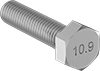
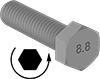
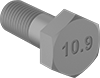
Choose these metric screws for high-strength fastening. Often used in high-stress applications, such as valves, pumps, motors, and automotive suspension systems, these screws are at least 25% stronger than medium-strength steel screws.
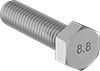
Choose these metric screws for fastening most machinery and equipment. They are twice as strong as low-strength steel screws.
These metric screws help prevent counterclockwise-moving parts from loosening. Use them for medium-strength fastening.
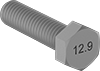
Choose these metric screws for heavy duty stamping applications as well as earth-moving machinery such as bulldozers and excavators. These screws are 10% stronger than our high-strength metric steel screws.
Use these general purpose 18-8 stainless steel screws for a variety of fastening applications. They have good chemical resistance.
More corrosion resistant than 18-8 stainless steel screws, these 316 stainless steel screws have excellent resistance to chemicals and salt water.
Designed for construction and exterior building applications, these metric screws are often used to join I-beams and scaffolding. Their partial threading leaves an unthreaded portion that is strong enough to stand up to the sideways forces of joints.
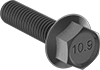
These metric screws are at least 25% stronger than medium-strength steel screws. Use them in high-stress applications, such as valves, pumps, motors, and automotive suspension systems. The flange distributes pressure where the screw meets the surface, so there's no need for a washer.
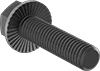
Choose these metric screws for high-stress applications, such as valves, pumps, motors, and automotive suspension systems. They are about 10% stronger than medium-strength steel screws. Their serrated flange helps to resist vibration.
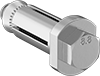
A high-strength alternative to blind rivets, use these screws when only one side of the material is accessible.
The standard for high-strength fastening.
Made of alloy steel, these low-profile screws are nearly twice as strong as their stainless steel counterparts. With half the height of a standard socket head, these low-profile screws fit in tight spaces.
These alloy steel set screws have a thin edge that digs into hard surfaces for a secure hold. They're available in metric sizes.
These metric set screws have good chemical resistance.
These metric set screws have a tip that makes good contact on flat surfaces and allows you to make frequent adjustments with minimal surface damage.
These metric 18-8 stainless steel set screws are chemical resistant. The tip makes good contact on flat surfaces and allows you to make frequent adjustments with minimal surface damage.
These metric set screws have a protruding tip that locks within a mating hole or slot to keep parts aligned. They're also known as dog-point set screws.
Turn these metric screws by hand using the hex head, or tighten them with a wrench for extra torque. With an extended tip that locks into a mating hole or slot—sometimes known as a dog point—they are often used to align and secure parts such as gears and pulley wheels.
These metric screws have a square head, so you can turn them by hand or use a wrench for more torque. Also known as half dog-point set screws, they have a protruding tip that locks within a mating hole or slot to keep parts aligned.
These metric set screws have a rolling ball that swivels 360° to minimize surface damage and allow for slight adjustments without loosening the screw.
Made from alloy steel, these metric set screws have a pointed tip that wedges into the contact surface for a secure hold on soft materials such as brass.
These metric 18-8 stainless steel screws have good chemical resistance and may be mildly magnetic.
More corrosion resistant than 18-8 stainless steel screws, these metric screws have excellent resistance to chemicals and salt water. They may be mildly magnetic.
Comparable to Class 12.9 steel.
For metric thread sizes with excellent resistance to chemicals and salt water, choose these 316 stainless steel shoulder screws.
With inch-sized threads the same diameter as the shoulder, these screws can handle heavy loads. They’re 18-8 stainless steel for good chemical resistance.
These screws have metric thread sizes. They are 18-8 stainless steel for good chemical resistance.
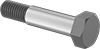
Also known as wheel and axle bolts, these metric screws have an unthreaded shoulder that acts as a shaft, so material attached to the threaded end can rotate.
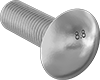
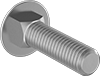
Choose these metric bolts for fastening most machinery and equipment. They are twice as strong as low-strength steel bolts. Carriage bolts have a smooth, rounded head for a finished look. The square neck keeps these bolts from turning when tightening a nut.
These bolts have good chemical resistance. Carriage bolts have a smooth, rounded head for a finished look. The square neck keeps these bolts from turning when tightening a nut.
These metric alloy steel screws are nearly twice as strong as stainless steel button head screws.
Drive the pointed tip of these screws into soft material, such as wood and drywall. They are also known as lag bolts.
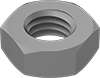
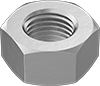
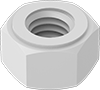
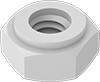
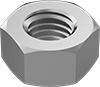
These nuts should be used for light duty fastening applications, such as securing access panels.
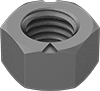
These nuts tighten when turned to the left; once fastened, they resist loosening from counterclockwise motion. Made of Grade 2 and Class 04 steel, these nuts can be used for fastening panels and other light duty fastening applications.
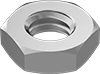
These nuts are half the height of standard hex nuts, and have closely spaced threads to prevent loosening from vibration. Half as strong as medium-strength steel nuts, they are often used for light-duty applications, such as fastening signs in place.
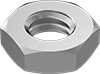
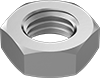
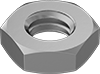
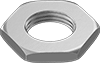
Half as thick as regular hex nuts, these nuts fit into spaces with low height clearances. They are about half as strong as medium-strength steel, and are often used for light duty applications, such as securing access panels.
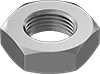
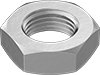
Made with fine-pitch threads, vibration is less likely to loosen these metric nuts than those with coarse-pitch threads since the threads sit closer together. Also called jam nuts, they are roughly half the height of standard hex nuts, so they’re good for applications with low clearance.
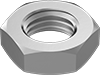
Useful in low-clearance applications, these metric nuts are roughly half the height of standard hex nuts, but aren’t as strong. All are 18-8 stainless steel, which is nearly as strong as steel but won’t rust in outdoor, washdown, and other corrosive environments.
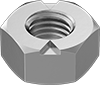
These nuts tighten when turned to the left; once fastened, they resist loosening from counterclockwise motion.
These metric nuts are made of 316 stainless steel and half as tall as regular hex nuts—use them around chemicals and salt water when space is limited.
With threads that tighten to the left and made of 316 stainless steel, these nuts won’t loosen from counterclockwise motion in saltwater and corrosive environments. They’re half the height of standard hex nuts, so they fit where there’s low clearance.
Made from brass, these metric nuts are corrosion resistant in wet environments, electrically conductive, and nonmagnetic. About half the height of standard hex nuts, they are useful in low-clearance applications but have less tensile strength.
These nuts tighten to the left and won’t loosen from counterclockwise motion.
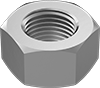
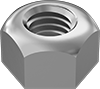
Class 8 nuts are comparable in strength to Class 8.8 bolts and are suitable for fastening most machinery and equipment.
These metric nuts tighten when turned to the left; once fastened, they resist loosening from counterclockwise motion.
Closely spaced metric threads prevent these nuts from loosening due to vibration. About 25% stronger than medium-strength steel nuts, these nuts are comparable in strength to Class 10.9 bolts.
About 25% stronger than medium-strength steel nuts, these nuts are comparable in strength to class 10.9 bolts.
These metric nuts are about 20% stronger than high strength steel nuts and are often used in heavy machinery.
About half the strength of medium-strength steel nuts, these metric nuts are for light duty fastening applications.
These nuts have good chemical resistance and may be mildly magnetic. Metric 18-8 stainless steel is also known as A2 stainless steel.
These metric nuts meet JIS (Japanese industrial Standard) B 1181.
Tighten these nuts by turning them to the left; once fastened, they resist loosening from counterclockwise motion.
These metric nuts have good chemical resistance and may be mildly magnetic.
Comparable in strength to Grade 5 steel and as resistant to chemicals and salt water as 316 stainless steel.
These metric nuts are corrosion resistant in wet environments, electrically conductive, and nonmagnetic.
These brass nuts resist rusting from water and have closely spaced threads to prevent loosening from vibration.
These metric nuts resist oil, grease, and solvents (except mineral acids).
Stronger than PTFE nuts and resistant to solvents, bases, and acids—including hydrochloric and nitric acid—these PVDF nuts are often used in chemical processing equipment.
One-third the weight of steel, these metric aluminum nuts are corrosion resistant in wet environments and nonmagnetic.
Comparable in strength to Class 12.9 bolts.
These Class 10 nuts are about 25% stronger than medium-strength steel extra-wide hex nuts.
Taller than standard hex nuts, these metric nuts provide a larger gripping area for installation with a wrench.
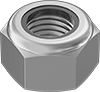
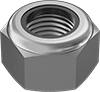
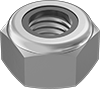
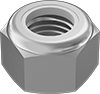
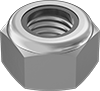
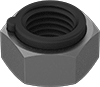
A nylon insert keeps metric bolt threads from coming loose due to vibration, wear, and temperature swings. About 25% stronger than medium-strength steel locknuts, these nuts are made of high-strength, Class 10 steel.
Closely spaced metric threads prevent loosening from vibration. These Class 10 steel locknuts are 25% stronger than our medium-strength steel nylon-insert locknuts.
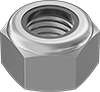
Get a grip on metric bolts exposed to vibration, wear, and changes in temperature. These metric locknuts have a nylon insert that holds onto bolts without damaging their threads.
Made from medium-strength steel with a nylon insert, these Class 8 metric locknuts are strong enough to use on most machinery and equipment that’s prone to vibration and temperature changes.
Made from low-strength steel, these locknuts should be used for light duty fastening applications, such as securing.access panels.
These metric locknuts have good chemical resistance.
More corrosion resistant than 18-8 stainless steel locknuts, these metric locknuts have excellent resistance to chemicals and salt water.
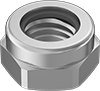
With a shorter hex height than standard DIN 985 locknuts, these nylon-insert locknuts meet international ISO 10511 dimensional standards and are easy to install in tight spaces.
These metric locknuts have an irregularly shaped thread at the top of the nut that grips the bolt for a stronger hold than nylon-insert locknuts.
Comparable in strength to Grade 8 bolts, these locknuts are about 25% stronger than medium-strength steel locknuts.
These locknuts have good chemical resistance.
Strong enough for use with most machinery and equipment, these Class 8 metric locknuts have an irregularly shaped thread in the middle of the nut that grips bolts tighter than nylon-insert locknuts.
Secure these metric nuts by inserting a cotter pin or safety wire through the slots and a drilled hole in your bolt for mild loosening resistance. Often referred to as castle nuts.
Made from stainless steel, these metric flex-top locknuts resist chemicals and may be mildly magnetic.
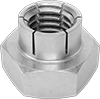
The metric steel insert grips the threads and lifts away from the nut body when installed, isolating the insert from the nut's load to resist spinoff caused by vibration.
These steel panel nuts are zinc plated for corrosion resistance.
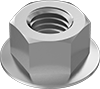
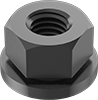
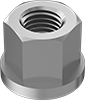
Also known as collar nuts, these metric nuts have a flange that distributes pressure across the surface, so you don't need a washer. Made of high-strength Class 10 steel, they’re about 25% stronger than medium-strength steel flange nuts.
No need for a washer—these metric medium-strength steel nuts have a flange that distributes pressure across its surface the way a washer does. Made of medium-strength, Class 8 steel, they’re suitable for fastening most machinery and equipment.
About half the strength of medium-strength steel flange nuts, use these metric nuts in light duty fastening applications, such as securing access panels.
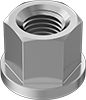
Skip the washer—these metric stainless steel nuts have a flange that does the same job, spreading pressure across its surface for a strong hold.
More corrosion resistant than 18-8 stainless steel flange nuts, these nuts have excellent resistance to chemicals and salt water.
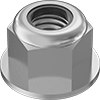
Grip metric bolts more securely than nylon-insert flange locknuts—the irregularly shaped threads on these locknuts hold extra tight. They resist vibration and sudden shocks, even after multiple uses.
They're about 25% stronger than medium-strength steel flange locknuts and comparable in strength to Class 10.9 bolts.
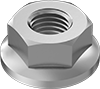
Strong enough for use in most machinery and equipment, these medium-strength metric nuts have serrations on the underside of the flange. The serrations prevent the nuts from loosening in applications with mild vibration.
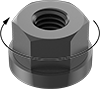
The nut head rotates while the flange remains stationary to prevent scratching the material surface as you tighten the nut.
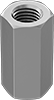
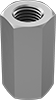
These metric coupling nuts have good chemical resistance.
More corrosion resistant than 18-8 stainless steel coupling nuts, these metric nuts have excellent resistance to chemicals and salt water.
Brass coupling nuts are corrosion resistant in wet environments and electrically conductive.
Choose these locknuts to fasten standard metric threads. They’re Class 8 steel, so they can be used in most fastening applications.
For light duty applications, choose these metric-sized coupling nuts.
These metric-sized coupling nuts are Class 10 steel, so they’re about 25% stronger than medium-strength steel coupling nuts.
Stainless steel coupling nuts have excellent corrosion resistance in most environments.
A smooth rounded body provides a finished look.
Made from 18-8 stainless steel, these metric nuts have good chemical resistance and may be mildly magnetic.
Made from 316 stainless steel, these metric wing nuts have excellent chemical resistance and can be used in saltwater environments.
These metric wing nuts provide more leverage for greater torque while tightening than knurled-head thumb nuts.
Made from 18-8 stainless steel, these metric thumb nuts have good chemical resistance and may be mildly magnetic.
Attach these metric slip-on nuts at any point on a threaded rod for quick installation.
These metric cap nuts have good chemical resistance and may be mildly magnetic.
These metric cap nuts have excellent resistance to chemicals and salt water.
Certified by EHEDG (European Hygienic Engineering and Design Group) to meet sanitary design standards, these cap nuts fit into tight spaces to cover and seal exposed threads in your food processing facility.
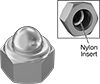
A nylon insert on these metric nuts prevents vibration from loosening them, and a domed head protects the threads at the end of the bolt from damage and debris.
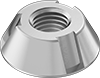
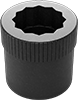
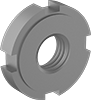
Tri-groove nuts are narrower than sloped and drilled spanner nuts to fit in tight spaces. Install with a tri-groove socket bit and either a drive handle or an open-end wrench.
Stronger than stainless steel, these nuts are comparable in strength to Grade 9 bolts.
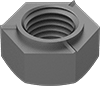
Weld these metric nuts to flat and uneven uncoated steel surfaces for a strong permanent hold.
You can weld these metric nuts to flat and uneven uncoated stainless steel surfaces for a strong permanent hold.
Made from 18-8 stainless steel, these metric square nuts have good chemical resistance and may be mildly magnetic.
About half the strength of medium-strength steel square nuts, use these metric nuts in light duty fastening applications, such as securing access panels.
Press these metric nuts into a drilled or punched hole with an arbor press or similar pressure tool.
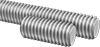
These metric Grade B7 fine-threaded rods meet the pressure and temperature requirements of ASTM A193 and are often used to secure pressure tanks, valves, and flanges.
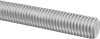
These metric Grade B7 threaded rods meet the pressure and temperature requirements of ASTM A193 and are often used to secure pressure tanks, valves, and flanges.
An economical alternative to Grade B7 and Grade B16 threaded rods, these metric Class 8.8 rods are suitable for fastening most machinery and equipment.
About half the strength of medium-strength steel threaded rods, use these metric fine-thread rods for light duty hanging, mounting, and fastening.
These metric threaded rods are about half the strength of medium-strength steel threaded rods for light duty hanging, mounting, and fastening.
These metric threaded rods tighten when turned to the left; once fastened, they resist loosening from counterclockwise motion. About half the strength of medium-strength steel threaded rods, use them for light duty hanging, mounting, and fastening.
These Class 10.9 steel threaded rods are about 25% stronger than medium-strength steel rods.
Class 12.9 rods are about 20% stronger than Class 10.9 threaded rods and are for use in heavy machinery.
These metric threaded rods are made from nylon 6/6 and resist oil, grease, and solvents. They’re nonconductive, making them good for use around sensitive electrical components.
Fiberglass threaded rods are stronger than nylon threaded rods. They resist acids, solvents, salt water, and oil.
Available in metric sizes, these 18-8 stainless steel threaded rods have good chemical resistance.
These metric 316 stainless steel threaded rods are more corrosion resistant than 18-8 and 410 stainless steel threaded rods and have excellent resistance to chemicals and salt water.
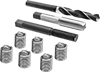
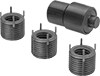
Inserts come with a through-hole tap and installation tool.
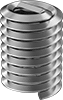
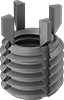
A distorted thread grips the screw to resist loosening.
Made of 18-8 stainless steel, these inserts have good corrosion resistance.
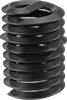
A black-phosphate finish provides mild corrosion resistance.
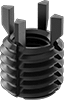
The strongest key-locking inserts we offer, these inserts are made to stringent military specifications.
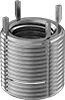
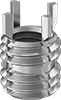
These inserts come with an installation tool. Drive the keys into the surrounding material for a more secure hold than thread-locking inserts.
Forming the strongest hold of any of our threaded inserts, these inserts have a distorted internal thread to lock screws into place and keys that drive into surrounding material to prevent slipping and rotating.
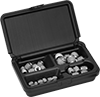
These assortments include various sizes of thread-locking inserts.
Made of 18-8 stainless steel, these inserts have better corrosion resistance than black-phosphate steel.
Mount components onto food processing lines, walls, and sanitary equipment while leaving space to clean in between.
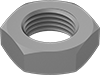
Adapt threaded rods from inch to metric. These adapters connect two male-threaded fasteners, so you can change the gender of a mating part or increase or decrease its thread size. The hex-shaped body fits into the head of a standard wrench.
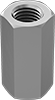
Increase or decrease metric thread size from one male-threaded part to another. Commonly used to connect two differently sized threaded rods, they have a hex-shaped body, so you can tighten them with a standard wrench.
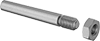
Threads on these pins stick out for easy removal from blind holes. Tighten the hex nut to draw the pin out.
With a nylon insert that grips your threaded shaft or spindle without damaging its threads, these locknuts—also called shaft nuts—hold bearings, bushings, gears, and pulleys prone to vibration tightly in place.
Used in pairs or with another bearing retaining nut, these jam nuts—often called shaft nuts—hold bearings, bushings, pulleys, and gears in place on your threaded shaft or spindle.
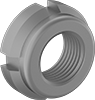
Often paired with spring lock washers to strengthen their hold, these retaining nuts—also known as shaft nuts—keep vibration from shifting bearings, bushings, pulleys, and gears on your threaded shaft or spindle.
Also known as trapezoidal-thread lead screws and nuts.
Multiple thread channels (also known as thread starts) create faster linear travel than lead screws with a single thread start.
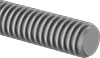
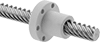
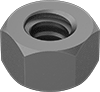
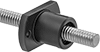
These metric lead screws and nuts have broad, square threads that are well suited for quick assembly, high clamping forces, and lifting and lowering heavy objects. They're commonly found in hand-powered clamps, vises, grates, doors, and work tables.
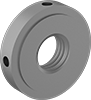
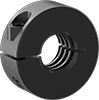
Install these threaded collars on a metric lead screw to separate and position components, or use them as an end stop to limit travel.
Internal ball bearings provide smooth low-friction travel in applications that require high speeds, accurate positioning, and repeatable movement. Also known as single-start metric ball screws and nuts, these have a single thread that runs the length of the screw.
Designed for use with right-hand, externally threaded rod ends, these rods have right-hand threads on both ends. Use them for remote valve operators, throttle controllers, shifting mechanisms, and virtually any push/pull assembly.
Designed for use with right-hand, internally threaded rod ends, these rods have right-hand threads on both ends. Use them for remote valve operators, throttle controllers, shifting mechanisms, and virtually any push/pull assembly.
Similar to turnbuckles, these rods have right-hand threads on one end and left-hand threads on the other so you can make a linkage that adjusts for tension.
Similar to turnbuckles, these rods have right-hand threads on one end and left-hand threads on the other so you can make a linkage that adjusts for tension. Add right- and left-hand threaded rod ends to build your linkages.
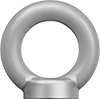
Also known as nut eyebolts, these are designed for through-hole applications.
Also known as machinery eyebolts.
Route wire and cable through the smooth eye without snagging.
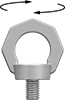
Unlike conventional eyebolts, you can rotate the eye 360° to match the angle of your load.
Create your own lifting eye by adding an eye nut to a stud or bolt.
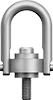
Designed for angular lifting, hoist rings resist stresses that would bend or break an eyebolt. They have a lifting ring that pivots 180° front to back to compensate for roll and sway when lifting heavy or unbalanced loads.
Choose these hoist rings when you need to lift your load from the side.
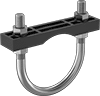
Also known as muffler clamps, these U-bolts have a rounded mounting plate that fully surrounds pipe, conduit, and tubing for a secure fit.
Secure setup clamps and fixtures to your machine table, or assemble heavy machines, such as engine mounts.
Designed to slide into T-slot tracks on machine tool tables, use these nuts to secure clamps and workpieces.
After sliding the nut into a T-slot, tighten the set screw to keep it in place.
Install from the top of the T-slot track and secure with a quarter turn. Also known as quarter-turn T-slot nuts.
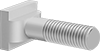
For quicker setups than a separate T-slot nut and stud, slide these bolts into T-slot tracks on machine tool tables.
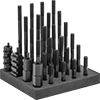
For mounting items to your machine table, these kits contain the full system of necessary components.
Hold a workpiece securely from the side with minimal contact, leaving more of the workpiece free for machining.
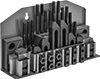
Get everything needed for basic workholding on a machine table.
Use these handles for quick assembly and disassembly. Their offset grip provides leverage, making them a good alternative to wing nuts.
Also known as double cams, these complete cam handles have a durable, extra-large handle for clamping on fixture bases, plates, and workpieces. For fast adjustments, push down on the handle and the head applies pressure to quickly draw two parts together.
Rated for high load capacity, use these metric inserts to connect threaded leveling mounts to heavy equipment.
Secure threaded metal conduit fittings to a knockout in an outlet box or enclosure.
Secure threaded plastic conduit fittings to a knockout in an outlet box or enclosure.
Secure jaws to a CNC lathe chuck with industry standard 1.5 mm × 60° serrations or wider 3 mm × 60° serrations.