We will reply to your message in the morning.
More
Rigid and hard with a slippery surface, these PTFE O-rings resist harsh chemicals, such as acetone, fluorinated solvents, methanol, and boric acid.
These temperature- and chemical-resistant O-rings prevent leaks in tube fittings that have a straight-thread connection, also known as O-ring boss fittings.
The FEP casing on these O-rings provides the same level of resistance to harsh chemicals as PTFE O-rings, but the core material is soft to make these O-rings more compressible.
Unlike silicone, the Viton® fluoroelastomer core will continue to ward of chemicals should the FEP casing wear away.
These durable O-rings bounce back to shape after repeated compression better than other types of Viton® fluoroelastomer O-rings.
These are the highest purity chemical-resistant O-rings we offer. They are made and bagged in an ISO Class 7 and Fed. Spec. Class 10,000 clean room, plus they’re USP VI certified; not for use in medical applications.
Made and bagged in an ISO Class 7 and Fed. Spec. Class 10,000 clean room.
In addition to resisting chemicals, such as benzene, butyl alcohol, and ethylene glycol, these Viton® fluoroelastomer ETP O-rings resist steam.
Inherently softer and more compressible than PTFE O-rings, these Kalrez 4079 O-rings have comparable chemical resistance.
Kalrez 6375 O-rings are preferred over Kalrez 4079 for chemical-processing environments and applications involving steam.
Also known as Boss O-rings, these Kalrez 4079 O-rings are for use in tube fittings with a straight-thread connection. They’re inherently softer and more compressible than PTFE O-rings with comparable chemical resistance.
Flexible even at temperatures as low as -80° F, these fluorosilicone O-rings will keep your fittings free from leaks. They’re often used on fuel and coolant hose because fluorosilicone resists many chemicals, including ethanol and ethylene glycol.
These fluorosilicone O-rings remain flexible at temperatures as low as -80° F. They resist ethanol, ethylene glycol, and isopropyl alcohol.
While these Aflas O-rings are commonly used with petroleum fluids, they also resist many chemicals, such as ammonia, calcium hydroxide, and acetic, boric, and phosphoric acids.
If these O-rings deteriorate, they can be picked up by metal detection systems.
These O-rings also resist ethanol and ethylene glycol.
Also known as Boss O-rings, these O-rings are for use in tube fittings with a straight-thread connection.
Made and bagged in an ISO Class 7 (Fed. Std. Class 10,000) clean room, these are the highest purity high-temperature O-rings we offer.
These O-rings are heat-treated, cleaned, and double-bagged in an ISO Class 5 (Fed. Std. Class 100) clean room for use in high-vacuum systems.
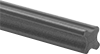
This square-profile cord stock has flat edges on all four sides, which creates a better seal than round profile in static applications, such as hose, pipe, and faucet connections.
The X shape of this cord stock provides four points of contact for a better seal in dynamic applications than round profile. It also requires less compression to make a seal, so it offers a longer service life.
Use neoprene cord stock to make O-rings for applications that come into contact with water.
In addition to water and steam, this EPDM cord stock resists diluted salt solutions, ethanol, and isopropyl alcohol.
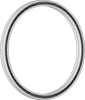
These PTFE backup rings resist harsh chemicals, such as acetone, fluorinated solvents, methanol, and many acids.
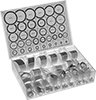
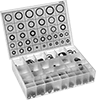
These 325-piece assortments mean you’ll always have a backup ring on hand.
These assortments include a mix of EPDM O-rings that resist water and steam and silicone O-rings that resist temperatures up to 450° F.
In addition to water and steam, these EPDM O-Rings resist ethanol and ethylene glycol.
Rigid and hard with a slippery surface, these O-rings resist harsh chemicals, such as acetone, fluorinated solvents, methanol, and boric nitric, and sulfonic acids.
Able to withstand heat up to 450° F, these O-rings maintain a strong seal even when the temperature rises.
A square O-ring prevents these piston seals from rocking in the groove.
PTFE gives these seals a slippery surface that allows rod speeds more than two times faster than our other piston seals.
Rated for pressure up to 10,000 psi, these seals withstand the highest pressure of our piston seals.
In addition to providing excellent sealing performance at low pressure, these seals withstand a wider range of temperatures and chemicals than U-cup seals. They’re also known as spring-energized seals.
Made from MDS-filled PTFE for a slippery surface, these wipers allow rods to move three times faster than other rod wipers.
Made from PTFE, these wear rings have a slippery surface that allows rods to move at least three times faster than nylon wear rings.
PTFE has excellent chemical resistance and withstands a wide temperature range of -110° F to 500° F.