

Container Type Container Type |
|---|
 |  |  |
| Cartridge | Nozzle- Top Can | Strip |
For Use On For Use On | Show |
|---|
|
For Use On For Use On | Hide |
|---|
For Joining For Joining |
|---|


System of Measurement System of Measurement |
|---|
|

Width Width |
|---|
|
Length Length |
|---|
|
For Use Outdoors For Use Outdoors |
|---|
|
Type Type |
|---|
|
Maximum Temperature Maximum Temperature |
|---|
|
Formulation Formulation |
|---|
|
Specifications Met Specifications Met |
|---|
|
Environment Environment |
|---|
Manufacturer Manufacturer |
|---|
|
Application Application |
|---|
|
Hardness Hardness |
|---|
|
RoHS (Restriction of Hazardous Substances) RoHS (Restriction ofHazardous Substances) |
|---|
|
REACH (Registration, Evaluation, Authorization and Restriction of Chemicals) REACH (Registration,Evaluation, Authorization and Restriction of Chemicals) |
|---|
|
About Sealant Flexibility
More
Mildew-Resistant Silicone Sealants

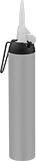
Resistant to mold and mildew, these sealants are well suited to high-humidity environments. They’re non-sagging, so they won't drip from vertical and overhead surfaces. Made from silicone, sealants are RTV (room-temperature vulcanizing).
Elongation and joint compression/expansion tolerance indicate flexibility—the higher the values are, the more joint movement sealants can sustain. Sealants that are good for joining dissimilar materials also work well in environments with wide temperature fluctuation.
Sealants that cannot be sold to Canada are restricted by product labeling requirements.
Container | |||||||||||||||
|---|---|---|---|---|---|---|---|---|---|---|---|---|---|---|---|
| Size, fl. oz. | Net Weight, oz. | Type | Begins to Harden | Reaches Full Strength | Elongation | Joint Compression/ Expansion Tolerance | Hardness | Temp. Range, °F | For Joining | Specifications Met | Color | Clarity | Cannot Be Sold To | Each | |
Silicone | |||||||||||||||
| __ | 6.5 | Nozzle-Top Can | 10 min. | 24 hrs. | 400% | -25% to 25% | Soft (Durometer 25A) | -70° to 400° | Metal Metal to Plastic Metal to Rubber Metal to Glass Plastic Plastic to Rubber Plastic to Glass Rubber Rubber to Glass Glass Masonry Wood | ASTM C920 Type S Grade NS Class 25, FDA Compliant 21 CFR 177.2600, Fed. Spec. TT-S-001543A, Fed. Spec. TT-S-00230C, MIL-A-46106 Type I, NSF/ANSI 51 | White | Opaque | Canada | 00000000 | 000000 |
| 10.1 | __ | Cartridge | 10 min. | 24 hrs. | 400% | -25% to 25% | Soft (Durometer 25A) | -70° to 400° | Metal Metal to Plastic Metal to Rubber Metal to Glass Plastic Plastic to Rubber Plastic to Glass Rubber Rubber to Glass Glass Masonry Wood | ASTM C920 Type S Grade NS Class 25, FDA Compliant 21 CFR 177.2600, Fed. Spec. TT-S-001543A, Fed. Spec. TT-S-00230C, MIL-A-46106 Type I, NSF/ANSI 51 | Clear | Clear | __ | 00000000 | 00000 |
| 10.1 | __ | Cartridge | 10 min. | 24 hrs. | 400% | -25% to 25% | Soft (Durometer 25A) | -70° to 400° | Metal Metal to Plastic Metal to Rubber Metal to Glass Plastic Plastic to Rubber Plastic to Glass Rubber Rubber to Glass Glass Masonry Wood | ASTM C920 Type S Grade NS Class 25, FDA Compliant 21 CFR 177.2600, Fed. Spec. TT-S-001543A, Fed. Spec. TT-S-00230C, MIL-A-46106 Type I, NSF/ANSI 51 | White | Opaque | __ | 00000000 | 00000 |
| 10.1 | __ | Cartridge | 20 min. | 24 hrs. | 550% | -25% to 25% | Soft (Durometer 25A) | -40° to 400° | Metal Metal to Plastic Metal to Rubber Metal to Glass Plastic Plastic to Rubber Plastic to Glass Rubber Rubber to Glass Glass Masonry Wood | ASTM C920 Type S Grade NS Class 25, Fed. Spec. TT-S-001543A, Fed. Spec. TT-S-00230C | Red | Opaque | __ | 00000000 | 00000 |
Sealants
These sealants are non-sagging, so they won't drip from vertical and overhead surfaces.
Elongation and joint compression/expansion tolerance indicate flexibility. For joints between dissimilar materials and in environments with wide temperature fluctuation, choose a sealant with a higher elongation or joint compression/expansion tolerance. For high-wear applications, choose a harder sealant for the most abrasion resistance.
Container | Each | ||||||||||||
|---|---|---|---|---|---|---|---|---|---|---|---|---|---|
| Size, fl. oz. | Type | Begins to Harden | Reaches Full Strength | Elongation | Joint Compression/ Expansion Tolerance | Tensile Strength, psi | Hardness | Temp. Range, °F | For Joining | Color | 1-11 | 12-Up | |
Hybrid Polymer | |||||||||||||
| 10.1 | Cartridge | 20 min. | 24 hrs. | 250% | -25% to 25% | 225 | Soft (Durometer 25A) | -75° to 250° | Plastic Plastic to Rubber Plastic to Composites Rubber Rubber to Composites Composites Masonry | Clear | 0000000 | 000000 | 000000 |
Non-Hardening Caulk
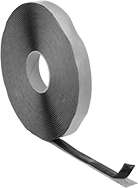
Also known as thumb-grade caulk, this forms a non-hardening, moisture-resistant seal that remains pliable.
Butyl rubber has a sticky, gummy consistency.
Black | ||||||||||
|---|---|---|---|---|---|---|---|---|---|---|
| Mfr. Model No. | Wd. | Thick. | Lg., ft. | Tensile Strength | Hardness | Temp. Range, °F | For Joining | Number of Pieces | Each | |
| 08578 | 5/16" | 5/16" | 1 | Not Rated | Not Rated | -20° to 200° | Metal Plastic Asphalt Composites Glass Masonry Wood | 60 | 0000000 | 000000 |