


System of Measurement System of Measurement |
|---|
|
Thread Size Thread Size | Show |
|---|
Thread Size Thread Size | Hide |
|---|

Thread Type Thread Type |
|---|


Material Material |
|---|
|


REACH (Registration, Evaluation, Authorization and Restriction of Chemicals) REACH (Registration,Evaluation, Authorization and Restriction of Chemicals) |
|---|
|
RoHS (Restriction of Hazardous Substances) RoHS (Restriction ofHazardous Substances) |
|---|
|
DFARS (Defense Acquisition Regulations Supplement) DFARS (Defense AcquisitionRegulations Supplement) |
|---|
Thread Direction Thread Direction |
|---|
 | |
Tensile Strength Tensile Strength |
|---|
|
Thread Fit Thread Fit |
|---|
Fastener Strength Grade/Class Fastener StrengthGrade/Class |
|---|
Travel Distance per Turn Travel Distance per Turn |
|---|
|
Hardness Hardness |
|---|
|


Thread Spacing Thread Spacing |
|---|
About Shaft Collars
Shaft collars are useful for holding and positioning components on a shaft. They can also serve as mechanical stops and stroke limiters.
More
Selecting Compatible Lead Screws and Nuts
More
Metric Lead Screws and Nuts
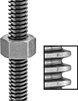
Found in hand-powered clamps, vises, grates, doors, and work tables, lead screws and nuts have broad, square threads that are well suited for quick assembly, high clamping forces, and lifting and lowering heavy objects. To ensure compatibility, please select components that have the same thread direction, size, and pitch. Class 7e and 7H components are compatible.
Travel distance per turn, also known as screw lead, is the distance a nut moves with one revolution of the lead screw.
 For technical drawings and 3-D models, click on a part number.

Hex nuts fasten and position lead screw components.
| Thread Size | Thread Pitch, mm | Ht., mm | Wd., mm | No. of Thread Starts | Speed Ratio | Travel Distance per Turn, mm | Thread Fit | Fastener Strength Grade/Class | Hardness | Each | |
Carbon Steel | |||||||||||
|---|---|---|---|---|---|---|---|---|---|---|---|
| M40 | 7 | 39.9 | 60.33 | 1 | 1:1 | 7 | 7H | Grade 2 | Not Rated | 000000000 | 000000 |
Bearing Retaining Jam Nuts
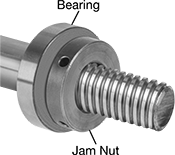
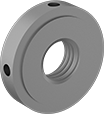
Used in pairs or with another bearing retaining nut, these jam nuts—often called shaft nuts—hold bearings, bushings, pulleys, and gears in place on your threaded shaft or spindle. Threading two nuts tightly against each other makes it harder for vibration to loosen your assembly than if you used only one nut. For the nut closer to the bearing, position the stepped face towards the bearing. These jam nuts have holes on the side, so you can tighten and loosen them with a pin spanner wrench. Made of carbon steel, they’re strong and wear resistant. All meet DIN 1816, an international standard for bearing locknut dimensions.
For technical drawings and 3-D models, click on a part number.
Thread | |||||||
|---|---|---|---|---|---|---|---|
| Size | Pitch, mm | Spacing | OD, mm | Wd., mm | Specifications Met | Each | |
Carbon Steel | |||||||
Stepped Face | |||||||
| M40 | 1.5 | Extra Fine | 62 | 12 | DIN 1816 | 0000000 | 000000 |
Bearing Retaining Nuts
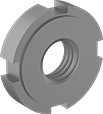
Often paired with spring lock washers to strengthen their hold, these retaining nuts—also known as shaft nuts—keep vibration from shifting bearings, bushings, pulleys, and gears on your threaded shaft or spindle. They have slotted sides, so you can tighten and loosen them with a spanner wrench or spanner socket. Made of carbon steel, they’re strong and wear resistant.
Use stepped-face retaining nuts with DIN 462 spring lock washers. You can also use them in pairs or with other bearing retaining nuts as jam nuts. For the nut closer to the bearing, position the stepped face towards the bearing. All meet DIN standards for bearing lockout dimensions.
For technical drawings and 3-D models, click on a part number.