

Base Type Base Type |
|---|
 | Bi-Pin |
Bulb Shape Bulb Shape |
|---|
 | Spotlight/ Floodlight |
Bulb Shape Number Bulb Shape Number |
|---|
|
Base Number Base Number | Show |
|---|
|
Base Number Base Number | Hide |
|---|
Light Setting Light Setting |
|---|
|


Bulb Diameter Bulb Diameter |
|---|
|
Color Temperature Color Temperature |
|---|
|
Maximum Temperature Maximum Temperature |
|---|
|
Brightness Brightness |
|---|
|
Color Color |
|---|
 | Clear |
DFARS (Defense Acquisition Regulations Supplement) DFARS (Defense AcquisitionRegulations Supplement)  |
|---|
RoHS (Restriction of Hazardous Substances) RoHS (Restriction ofHazardous Substances) |
|---|
|
REACH (Registration, Evaluation, Authorization and Restriction of Chemicals) REACH (Registration,Evaluation, Authorization and Restriction of Chemicals) |
|---|
|
About Brightness
More
About Light Appearance
More
Bi-Pin Base Floodlight Bulbs
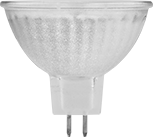
Often used in recessed can fixtures and track lighting, these bulbs produce a focused beam of light. Brightness is measured in lumens; the higher the lumens, the brighter the bulb. Bulbs with a warm light appearance have yellow tones. Bulbs with a neutral light appearance are commonly used in workspaces. A bulb’s estimated yearly energy cost is based on 3 hours of usage per day at $0.11 per kWh.
LED bulbs last longer and are more efficient than other technologies. They generate little heat and withstand vibration. Plastic LED bulbs are shatterproof.
Halogen bulbs are slightly more energy efficient than incandescent bulbs, but they generate more heat.
Bulbs that cannot be sold to the regions listed do not meet local energy efficiency requirements.
| Equiv. Incand. Bulb Wattage | Light Appearance | Brightness, lumens | Beam Angle | Light Technology | Bulb Material | Color | Wattage | Rated Life, hrs. | Est. Yearly Energy Cost, $ | Bulb Dia. | O'all Lg. | Cannot Be Sold To | Pkg. Qty. | Pkg. | |
MR16 Bulb | |||||||||||||||
|---|---|---|---|---|---|---|---|---|---|---|---|---|---|---|---|
12V AC/12V DC | |||||||||||||||
| 20W | Warm (2,700K) | 350 | 25° | LED | Plastic | Clear | 5W | 25,000 | 0.60 | 2" | 1 3/4" | CA | 1 | 0000000 | 00000 |
| 20W | Warm (2,700K) | 350 | 25° | LED | Plastic | Clear | 5W | 25,000 | 0.60 | 2" | 1 3/4" | CA | 6 | 0000000 | 00000 |
| 20W | Warm (3,000K) | 200 | 40° | LED | Glass | Clear | 2.6W | 25,000 | 0.31 | 2" | 2" | __ | 1 | 0000000 | 0000 |
| 20W | Warm (3,000K) | 200 | 40° | LED | Glass | Clear | 2.6W | 25,000 | 0.31 | 2" | 2" | __ | 12 | 0000000 | 000000 |
| 20W | Warm (3,000K) | 350 | 25° | LED | Plastic | Clear | 5W | 25,000 | 0.60 | 2" | 1 3/4" | CA | 1 | 0000000 | 0000 |
| 20W | Warm (3,000K) | 350 | 25° | LED | Plastic | Clear | 5W | 25,000 | 0.60 | 2" | 1 3/4" | CA | 6 | 0000000 | 00000 |
| 35W | Warm (3,000K) | 450 | 25° | LED | Plastic | Clear | 6W | 25,000 | 0.72 | 2" | 1 3/4" | __ | 1 | 0000000 | 00000 |
| 35W | Warm (3,000K) | 450 | 25° | LED | Plastic | Clear | 6W | 25,000 | 0.72 | 2" | 1 3/4" | __ | 6 | 0000000 | 00000 |
| 35W | Warm (3,000K) | 450 | 35° | LED | Plastic | Clear | 6W | 25,000 | 0.72 | 2" | 1 3/4" | __ | 1 | 0000000 | 00000 |
| 35W | Warm (3,000K) | 450 | 35° | LED | Plastic | Clear | 6W | 25,000 | 0.72 | 2" | 1 3/4" | __ | 6 | 0000000 | 00000 |
| 50W | Warm (3,000K) | 700 | 35° | LED | Glass | Clear | 7W | 25,000 | 1.08 | 2" | 2" | __ | 1 | 00000000 | 00000 |
| 50W | Warm (3,000K) | 700 | 35° | LED | Glass | Clear | 7W | 25,000 | 1.08 | 2" | 2" | __ | 6 | 00000000 | 00000 |
| 75W | Warm (3,000K) | 490 | 40° | LED | Plastic | Clear | 8W | 25,000 | 0.96 | 2" | 1 7/8" | __ | 1 | 00000000 | 00000 |
6V DC | |||||||||||||||
| 5W | Warm (3,000K) | 90 | Not Rated | Halogen | Glass | Clear | 5W | 200 | 0.60 | 2" | 1 3/4" | __ | 1 | 0000000 | 0000 |
Bi-Pin Base Spotlight Bulbs
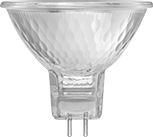
These bulbs produce a narrower, more concentrated beam of light than floodlight bulbs. Bulbs with a warm light appearance have yellow tones. Those with a neutral light appearance are commonly used in workspaces. A bulb’s estimated yearly energy cost is based on 3 hours of usage per day at $0.11 per kWh.
LED bulbs last longer and are more efficient than other technologies. They generate little heat, withstand vibration, and are shatterproof.
| Wattage | Light Appearance | Brightness | Beam Angle | Base No. | Light Technology | Bulb Material | Color | Rated Life, hrs. | Est. Yearly Energy Cost, $ | Bulb Dia. | O'all Lg. | Pkg. Qty. | Pkg. | |
MR16 Bulb | ||||||||||||||
|---|---|---|---|---|---|---|---|---|---|---|---|---|---|---|
12V AC/12V DC | ||||||||||||||
| 8W | Warm (3,000K) | 490 lumens | 15° | GU5.3 | LED | Plastic | Clear | 25,000 | 0.96 | 2" | 1 7/8" | 1 | 00000000 | 000000 |
| 9W | Warm (3,000K) | 700 lumens | 15° | GU5.3 | LED | Plastic | Clear | 25,000 | 1.08 | 2" | 2" | 1 | 00000000 | 00000 |
| 9W | Warm (3,000K) | 700 lumens | 15° | GU5.3 | LED | Plastic | Clear | 25,000 | 1.08 | 2" | 2" | 6 | 00000000 | 00000 |