We will reply to your message in the morning.
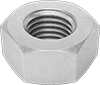
Class 8 nuts are comparable in strength to Class 8.8 bolts and are suitable for fastening most machinery and equipment.
These nuts are suitable for fastening most machinery and equipment.
These metric nuts tighten when turned to the left; once fastened, they resist loosening from counterclockwise motion.
These nuts tighten when turned to the left; once fastened, they resist loosening from counterclockwise motion.
These metric nuts meet JIS (Japanese Industrial Standard) B 1181.
Choose these nuts for their adherence to strict military standards for material and construction.
These nuts are about 25% stronger than medium-strength steel nuts.
About 25% stronger than medium-strength steel nuts, these nuts are comparable in strength to class 10.9 bolts.
Closely spaced metric threads prevent these nuts from loosening due to vibration. About 25% stronger than medium-strength steel nuts, these nuts are comparable in strength to Class 10.9 bolts.
Tighten these nuts by turning them to the left; once fastened, they resist loosening from counterclockwise motion.
About half the strength of medium-strength steel nuts, these nuts are for light duty fastening applications.
About half the strength of medium-strength steel nuts, these metric nuts are for light duty fastening applications.
These metric nuts are about 20% stronger than high strength steel nuts and are often used in heavy machinery.
These nuts are about 20% stronger than high strength steel nuts and are often used in heavy machinery.
These nuts have good chemical resistance and may be mildly magnetic. Metric 18-8 stainless steel is also known as A2 stainless steel.
These nuts have good chemical resistance and may be mildly magnetic.
These metric nuts meet JIS (Japanese industrial Standard) B 1181.
These metric nuts have good chemical resistance and may be mildly magnetic.
These nuts have excellent chemical resistance and can be used in saltwater environments.
Comparable in strength to Grade 5 steel and as resistant to chemicals and salt water as 316 stainless steel.
These metric nuts resist oil, grease, and solvents (except mineral acids).
Made from nylon 6/6, these nuts resist oil, grease, and solvents (except mineral acids).
PEEK nuts are often used as an alternative to metal hex nuts. They withstand temperatures up to 550° F and resist acids, bases, and salt solutions.
Polycarbonate nuts stand up to oil, grease, and detergents.
Glass-filled nylon nuts are stronger than nylon 6/6 nuts. They resist oil, grease, and solvents (except mineral acids).
PTFE nuts withstand temperatures up to 500° F. They resist oil, grease, detergents, and most mineral acids. They're the lowest friction plastic nuts we offer, so they thread on smoothly.
Fiberglass nuts are stronger than nylon 6/6 nuts. They resist acids, solvents, salt water, and oil.
Polypropylene nuts resist organic solvents and degreasing agents.
Stronger than PTFE nuts and resistant to solvents, bases, and acids—including hydrochloric and nitric acid—these PVDF nuts are often used in chemical processing equipment.
For use in wet environments, acetal nuts resist alcohol, gasoline, and solvents.
These metric nuts are corrosion resistant in wet environments, electrically conductive, and nonmagnetic.
These nuts are corrosion resistant in wet environments, electrically conductive, and nonmagnetic.
These brass nuts resist rusting from water and have closely spaced threads to prevent loosening from vibration.
One-third the weight of steel, these metric aluminum nuts are corrosion resistant in wet environments and nonmagnetic.
One-third the weight of steel, these aluminum nuts are corrosion resistant in wet environments and nonmagnetic.
These nuts are resistant to salt water, electrically conductive, and nonmagnetic.
These metric nuts are resistant to salt water, electrically conductive, and nonmagnetic.
These metric nuts have a high strength-to-weight ratio and resist acids and salt water.
These nuts have a high strength-to-weight ratio and resist acids and salt water.
Commonly used in valves, pumps, and shafts, these 400 nickel nuts resist salt water and caustic chemicals.
Ceramic nuts won't melt, seize, or become brittle—even at temperatures up to 3000° F.
Half as thick as regular hex nuts, these nuts fit into spaces with low height clearances. They are about half as strong as medium-strength steel, and are often used for light duty applications, such as securing access panels.
Made from Grade 5 steel, these inch-sized nuts are suitable for most fastening applications.
These nuts are half the height of standard hex nuts, and have closely spaced threads to prevent loosening from vibration. Half as strong as medium-strength steel nuts, they are often used for light-duty applications, such as fastening signs in place.
These nuts tighten when turned to the left; once fastened, they resist loosening from counterclockwise motion. They’re Grade 5 steel, so you can used these inch-sized nuts for most fastening applications.
These nuts should be used for light duty fastening applications, such as securing access panels.
These nuts tighten when turned to the left; once fastened, they resist loosening from counterclockwise motion. Made of Grade 2 and Class 04 steel, these nuts can be used for fastening panels and other light duty fastening applications.
These nuts are about 25% stronger than medium-strength steel thin hex nuts. Available in inch thread sizes.
Useful in low-clearance applications, these metric nuts are roughly half the height of standard hex nuts, but aren’t as strong. All are 18-8 stainless steel, which is nearly as strong as steel but won’t rust in outdoor, washdown, and other corrosive environments.
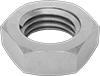
Made with fine-pitch threads, vibration is less likely to loosen these metric nuts than those with coarse-pitch threads since the threads sit closer together. Also called jam nuts, they are roughly half the height of standard hex nuts, so they’re good for applications with low clearance.
These metric nuts are made of 316 stainless steel and half as tall as regular hex nuts—use them around chemicals and salt water when space is limited.
With threads that tighten to the left and made of 316 stainless steel, these nuts won’t loosen from counterclockwise motion in saltwater and corrosive environments. They’re half the height of standard hex nuts, so they fit where there’s low clearance.
Made from brass, these metric nuts are corrosion resistant in wet environments, electrically conductive, and nonmagnetic. About half the height of standard hex nuts, they are useful in low-clearance applications but have less tensile strength.
These nuts tighten to the left and won’t loosen from counterclockwise motion.
Comparable in strength to Class 12.9 bolts.
These nuts are comparable in strength to Grade 9 bolts.
These Class 10 nuts are about 25% stronger than medium-strength steel extra-wide hex nuts.
About half the strength of medium-strength steel extra-wide hex nuts, use these nuts for light duty fastening applications, such as securing access panels.
These nuts have good chemical resistance.
More corrosion resistant than 18-8 stainless steel nuts, these nuts can be used in saltwater environments.
More corrosion resistant than 18-8 stainless steel nuts, these nuts have excellent resistance to chemicals and salt water.
Able to maintain their strength in high-pressure and high temperature environments, these nuts are used with ASTM A193 bolts to fasten pressure tanks, valves, and flanges.
Taller than standard hex nuts, these metric nuts provide a larger gripping area for installation with a wrench.
Taller than standard hex nuts, these nuts provide a larger gripping area for installation with a wrench.
These 18-8 stainless steel nuts have good chemical resistance and may be mildly magnetic.
Also known as small-pattern hex nuts, these are about 20% narrower than standard hex nuts for use in tight spaces where standard hex nuts won't fit.
Brass nuts are resistant to corrosion in wet environments and electrically conductive.
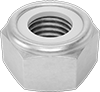
A nylon insert keeps metric bolt threads from coming loose due to vibration, wear, and temperature swings. About 25% stronger than medium-strength steel locknuts, these nuts are made of high-strength, Class 10 steel.
Includes inch thread sizes. These Grade 8 steel locknuts are 25% stronger than our medium-strength steel nylon-insert locknuts.
Closely spaced metric threads prevent loosening from vibration. These Class 10 steel locknuts are 25% stronger than our medium-strength steel nylon-insert locknuts.
Made from medium-strength steel with a nylon insert, these Class 8 metric locknuts are strong enough to use on most machinery and equipment that’s prone to vibration and temperature changes.
Made from Grade 5 steel, these inch-sized locknuts are suitable for fastening most machinery and equipment.
Get a grip on metric bolts exposed to vibration, wear, and changes in temperature. These metric locknuts have a nylon insert that holds onto bolts without damaging their threads.
Made from low-strength steel, these locknuts should be used for light duty fastening applications, such as securing.access panels.
Choose these locknuts for their adherence to strict military standards for material and construction. They’re low-strength steel, so they should be used for fastening panels and other light duty fastening applications.
These metric locknuts have good chemical resistance.
These locknuts have good chemical resistance.
Choose these locknuts for their adherence to strict military standards for material and construction.
More corrosion resistant than 18-8 stainless steel locknuts, these metric locknuts have excellent resistance to chemicals and salt water.
More corrosion resistant than 18-8 stainless steel locknuts, these locknuts have excellent resistance to chemicals and salt water.
One-third the weight of steel, aluminum locknuts resist corrosion in wet environments.
Brass locknuts are corrosion resistant in wet environments and electrically conductive.
Titanium locknuts have a high strength-to-weight ratio and are resistant to acids and salt water.
With a shorter hex height than standard DIN 985 locknuts, these nylon-insert locknuts meet international ISO 10511 dimensional standards and are easy to install in tight spaces.
These locknuts are about half the height of standard nylon-insert locknuts. Use them in light duty low clearance applications or jam one against a hex nut to hold it in place.
These Grade 8 locknuts are about 25% stronger than medium-strength steel thin locknuts.
Grade 5 locknuts are suitable for fastening most machinery and equipment when used in conjunction with a standard hex nut.
These locknuts have good chemical resistance and may be mildly magnetic.
More corrosion resistant than 18-8 stainless steel locknuts, these have excellent resistance to chemicals and salt water.
Comparable in strength to Grade 8 bolts, these locknuts are about three times stronger than low-strength steel extra-wide thin locknuts.
Comparable in strength to Grade 8 bolts, these locknuts are about 25% stronger than medium-strength steel locknuts.
These metric locknuts have an irregularly shaped thread at the top of the nut that grips the bolt for a stronger hold than nylon-insert locknuts.
These locknuts have an irregularly shaped thread at the top of the nut that grips the bolt for a stronger hold than nylon-insert locknuts.
About half the strength of medium-strength steel locknuts, these are for light duty fastening applications, such as securing access panels.
Strong enough for use with most machinery and equipment, these Class 8 metric locknuts have an irregularly shaped thread in the middle of the nut that grips bolts tighter than nylon-insert locknuts.
These Grade 8 locknuts are about three times stronger than low-strength steel distorted-thread locknuts.
Use these locknuts for light duty fastening applications, such as securing access panels.
These metric locknuts have a free-spinning tooth lock washer that grips the material surface instead of threads for easy installation and mild vibration resistance.
Also known as Keps and K Lock nuts, these locknuts have a free-spinning tooth lock washer that grips the material surface instead of threads for easy installation and mild vibration resistance.
These metric stainless steel locknuts have good chemical resistance and may be mildly magnetic.
These stainless steel locknuts have good chemical resistance and may be mildly magnetic.
A conical washer acts as a spring to add tension between the nut and the material surface for easy installation and mild vibration resistance. These metric locknuts have a smooth rim to resist scratching materials when tightened.
These locknuts have a curved washer that acts as a spring for easy installation and mild vibration resistance. The smooth rim makes them less likely to scratch materials when tightened than locknuts with a tooth lock washer.
Threads at the top of these metric locknuts expand to grip the bolt on all sides for a stronger hold than distorted-thread locknuts.
Threads at the top of these locknuts expand to grip the bolt on all sides for a stronger hold than distorted thread locknuts.
Made from stainless steel, these metric flex-top locknuts resist chemicals and may be mildly magnetic.
Made from 18-8 stainless steel, these flex top locknuts have good chemical resistance and may be mildly magnetic.
Known for their strength, these steel locknuts are cadmium plated to resist corrosion in wet environments.
Stainless steel locknuts have excellent corrosion resistance in most environments.
Secure these metric nuts by inserting a cotter pin or safety wire through the slots and a drilled hole in your bolt for mild loosening resistance. Often referred to as castle nuts.
Also known as castle nuts, secure these nuts by inserting a cotter pin or safety wire through the slots and a drilled hole in your bolt for mild loosening resistance.
These locknuts, also known as Fuji locknuts, maintain their holding power with reuse longer than nylon-insert locknuts. They have a spring ring that creates tension as you tighten the nut, keeping them in place.
For a secure hold where chemicals are a concern, these stainless steel locknuts have a spring that creates tension when tightened. Also known as Fuji locknuts.
The metric steel insert grips the threads and lifts away from the nut body when installed, isolating the insert from the nut's load to resist spinoff caused by vibration.
When installed, the steel insert grips the threads and lifts away from the nut body, isolating the insert from the nut's load to resist spinoff caused by vibration.
About two-thirds the height of standard steel-insert locknuts, use these locknuts in low-clearance applications or jam one against a hex nut to hold it in place.
These locknuts include a two-piece clamp that expands to grip the bolt on all sides and a concave jam nut that clamps the threads onto the bolt for added vibration resistance. They're also known as drake-style nuts.
These locknuts have serrations that grip the material surface instead of the threads for easy installation and mild vibration resistance.
Strong enough for use in most machinery and equipment, these medium-strength metric nuts have serrations on the underside of the flange. The serrations prevent the nuts from loosening in applications with mild vibration.
These flange locknuts have serrations that grip the material surface instead of the threads for easy installation and mild vibration resistance.
They're about 25% stronger than medium-strength steel flange locknuts and comparable in strength to Class 10.9 bolts.
About half the strength of medium-strength steel flange locknuts, these are for light duty fastening applications, such as securing access panels.
Metric 18-8 stainless steel is also known as A2 stainless steel. These flange locknuts have good chemical resistance and may be mildly magnetic.
Made from 18-8 stainless steel, these flange locknuts have good chemical resistance and may be mildly magnetic
Metric 316 stainless steel is also known as A4 stainless steel. These flange locknuts have excellent resistance to chemicals and salt water.
These flange locknuts have excellent resistance to chemicals and salt water.
Grade F nuts are comparable in strength to Grade 5 bolts.
Grip metric bolts more securely than nylon-insert flange locknuts—the irregularly shaped threads on these locknuts hold extra tight. They resist vibration and sudden shocks, even after multiple uses.
These flange locknuts are comparable in strength to Grade 8 bolts.
Choose these flange locknuts for their adherence to strict military standards for material and construction.
These flange locknuts have excellent resistance to chemicals and salt water. They have an irregularly shaped thread that grips the bolt for a stronger hold than nylon-insert flange locknuts.
These nylon flange locknuts form threads as they're tightened to resist vibration.
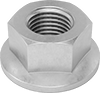
Also known as collar nuts, these metric nuts have a flange that distributes pressure across the surface, so you don't need a washer. Made of high-strength Class 10 steel, they’re about 25% stronger than medium-strength steel flange nuts.
Made from Grade 8 steel, these nuts are about 25% stronger than medium-strength steel flange nuts.
These metric nuts meet JIS (Japanese Industrial Standard) B 1190.
No need for a washer—these metric medium-strength steel nuts have a flange that distributes pressure across its surface the way a washer does. Made of medium-strength, Class 8 steel, they’re suitable for fastening most machinery and equipment.
Made to Japanese Industrial Standards, these nuts fasten most Japanese machinery and equipment without a washer.
About half the strength of medium-strength steel flange nuts, use these metric nuts in light duty fastening applications, such as securing access panels.
About half the strength of medium-strength steel flange nuts, use these nuts in light duty fastening applications, such as securing access panels.
Skip the washer—these metric stainless steel nuts have a flange that does the same job, spreading pressure across its surface for a strong hold.
Made from 18-8 stainless steel, these flange nuts have good chemical resistance.
More corrosion resistant than 18-8 stainless steel flange nuts, these nuts have excellent resistance to chemicals and salt water.
Fiberglass flange nuts are chemical resistant, nonconductive, and lightweight.
These flange nuts have a black-oxide finish for mild corrosion resistance in dry environments.
Stainless steel nuts have excellent corrosion resistance in most environments.
The nut head rotates while the flange remains stationary to prevent scratching the material surface as you tighten the nut.
For light duty applications, choose these metric-sized coupling nuts.
About half the strength of medium-strength steel coupling nuts, these nuts are for light duty fastening applications.
Made from Grade 5 steel, these inch-sized coupling nuts are suitable for most applications.
Choose these locknuts to fasten standard metric threads. They’re Class 8 steel, so they can be used in most fastening applications.
Made from Grade 8 steel, these nuts are about 25% stronger than medium-strength steel coupling nuts. Furnished in inch thread sizes.
These metric-sized coupling nuts are Class 10 steel, so they’re about 25% stronger than medium-strength steel coupling nuts.
These metric coupling nuts have good chemical resistance.
These coupling nuts have good chemical resistance.
More corrosion resistant than 18-8 stainless steel coupling nuts, these metric nuts have excellent resistance to chemicals and salt water.
More corrosion resistant than 18-8 stainless steel coupling nuts, these nuts have excellent resistance to chemicals and salt water.
Brass coupling nuts are corrosion resistant in wet environments and electrically conductive.
One-third the weight of steel, aluminum coupling nuts resist corrosion in wet environments.
Plastic coupling nuts are chemical resistant, nonconductive, and lightweight.
A smooth rounded body provides a finished look.
Stainless steel coupling nuts have excellent corrosion resistance in most environments.
Known for their strength, steel coupling nuts are available with a corrosion-resistant finish.
Use the sight hole to check for proper thread engagement.
These metric cap nuts have good chemical resistance and may be mildly magnetic.
These cap nuts have good chemical resistance and may be mildly magnetic.
These metric cap nuts have excellent resistance to chemicals and salt water.
These cap nuts have excellent resistance to chemicals and salt water.
These metric nuts are about half the strength of medium-strength steel cap nuts. Use them in light duty fastening applications, such as securing access panels.
About half the strength of medium-strength steel cap nuts, use them in light duty fastening applications, such as securing access panels.
Comparable in strength to Class 10.9 bolts, these nuts are about 25% stronger than medium-strength steel cap nuts.
These metric nylon 6/6 cap nuts are chemical resistant, nonconductive, and lightweight.
These nylon 6/6 cap nuts are chemical resistant, nonconductive, and lightweight.
Brass cap nuts are corrosion resistant in wet environments and electrically conductive.
One-third the weight of steel, aluminum cap nuts resist corrosion in wet environments.
Certified by EHEDG (European Hygienic Engineering and Design Group) to meet sanitary design standards, these cap nuts fit into tight spaces to cover and seal exposed threads in your food processing facility.
Low-profile cap nuts are about 20% shorter than standard cap nuts for use in low-profile applications.
A nylon insert on these metric nuts prevents vibration from loosening them, and a domed head protects the threads at the end of the bolt from damage and debris.
The nylon cap covers and grips the threads to resist loosening.
An irregularly shaped thread grips the bolt for a stronger hold than nylon-insert cap locknuts.
The dome is open so these cap nuts can be used on bolts of any length.
These metric wing nuts provide more leverage for greater torque while tightening than knurled-head thumb nuts.
Wings provide more leverage for greater torque while tightening than knurled-head thumb nuts.
Made from 18-8 stainless steel, these metric nuts have good chemical resistance and may be mildly magnetic.
These wing nuts have good chemical resistance and may be mildly magnetic.
Made from 316 stainless steel, these metric wing nuts have excellent chemical resistance and can be used in saltwater environments.
These wing nuts have excellent chemical resistance and can be used in saltwater environments.
Made from nylon 6/6, these metric wing nuts are chemical resistant, nonconductive, and lightweight.
These nylon 6/6 wing nuts are chemical resistant, nonconductive, and lightweight.
Brass wing nuts are corrosion resistant in wet environments and electrically conductive.
Zinc alloy wing nuts are corrosion resistant in wet environments.
A nylon insert grips threads to resist loosening.
The flange distributes the load over a large area and reduces stress where the nut meets the material surface.
These metric thumb nuts have good chemical resistance. The flange distributes pressure over a large area to reduce stress on your part.
These thumb nuts have good chemical resistance. The flange distributes pressure over a large area to reduce stress on your part.
More corrosion resistant than 18-8 stainless steel thumb nuts, these have excellent resistance to chemicals and salt water.
These metric thumb nuts are corrosion resistant in wet environments, electrically conductive, and nonmagnetic. The flange distributes pressure over a large area to reduce stress on your part.
These thumb nuts are corrosion resistant in wet environments, electrically conductive, and nonmagnetic. The flange distributes pressure over a large area to reduce stress on your part.
Made from 18-8 stainless steel, these metric thumb nuts have good chemical resistance and may be mildly magnetic.
These thumb nuts have good chemical resistance and may be mildly magnetic.
These thumb nuts have an aluminum insert to withstand more torque than plastic thumb nuts during installation.
These nylon thumb nuts are chemical resistant, nonconductive, and lightweight.
Use these thumb nuts in low-clearance applications or jam one against another nut to hold it in place.
Cover and protect threads in sanitary environments, such as food-processing or pharmaceutical plants.
Tighten these thumb nuts with a wrench for more torque while fastening.
Press these metric nuts into a drilled or punched hole with an arbor press or similar pressure tool.
Also known as clinch style captive nuts, press these nuts into a drilled or punched hole with an arbor press or similar pressure tool.
A flat hex head sits flush against the material surface for use in low-clearance applications.
Stainless steel press-fit nuts have excellent corrosion resistance in most environments.
These press-fit nuts have a zinc plating for corrosion resistance in wet environments.
These press-fit nuts have a nylon insert that grips threads to resist loosening.
Also known as broach style captive nuts, these metric nuts have good chemical resistance and may be mildly magnetic.
Also known as broach style captive nuts, these nuts have good chemical resistance and may be mildly magnetic.
These press-fit nuts are tin plated to resist corrosion from chemicals and salt water.
These tools include everything you need to install press-fit nuts by hand.
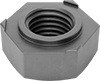
Weld these metric nuts to flat and uneven uncoated steel surfaces for a strong permanent hold.
Weld these nuts to flat and uneven uncoated steel surfaces for a strong permanent hold.
You can weld these metric nuts to flat and uneven uncoated stainless steel surfaces for a strong permanent hold.
You can weld these nuts to flat and uneven uncoated stainless steel surfaces for a strong permanent hold.
Square weld nuts have more weld points than hex weld nuts for a stronger hold. Use them on flat surfaces.
Projections on the base concentrate the weld and provide room for heat to dissipate.
A smooth base provides more contact with the mating surface than weld nuts with projections.
Use these metric nuts in channels and tight spaces where round-base weld nuts won't fit.
These nuts can be used in channels and tight spaces where round-base weld nuts won't fit.
Weld these nuts to stainless steel surfaces.
Weld these nuts to uncoated steel surfaces.
A smooth base on these metric nuts provides more contact with the mating surface than weld nuts with projections
Threads float inside the retainer of these metric nuts so you can install a bolt at a slight angle to align with off center parts.
Threads float inside the retainer so you can install a bolt at a slight angle to align with off center parts.
Create threads in hard-to-work areas—where you can’t reach the back of a workpiece, or material is too thin to be tapped.
Stainless steel adhesive-mount nuts have excellent corrosion resistance in most environments.
These adhesive-mount nuts have a zinc plating for corrosion resistance in wet environments.
These nuts have three mounting holes to accept screws and rivets for use with thin materials.
About half the strength of medium-strength steel square nuts, use these metric nuts in light duty fastening applications, such as securing access panels.
About half the strength and two-thirds the height of medium-strength steel square nuts, use these metric nuts in light duty, low-clearance applications.
About half the strength of medium-strength steel square nuts, use these nuts in light duty fastening applications, such as securing access panels.
Two-thirds the height of typical square nuts and made of stainless steel, these metric nuts are designed for use in low-clearance applications in humid, damp, and washdown environments.
Made from 18-8 stainless steel, these metric square nuts have good chemical resistance and may be mildly magnetic.
These square nuts have good chemical resistance and may be mildly magnetic.
More corrosion resistant than 18-8 stainless steel square nuts, these nuts have excellent resistance to chemicals and salt water.
Unlike metal nuts, these metric carbon fiber square nuts won’t warp at extreme temperatures, making them ideal for heat treating and furnace fixtures.
Brass square nuts are corrosion resistant in wet environments and electrically conductive.
These steel panel nuts are zinc plated for corrosion resistance.
All of these stainless steel panel nuts have some chemical resistance.
Brass panel nuts are corrosion resistant in wet environments and electrically conductive.
These panel nuts are knurled to provide a secure grip for tightening and loosening by hand.
About twice as strong as aluminum rivet nuts, these steel rivet nuts are zinc plated for mild corrosion resistance.
The most corrosion resistant twist-resistant rivet nuts we offer, these stand up to chemicals.
These aluminum rivet nuts are one-third the weight of steel rivet nuts and have mild corrosion resistance.
A hex-shaped body provides the highest twist resistance of any rivet nut.
Wedges under the flange lock the nut in place in soft materials such as brass and aluminum.
About twice as strong as aluminum rivet nuts, these low-profile rivet nuts have a cadmium or tin-zinc plating for corrosion resistance.
These kits include one size of low-profile rivet nuts.
The most corrosion resistant low-profile rivet nuts we offer, these stand up to chemicals.
These low-profile rivet nuts are one-third the weight of steel and have mild corrosion resistance.
A nonconductive rubber coating insulates the nut from electricity, seals out moisture, and damps vibration.
Once installed these rivet nuts have a large back flange that distributes the load across a broad area for a strong hold in plastic and composites.
About twice as strong as aluminum rivet nuts, these rivet nuts are zinc plated for mild corrosion resistance.
A PVC foam seal under the flange keeps liquids and gasses from leaking between the nut and the surrounding material.
The thread area is enclosed, which prevents leakage past the threads from either side of your application.
Threads float inside the nut so you can install a screw at a slight angle to align with off-center parts. They’re also known as Riv-Float nuts.
These rivet nuts are mildly corrosion resistant.
Stronger than stainless steel, these nuts are comparable in strength to Grade 9 bolts.
These metric nuts have a barrel with multiple threads for secure thread engagement. Also known as U-style clip-on nuts.
The S-style design provides more strength than other no-slip clip-on nuts.
Use these light-duty clip-on nuts in low-clearance applications.
Slide these nuts on the edge of a panel and position them by hand. Also known as G-style clip-on nuts.
Also known as G-style clip on nuts, slide these nuts on the edge of a panel and position them by hand.
With a slim, round profile and a slotted drive, these metric nuts work in tight spots where there's no room for a wrench to turn. Instead, tighten them from the center of the nut with a slotted screwdriver.
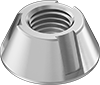
The most tamper-resistant nuts we offer, these have a hex head that breaks away upon tightening, leaving a non-removable cone. Install with a standard wrench.
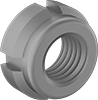
Tri-groove nuts are narrower than sloped and drilled spanner nuts to fit in tight spaces. Install with a tri-groove socket bit and either a drive handle or an open-end wrench.
Difficult to grasp with standard hand tools, these metric nuts have sloped sides to reduce the risk of unwanted removal.
A wide base and large bearing surface make these nuts good for securing large objects. Install with a spanner driver.
About half the strength of medium-strength steel coupling nuts, these metric nuts are for light duty fastening applications.
Use these tube-end weld nuts with left-hand threaded fasteners.
Stainless steel snap-in nuts have excellent corrosion resistance in most environments.
Snap these nuts into square holes in thin materials.
Stainless steel sealing nuts have excellent corrosion resistance in most environments.
These nickel-plated brass sealing nuts have good resistance to chemicals and salt water.
Attach these metric slip-on nuts at any point on a threaded rod for quick installation.
Attach these slip-on nuts at any point on a threaded rod for quick installation.
These metric push nuts can be used as a standalone for light-duty applications or as a jam nut.
Steel inserts have high strength for durability.
The most corrosion resistant tee nut inserts we offer, these inserts stand up to chemicals and salt water.
These 18-8 stainless steel tee nut inserts have better corrosion resistance than zinc-plated steel tee nut inserts.
Fewer prongs than other tee nut inserts reduce the risk of splitting hardwood—these inserts have three short prongs.
Six prongs around the barrel of these inserts provide a strong hold and prevent them from loosening and twisting.
Ridges on the barrel of these inserts make them less likely to split hardwood than inserts with prongs. They're often used in wood that has been cut across the growth rings.
Hooked prongs give these inserts excellent holding power even when removing screws.
The flange keeps these inserts from being pulled through a hole and provides a load bearing surface.
Large threads cut into softwood such as particleboard for a strong hold.
Assortments include various sizes of tapping inserts for softwood.
These 18-8 stainless steel inserts have excellent resistance to chemicals and may be mildly magnetic.
Made from brass, these inserts are nonmagnetic, mildly corrosion resistant, and electrically conductive.
Assortments include various sizes of tapping inserts for hardwood.
A closed end seals out elements and protects the threads on these inserts from debris.
Mount these inserts flush or below the material's surface.
A wide flange distributes the load over a large area. Hammer these inserts into a drilled hole.
Mount components onto food processing lines, walls, and sanitary equipment while leaving space to clean in between.
These standoffs are designed to fit in the limited space of compact electronics such as laptops and hand-held devices.
The ends of these removable supports snap in and compress between panels to reduce vibration of miniature cooling fans in compact electronics.
Stick these supports to surfaces where you don't want to drill a hole. The snap-in end can be released for repairs and upgrades.
Use these barrels with a screw you already have or pair with a different type of screw to create a custom fastener. Made from 316 stainless steel, they have excellent chemical resistance and can be used in saltwater environments.
Use these barrels with a screw you already have or pair with a different type of screw to create a custom fastener. They're zinc plated to resist corrosion in wet environments.
Use these hex drive screws and binding barrels as a low-profile alternative to standard nut and bolt combinations.
These binding barrels and screws have good chemical resistance.
More corrosion resistant than 18-8 stainless steel binding barrels and screws, these have excellent resistance to chemicals and salt water.
Brass binding barrels and screws are corrosion resistant in wet environments and electrically conductive.
Stainless steel thumb screws have excellent corrosion resistance in most environments.
These metric thumb screws have wings that provide more leverage than spade-head thumb screws for greater torque while tightening. A zinc plating provides corrosion resistance in wet environments.
Wings provide more leverage than spade-head thumb screws for greater torque while tightening. A zinc plating provides corrosion resistance in wet environments.
In addition to joining male- and female-threaded parts, these adapters can increase or decrease metric thread sizes and change the thread pitch.
Change inch threads to metric with these adapters, or swap metric threads for inch. An external hex lets you tighten or loosen them with a wrench.
Connect male- and female-threaded parts of different thread types and sizes, while allowing air, liquids, wire, or other thin materials to pass through.
Increase or decrease metric thread size from one male-threaded part to another. Commonly used to connect two differently sized threaded rods, they have a hex-shaped body, so you can tighten them with a standard wrench.
Adapt threaded rods from inch to metric. These adapters connect two male-threaded fasteners, so you can change the gender of a mating part or increase or decrease its thread size. The hex-shaped body fits into the head of a standard wrench.
Often called sleeve nuts, these thread adapters fasten parts with right-hand threads to parts with left-hand threads.
Twist these adapters onto female metric threads to change pitch or switch thread sizes.
Join two female-threaded parts of various thread types and sizes, while allowing air, liquids, wire, or other thin materials to pass through.
One side inch, one side metric, and a hex in the middle—these handy fasteners connect two female-threaded parts, such as coupling nuts, adapting from inch threads to metric. Tighten with a standard wrench.
Use these rivet nuts for light duty fastening in low-clearance applications. Assortments include rivet nuts, mandrels, and an installation tool.
A ribbed-shaped body holds the nut in place so it won't move when tightening a screw. Assortments contain rivet nuts, mandrels, nosepieces, and a plier-style installation tool.
These rivet nuts have a smooth body and fit in smaller holes than twist-resistant rivet nuts. Assortments include rivet nuts, mandrels, nosepieces, and a plier-style installation tool.
Designed for use with bearing nuts, these lock washers have a conical shape that presses like a spring against bearings, bushings, gears, and pulleys to hold them in place on your threaded shaft or spindle.
Teeth on the outside edge of these metric washers bite into the screw head and joint for a tight grip.
The teeth on these washers bite further into the screw head and joint than standard external-tooth washers to provide a stronger hold.
To keep 90° countersunk screws from loosening in vibration applications, the teeth on these washers bite further into the screw head and joint than standard external-tooth lock washers for a more secure hold.
The combination of internal and external teeth boosts gripping power to maintain a tight hold and provide more vibration resistance than other tooth lock washers. Use with fasteners that have heads large enough to make contact with the external teeth, such as pan, button, and binding head screws.
No groove required—press these rings onto the end of a shaft for a firm grip.
Also known as E-style rings.
With teeth along the inside, these retaining rings hold chamfered shafts inside the housing of your equipment.
No groove required—these rings have teeth that firmly grip the bore.
316 stainless steel studs have excellent resistance to chemicals and salt water.
These steel studs are zinc plated to resist corrosion in wet environments.
Add a stud to thin material when you only have access to one side.
With a nylon insert that grips your threaded shaft or spindle without damaging its threads, these locknuts—also called shaft nuts—hold bearings, bushings, gears, and pulleys prone to vibration tightly in place.
Often paired with spring lock washers to strengthen their hold, these retaining nuts—also known as shaft nuts—keep vibration from shifting bearings, bushings, pulleys, and gears on your threaded shaft or spindle.
Used in pairs or with another bearing retaining nut, these jam nuts—often called shaft nuts—hold bearings, bushings, pulleys, and gears in place on your threaded shaft or spindle.
These metric lead screws and nuts have broad, square threads that are well suited for quick assembly, high clamping forces, and lifting and lowering heavy objects. They're commonly found in hand-powered clamps, vises, grates, doors, and work tables.
Also known as trapezoidal-thread lead screws and nuts.
Multiple thread channels (also known as thread starts) create faster linear travel than lead screws with a single thread start.
Also known as single-start and self-locking lead screws and nuts, these have a single thread that runs the length of the screw. The nut travels only when the screw turns, so your system won't unexpectedly move when the lead screw is at rest.
Internal ball bearings provide smooth low-friction travel in applications that require high speeds, accurate positioning, and repeatable movement. Also known as single-start metric ball screws and nuts, these have a single thread that runs the length of the screw.
Install these threaded collars on a metric lead screw to separate and position components, or use them as an end stop to limit travel.
A set of ball bearings reduces friction and secures the end of a metric ball or lead screw.
Install these nuts on a rotary shaft to create a linear positioning system without a lead screw. Instead of threads, a set of angled ball bearings drives the nut along a shaft as it spins.
Combine with mounting blocks to mount and secure threaded-body shock absorbers.
Attach these nuts to rods, pipes, and tubes to make pivoting and hinge movements where misalignment is not a concern.
Made of stainless steel for excellent corrosion resistance, these nuts make pivoting and hinge movements where misalignment is not a concern.
Screw and nut sets or nuts secure brackets and other accessories to rails.
Serrated grooves grip the lip of the channel.
A spring plus serrated grooves that grip the lip of the channel provide a more secure hold than standard strut channel nuts.
Use with hex nuts to connect threaded rod.
Notches on these washers grip the channel to keep them in place.
Build test fixtures, prototypes, and other small structures with this miniature version of T-slotted framing and fittings.
Use these handles for quick assembly and disassembly. Their offset grip provides leverage, making them a good alternative to wing nuts.
Rated for high load capacity, use these metric inserts to connect threaded leveling mounts to heavy equipment.
Designed to slide into T-slot tracks on machine tool tables, use these nuts to secure clamps and workpieces.
Install from the top of the T-slot track and secure with a quarter turn. Also known as quarter-turn T-slot nuts.
After sliding the nut into a T-slot, tighten the set screw to keep it in place.
Secure setup clamps and fixtures to your machine table, or assemble heavy machines, such as engine mounts.
Also known as tap-end and fixture studs, these rods have friction-fit threads on one end to resist loosening and standard threads on the other side for attaching a nut.
For quicker setups than a separate T-slot nut and stud, slide these bolts into T-slot tracks on machine tool tables.
Prevent chips, debris, and small parts from falling into T-slots.
Scrape debris out of machine table T-slots.
For mounting items to your machine table, these kits contain the full system of necessary components.
Hold a workpiece securely from the side with minimal contact, leaving more of the workpiece free for machining.
These clamps wedge against the workpiece ID to grip cast, unfinished, or uneven parts, leaving the outside clear for machining.
Get everything needed for basic workholding on a machine table.
Push nuts and retaining rings over threaded fasteners and shafts. These tools have a magnetized tip so nuts don't fall off as you slide them on.
Turn these tools by hand to install low-profile rivet nuts.
Use these tools to install most styles of rivet nuts. Use a wrench to hold the tool and a ratchet to tighten the nut.
Smaller and lighter than cordless and hydraulic rivet nut tools, use these to install thin-walled bulbed, ribbed, sleeve, and smooth rivet nuts.
Install all styles of rivet nuts more quickly than cordless rivet nut tools.
Use these corrosion-resistant fittings in a low-pressure pipe line.
Use these fittings in low-pressure flow applications. They have good corrosion resistance.
Use these fittings for low-pressure applications in noncorrosive environments.
Made of corrosion-resistant plastic, these fittings won’t deteriorate when used in oil applications. They have high strength and impact resistance.
Tighten these nuts onto high-pressure compression sleeves and fittings to create a strong seal on stainless steel tubing.
Use these nuts with compression sleeves and fittings to create a strong seal on stainless steel tubing.
Pair these nuts with vibration-resistant compression sleeves and fittings for a strong seal on stainless steel tubing.
Pair these nuts with compression sleeves and high-pressure fittings. They withstand about twice as much pressure as nuts for standard compression fittings, so they’re good for hydraulic power applications.
Use these nuts with compression sleeves and fittings, also known as bite fittings, to create a strong seal on steel tubing.
Create a strong seal on copper tubing when you couple these nuts with compression sleeves and fittings.
These nuts attach to high-pressure nipples for compressed gas so you can connect your tank to the inlet of a pressure regulator.
A cushion covering the clamp reduces vibration and wear from clamp edges. Clamps surround lines of pipe, tubing, and conduit completely while holding them close to the mounting surface.
Organize multiple lines of pipe, tubing, and conduit with one clamp. Wider than standard loop clamps, multiline loop clamps surround two lines of material to create a secure grip while holding the lines close to the mounting surface. A cushion covering the clamp reduces vibration and wear from clamp edges.
A molded cushion reduces vibration and wear from clamp edges, plus it provides a tighter fit around material than standard vibration-damping loop clamps.
These clamps completely surround single lines of pipe, tubing, and conduit while holding them close to the mounting surface.
Organize multiple lines of pipe, tubing, and conduit with one clamp. Wider than standard loop clamps, multiline loop clamps surround two lines of material to create a secure grip while holding the lines close to the mounting surface.
Compared to metal loop clamps, plastic loop clamps reduce wear on soft materials, such as tubing and cable. Clamps are nonconductive and noncorrosive.
Create your own lifting eye by adding an eye nut to a stud or bolt.
Use these lug nuts to secure a pneumatic wheel.
Secure threaded metal conduit fittings to a knockout in an outlet box or enclosure.
Secure threaded plastic conduit fittings to a knockout in an outlet box or enclosure.
Slide these clips on DIN rails—often used in equipment cabinet racks—to route and organize cables. Since these clips don’t require adhesive or screws, you can move them anywhere along the rail.
Secure jaws to a CNC lathe chuck with industry standard 1.5 mm × 60° serrations or wider 3 mm × 60° serrations.
Convert drum openings with metric or BSPP threads to a 2 NPT pipe size.