We will reply to your message within an hour.
These fittings are made to tighter tolerances than other stainless steel pipe fittings. They are also known as instrumentation fittings.
Use these fittings in extreme-pressure conditions up to 15,000 psi.
These fittings are strong enough to handle extreme pressures, yet small enough to fit into cramped spaces.
Metal hose fittings have better durability than plastic barbed hose fittings.
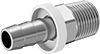
Fittings are metal for better durability than plastic barbed hose fittings. They have sharper barbs than standard barbed hose fittings to grip push-on hose without the need for clamps or ferrules. The more you pull on the fittings, the tighter the hose will grip.
Fittings are threaded on both ends so you can connect them directly to a threaded hose or to pumps, cylinders, and other equipment in your hydraulic system.
Crimp these fittings onto hydraulic hose for a permanent, leak-tight connection. Since they crimp on, they handle higher pressure than screw-on fittings.
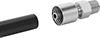
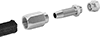
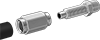
Create or repair D.O.T. hose assemblies in the field with just a wrench and a vise, no crimper required.
Fittings have sharp barbs that grip push-on hose with no clamps or ferrules required. The more you pull on the fittings, the tighter the hose will grip. Use in low-pressure hydraulic applications up to 350 psi.
With just a vise and a wrench, make or repair hose assemblies in the field.
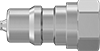
Use these couplings at pressures up to 5,000 psi. They consist of a plug and socket that connect and disconnect quickly. Use them if you need frequent access to a line. They are compatible with International Standard ISO B-shape plugs and sockets.
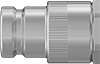
Use these couplings at pressures up to 10,000 psi. Also known as flush-face couplings, the plugs and sockets have a flat face, which allows them to mate close together, reducing fluid loss when connecting and disconnecting the line. They are compatible with High-Pressure Minimal-Spill-shape plugs and sockets.
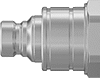
Use these couplings at pressures up to 7,200 psi. Also known as flush-face couplings, the plugs and sockets have a flat face, which allows them to mate close together, reducing fluid loss when connecting and disconnecting the line. They are compatible with International Standard ISO Minimal-Spill-shape plugs and sockets.
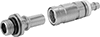
Reduce the risk of spills near electronics when connecting and disconnecting liquid cooling lines. Also known as double shut-off couplings, these couplings have a shut-off valve on both sides that stops the flow of coolant if they’re separated.
No need for expensive crimping tools—these fittings make air conditioning and refrigeration assemblies with clamps.
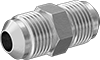
The threads on the tube end of these fittings are Class 3A or 3B and adhere to tighter tolerances than other 37° flared fittings.
A PTFE seal on the tube end of these fittings allows for an extra-strong connection in high-vibration applications.
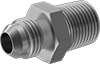
Also known as JIC (Joint Industrial Council) fittings, these provide a tight metal-to-metal seal on stainless steel tubing that is flared to 37°.
Individually bagged to prevent contamination, these fittings are suitable for applications that require a high level of cleanliness.
No sleeve is required to assemble these fittings, which makes for a faster, more convenient installation compared to 37° flared fittings. They are also known as refrigeration and SAE fittings.
Also known as JIC (Joint Industrial Council) fittings, these connect to tubing that is flared to 37°. They can handle higher pressures than 45° flared fittings.
Also known as JIC (Joint Industrial Council) fittings, these provide a tight metal-to-metal seal on steel tubing that is flared to 37°.
Also known as JIC (Joint Industrial Council) fittings, these provide a tight seal on tubing that is flared to 37°.