We will reply to your message in the morning.
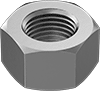
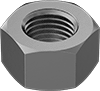
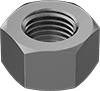
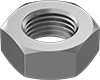
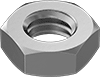
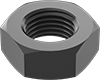
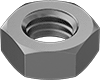
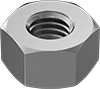
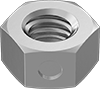
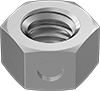
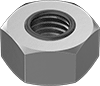
These nuts are suitable for fastening most machinery and equipment.
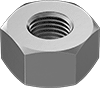
Choose these nuts for their adherence to strict military standards for material and construction.
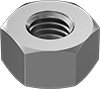
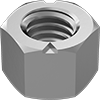
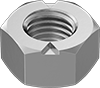
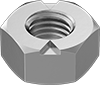
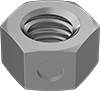
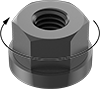
These nuts tighten when turned to the left; once fastened, they resist loosening from counterclockwise motion.
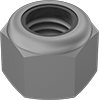
These nuts are about 25% stronger than medium-strength steel nuts.
Tighten these nuts by turning them to the left; once fastened, they resist loosening from counterclockwise motion.
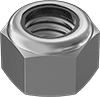

These nuts are about 20% stronger than high strength steel nuts and are often used in heavy machinery.
About half the strength of medium-strength steel nuts, these nuts are for light duty fastening applications.

These nuts have good chemical resistance and may be mildly magnetic.
These nuts have excellent chemical resistance and can be used in saltwater environments.
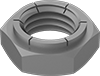
Made from nylon 6/6, these nuts resist oil, grease, and solvents (except mineral acids).
PEEK nuts are often used as an alternative to metal hex nuts. They withstand temperatures up to 550° F and resist acids, bases, and salt solutions.
Fiberglass nuts are stronger than nylon 6/6 nuts. They resist acids, solvents, salt water, and oil.
PTFE nuts withstand temperatures up to 500° F. They resist oil, grease, detergents, and most mineral acids. They're the lowest friction plastic nuts we offer, so they thread on smoothly.
One-third the weight of steel, these aluminum nuts are corrosion resistant in wet environments and nonmagnetic.
These nuts are resistant to salt water, electrically conductive, and nonmagnetic.
These nuts are corrosion resistant in wet environments, electrically conductive, and nonmagnetic.
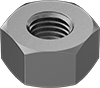
Made from Grade 5 steel, these inch-sized nuts are suitable for most fastening applications.
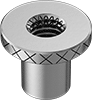
These nuts tighten when turned to the left; once fastened, they resist loosening from counterclockwise motion. They’re Grade 5 steel, so you can used these inch-sized nuts for most fastening applications.
These nuts should be used for light duty fastening applications, such as securing access panels.
These nuts tighten when turned to the left; once fastened, they resist loosening from counterclockwise motion. Made of Grade 2 and Class 04 steel, these nuts can be used for fastening panels and other light duty fastening applications.
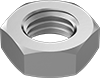
These nuts are about 25% stronger than medium-strength steel thin hex nuts. Available in inch thread sizes.
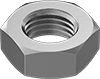
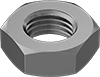
With threads that tighten to the left and made of 316 stainless steel, these nuts won’t loosen from counterclockwise motion in saltwater and corrosive environments. They’re half the height of standard hex nuts, so they fit where there’s low clearance.
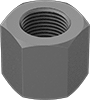
Taller than standard hex nuts, these nuts provide a larger gripping area for installation with a wrench.
These nuts are comparable in strength to Grade 9 bolts.
These nuts have good chemical resistance.
More corrosion resistant than 18-8 stainless steel nuts, these nuts can be used in saltwater environments.
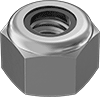
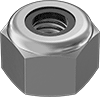
Includes inch thread sizes. These Grade 8 steel locknuts are 25% stronger than our medium-strength steel nylon-insert locknuts.
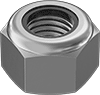
Made from Grade 5 steel, these inch-sized locknuts are suitable for fastening most machinery and equipment.
Made from low-strength steel, these locknuts should be used for light duty fastening applications, such as securing.access panels.
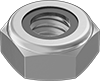
Choose these locknuts for their adherence to strict military standards for material and construction. They’re low-strength steel, so they should be used for fastening panels and other light duty fastening applications.
These locknuts have good chemical resistance.
More corrosion resistant than 18-8 stainless steel locknuts, these locknuts have excellent resistance to chemicals and salt water.
These Grade 8 locknuts are about 25% stronger than medium-strength steel thin locknuts.
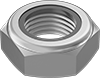
These locknuts are about half the height of standard nylon-insert locknuts. Use them in light duty low clearance applications or jam one against a hex nut to hold it in place.
Choose these locknuts for their adherence to strict military standards for material and construction.
These locknuts have good chemical resistance and may be mildly magnetic.
Comparable in strength to Grade 8 bolts, these locknuts are about 25% stronger than medium-strength steel locknuts.
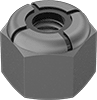
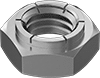
These locknuts have an irregularly shaped thread at the top of the nut that grips the bolt for a stronger hold than nylon-insert locknuts.
About half the strength of medium-strength steel locknuts, these are for light duty fastening applications, such as securing access panels.
These Grade 8 locknuts are about three times stronger than low-strength steel distorted-thread locknuts.
Use these locknuts for light duty fastening applications, such as securing access panels.
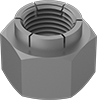
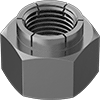
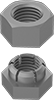
Threads at the top of these locknuts expand to grip the bolt on all sides for a stronger hold than distorted thread locknuts.
Made from 18-8 stainless steel, these flex top locknuts have good chemical resistance and may be mildly magnetic.
Known for their strength, these steel locknuts are cadmium plated to resist corrosion in wet environments.
Stainless steel locknuts have excellent corrosion resistance in most environments.
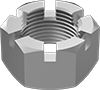
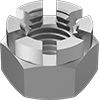
Also known as castle nuts, secure these nuts by inserting a cotter pin or safety wire through the slots and a drilled hole in your bolt for mild loosening resistance.
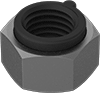
About two-thirds the height of standard steel-insert locknuts, use these locknuts in low-clearance applications or jam one against a hex nut to hold it in place.
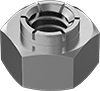
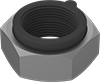
When installed, the steel insert grips the threads and lifts away from the nut body, isolating the insert from the nut's load to resist spinoff caused by vibration.
These locknuts include a two-piece clamp that expands to grip the bolt on all sides and a concave jam nut that clamps the threads onto the bolt for added vibration resistance. They're also known as drake-style nuts.
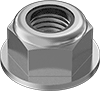
These flange locknuts are comparable in strength to Grade 8 bolts.
These flange locknuts have excellent resistance to chemicals and salt water. They have an irregularly shaped thread that grips the bolt for a stronger hold than nylon-insert flange locknuts.
Made from 18-8 stainless steel, these flange locknuts have good chemical resistance and may be mildly magnetic
About half the strength of medium-strength steel flange locknuts, these are for light duty fastening applications, such as securing access panels.
Grade F nuts are comparable in strength to Grade 5 bolts.
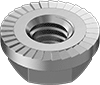
Made from Grade 8 steel, these nuts are about 25% stronger than medium-strength steel flange nuts.
About half the strength of medium-strength steel flange nuts, use these nuts in light duty fastening applications, such as securing access panels.
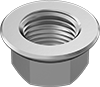
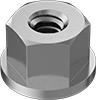
Made from 18-8 stainless steel, these flange nuts have good chemical resistance.
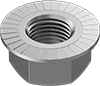
More corrosion resistant than 18-8 stainless steel flange nuts, these nuts have excellent resistance to chemicals and salt water.
Fiberglass flange nuts are chemical resistant, nonconductive, and lightweight.
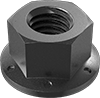
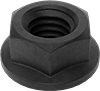
These flange nuts have a black-oxide finish for mild corrosion resistance in dry environments.
Stainless steel nuts have excellent corrosion resistance in most environments.
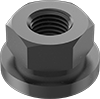
The nut head rotates while the flange remains stationary to prevent scratching the material surface as you tighten the nut.
Made from Grade 5 steel, these inch-sized coupling nuts are suitable for most applications.
About half the strength of medium-strength steel coupling nuts, these nuts are for light duty fastening applications.
Made from Grade 8 steel, these nuts are about 25% stronger than medium-strength steel coupling nuts. Furnished in inch thread sizes.
These coupling nuts have good chemical resistance.
More corrosion resistant than 18-8 stainless steel coupling nuts, these nuts have excellent resistance to chemicals and salt water.
Brass coupling nuts are corrosion resistant in wet environments and electrically conductive.
A smooth rounded body provides a finished look.
Stainless steel coupling nuts have excellent corrosion resistance in most environments.
These cap nuts have good chemical resistance and may be mildly magnetic.
These cap nuts have excellent resistance to chemicals and salt water.
About half the strength of medium-strength steel cap nuts, use them in light duty fastening applications, such as securing access panels.
Brass cap nuts are corrosion resistant in wet environments and electrically conductive.
These nylon 6/6 cap nuts are chemical resistant, nonconductive, and lightweight.
An irregularly shaped thread grips the bolt for a stronger hold than nylon-insert cap locknuts.
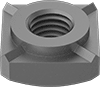
Square weld nuts have more weld points than hex weld nuts for a stronger hold. Use them on flat surfaces.
These nickel-plated brass sealing nuts have good resistance to chemicals and salt water.
Stainless steel sealing nuts have excellent corrosion resistance in most environments.
Wings provide more leverage for greater torque while tightening than knurled-head thumb nuts.
These wing nuts have good chemical resistance and may be mildly magnetic.
These thumb nuts have good chemical resistance and may be mildly magnetic.
Stronger than stainless steel, these nuts are comparable in strength to Grade 9 bolts.
About half the strength of medium-strength steel coupling nuts, these metric nuts are for light duty fastening applications.
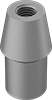
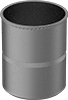
Use these tube-end weld nuts with left-hand threaded fasteners.
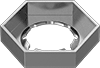
Hex speed nuts can be gripped with a wrench for ease of removal.
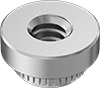
Also known as clinch style captive nuts, press these nuts into a drilled or punched hole with an arbor press or similar pressure tool.
About twice as strong as aluminum rivet nuts, these low-profile rivet nuts have a cadmium or tin-zinc plating for corrosion resistance.
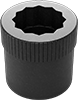
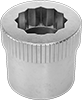
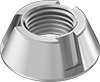
Tri-groove nuts are narrower than sloped and drilled spanner nuts to fit in tight spaces. Install with a tri-groove socket bit and either a drive handle or an open-end wrench.
Change thread sizes or types, such as fine to coarse threads, on parts without changing gender.
Change inch threads to metric with these adapters, or swap metric threads for inch. An external hex lets you tighten or loosen them with a wrench.
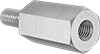
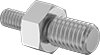
Connect two differently sized male-threaded parts, such as threaded rods, and tighten with a standard wrench.
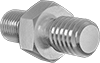
Adapt threaded rods from inch to metric. These adapters connect two male-threaded fasteners, so you can change the gender of a mating part or increase or decrease its thread size. The hex-shaped body fits into the head of a standard wrench.
Need to join two female-threaded parts, such as coupling nuts, with dissimilar inch thread sizes? Attach them to these adapters and tighten the exterior hex nut for a secure connection.
One side inch, one side metric, and a hex in the middle—these handy fasteners connect two female-threaded parts, such as coupling nuts, adapting from inch threads to metric. Tighten with a standard wrench.
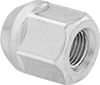
Use these lug nuts to secure a pneumatic wheel.
The closed body protects threads from damage and debris and has a slim profile to fit in tight spaces.
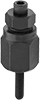
Combine with mounting blocks to mount and secure threaded-body shock absorbers.
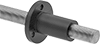
Also known as single-start and self-locking lead screws and nuts, these have a single thread that runs the length of the screw. The nut travels only when the screw turns, so your system won't unexpectedly move when the lead screw is at rest.
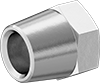
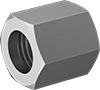
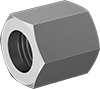
Use these nuts with a sleeve and fitting to provide a tight metal-to-metal seal on steel tubing that is flared to 37°.
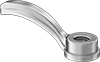
Use these handles for quick assembly and disassembly. Their offset grip provides leverage, making them a good alternative to wing nuts.
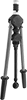
Use these tools to install most styles of rivet nuts. Use a wrench to hold the tool and a ratchet to tighten the nut.
Use these tools to install smooth and ribbed body rivet nuts. An indicator allows you to ensure your rivet nut installs correctly.
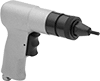
Smaller and lighter than cordless and hydraulic rivet nut tools, use these to install thin-walled bulbed, ribbed, sleeve, and smooth rivet nuts.
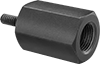
Use adapters on the ends of forcing screws and face-grip puller legs when pulling shafts, bearing caps, and pinions.