We will reply to your message within two hours.
More
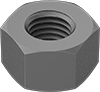
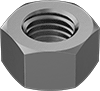
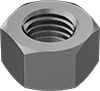
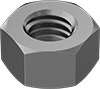
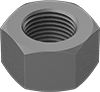
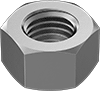
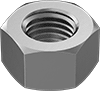
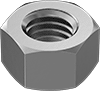
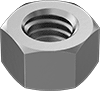
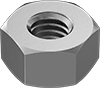
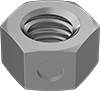
These nuts are suitable for fastening most machinery and equipment.
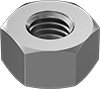
Choose these nuts for their adherence to strict military standards for material and construction.
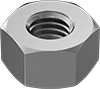
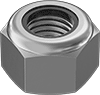
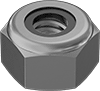
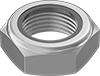
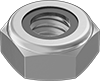
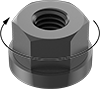
These nuts tighten when turned to the left; once fastened, they resist loosening from counterclockwise motion.
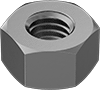
These nuts are about 25% stronger than medium-strength steel nuts.
These nuts come with a traceable lot number and a physical and chemical test report.
Tighten these nuts by turning them to the left; once fastened, they resist loosening from counterclockwise motion.
About half the strength of medium-strength steel nuts, these nuts are for light duty fastening applications.
These nuts are about 20% stronger than high strength steel nuts and are often used in heavy machinery.
These nuts have good chemical resistance and may be mildly magnetic.
These nuts have excellent chemical resistance and can be used in saltwater environments.
Hardened for added strength, these nuts are more corrosion resistant to chemicals and salt water than 18-8 stainless steel nuts.
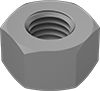
Commonly used to fasten structural parts and pumps, these nuts are comparable in strength to Grade 8 steel.
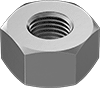
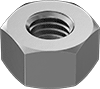
Made from nylon 6/6, these nuts resist oil, grease, and solvents (except mineral acids).
Fiberglass nuts are stronger than nylon 6/6 nuts. They resist acids, solvents, salt water, and oil.
PVC nuts resist acids, alkalies, salt solutions, and alcohol.
PTFE nuts withstand temperatures up to 500° F. They resist oil, grease, detergents, and most mineral acids. They're the lowest friction plastic nuts we offer, so they thread on smoothly.
Stronger than PTFE nuts and resistant to solvents, bases, and acids—including hydrochloric and nitric acid—these PVDF nuts are often used in chemical processing equipment.
These nuts are corrosion resistant in wet environments, electrically conductive, and nonmagnetic.
One-third the weight of steel, these aluminum nuts are corrosion resistant in wet environments and nonmagnetic.
Commonly used in valves, pumps, and shafts, these 400 nickel nuts resist salt water and caustic chemicals.
More corrosion resistant than 400 nickel nuts, these nuts are often used in marine environments and chemical-processing plants.
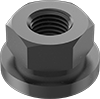
These nuts are resistant to salt water, electrically conductive, and nonmagnetic.
These nuts have a high strength-to-weight ratio and resist acids and salt water.
These nuts are comparable in strength to Grade 9 bolts.
Also kown as heavy hex nuts, these nuts are about 10% wider and taller than standard hex nuts to distribute load over a large area.
About half the strength of medium-strength steel extra-wide hex nuts, use these nuts for light duty fastening applications, such as securing access panels.
These nuts have good chemical resistance.
More corrosion resistant than 18-8 stainless steel nuts, these nuts can be used in saltwater environments.
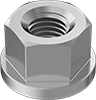
Brass nuts are resistant to corrosion in wet environments and electrically conductive.
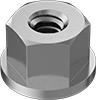
Bronze nuts are stronger and more resistant to salt water than brass nuts.
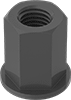
More corrosion resistant than 18-8 stainless steel nuts, these nuts have excellent resistance to chemicals and salt water.
Able to maintain their strength in high-pressure and high temperature environments, these nuts are used with ASTM A193 bolts to fasten pressure tanks, valves, and flanges.
Made from Grade 5 steel, these inch-sized nuts are suitable for most fastening applications.
These nuts tighten when turned to the left; once fastened, they resist loosening from counterclockwise motion. They’re Grade 5 steel, so you can used these inch-sized nuts for most fastening applications.
These nuts are about 25% stronger than medium-strength steel thin hex nuts. Available in inch thread sizes.
These nuts should be used for light duty fastening applications, such as securing access panels.
These nuts tighten when turned to the left; once fastened, they resist loosening from counterclockwise motion. Made of Grade 2 and Class 04 steel, these nuts can be used for fastening panels and other light duty fastening applications.
With threads that tighten to the left and made of 316 stainless steel, these nuts won’t loosen from counterclockwise motion in saltwater and corrosive environments. They’re half the height of standard hex nuts, so they fit where there’s low clearance.
Plastic nuts are chemical resistant, nonconductive, and lightweight.
These nuts tighten to the left and won’t loosen from counterclockwise motion.
Titanium nuts have a high strength-to-weight ratio and are resistant to acids and salt water.
Taller than standard hex nuts, these nuts provide a larger gripping area for installation with a wrench.
These nuts are often used in conjunction with an extra-wide hex nut to fasten Grade 9 bolts in heavy machinery, such as earth-moving equipment.
Use these nuts for light duty fastening applications, such as securing access panels.
Stainless steel nuts have excellent corrosion resistance in most environments.
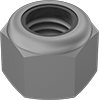
Includes inch thread sizes. These Grade 8 steel locknuts are 25% stronger than our medium-strength steel nylon-insert locknuts.
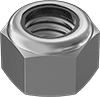
Made from Grade 5 steel, these inch-sized locknuts are suitable for fastening most machinery and equipment.
Made from low-strength steel, these locknuts should be used for light duty fastening applications, such as securing.access panels.
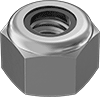
These locknuts have good chemical resistance.
More corrosion resistant than 18-8 stainless steel locknuts, these locknuts have excellent resistance to chemicals and salt water.
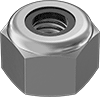
Brass locknuts are corrosion resistant in wet environments and electrically conductive.
Grade 5 locknuts are suitable for fastening most machinery and equipment when used in conjunction with a standard hex nut.
These locknuts are about half the height of standard nylon-insert locknuts. Use them in light duty low clearance applications or jam one against a hex nut to hold it in place.
These locknuts have good chemical resistance and may be mildly magnetic.
More corrosion resistant than 18-8 stainless steel locknuts, these have excellent resistance to chemicals and salt water.
Use these locknuts for light duty fastening applications, such as securing access panels.
Known for their strength, these locknuts are zinc-plated to resist corrosion in wet environments.
Comparable in strength to Grade 8 bolts, these locknuts are about 25% stronger than medium-strength steel locknuts.
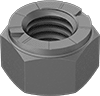
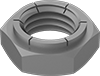
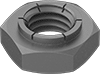
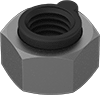
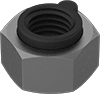
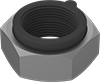
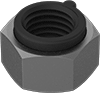
These locknuts have an irregularly shaped thread at the top of the nut that grips the bolt for a stronger hold than nylon-insert locknuts.
These Grade 9 locknuts are about 20% stronger than high-strength steel locknuts and are often used in heavy machinery, such as earth-moving equipment.
These Grade 8 locknuts are about three times stronger than low-strength steel distorted-thread locknuts.
These locknuts tighten when turned to the left.
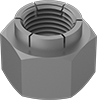
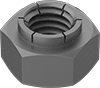
Threads at the top of these locknuts expand to grip the bolt on all sides for a stronger hold than distorted thread locknuts.
Known for their strength, these steel locknuts are cadmium plated to resist corrosion in wet environments.
About half the height and 10% wider than standard flex-top locknuts, use these locknuts in low-clearance applications or jam one against an extra-wide hex nut to hold it in place.
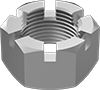
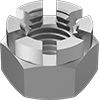
Also known as castle nuts, secure these nuts by inserting a cotter pin or safety wire through the slots and a drilled hole in your bolt for mild loosening resistance.
About half the strength of medium-strength steel locknuts, these are for light duty fastening applications, such as securing access panels.
Stainless steel locknuts have excellent corrosion resistance in most environments.
High-strength steel locknuts are about 25% stronger than medium-strength steel locknuts.
These locknuts are suitable for fastening most machinery and equipment.
About two-thirds the height of standard steel-insert locknuts, use these locknuts in low-clearance applications or jam one against a hex nut to hold it in place.
When installed, the steel insert grips the threads and lifts away from the nut body, isolating the insert from the nut's load to resist spinoff caused by vibration.
Made from Grade 8 steel, these nuts are about 25% stronger than medium-strength steel flange nuts.
About half the strength of medium-strength steel flange nuts, use these nuts in light duty fastening applications, such as securing access panels.
More corrosion resistant than 18-8 stainless steel flange nuts, these nuts have excellent resistance to chemicals and salt water.
Made from 18-8 stainless steel, these flange nuts have good chemical resistance.
Fiberglass flange nuts are chemical resistant, nonconductive, and lightweight.
These nuts are about 25% stronger than medium-strength steel flange locknuts.
About half the strength of medium-strength steel flange locknuts, these are for light duty fastening applications, such as securing access panels.
These flange locknuts are comparable in strength to Grade 8 bolts.
Grade F nuts are comparable in strength to Grade 5 bolts.
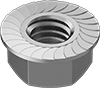
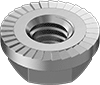
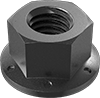
The nut head rotates while the flange remains stationary to prevent scratching the material surface as you tighten the nut.
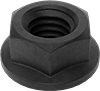
These flange nuts have a black-oxide finish for mild corrosion resistance in dry environments.
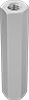
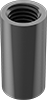
About half the strength of medium-strength steel coupling nuts, these nuts are for light duty fastening applications.
The left-hand threads on these coupling nuts resists loosening from counterclockwise vibration. Use in light duty applications.
Made from Grade 8 steel, these nuts are about 25% stronger than medium-strength steel coupling nuts. Furnished in inch thread sizes.
Made from Grade 5 steel, these inch-sized coupling nuts are suitable for most applications.
Comparable in strength to Grade 9 bolts, these coupling nuts are about 20% stronger than high-strength steel coupling nuts. Available in inch thread sizes.
These coupling nuts have good chemical resistance.
More corrosion resistant than 18-8 stainless steel coupling nuts, these nuts have excellent resistance to chemicals and salt water.
Brass coupling nuts are corrosion resistant in wet environments and electrically conductive.
One-third the weight of steel, aluminum coupling nuts resist corrosion in wet environments.
Known for their strength, steel coupling nuts are available with a corrosion-resistant finish.
Stainless steel coupling nuts have excellent corrosion resistance in most environments.
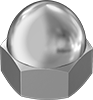
A smooth rounded body provides a finished look.
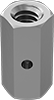
Use the sight hole to check for proper thread engagement.
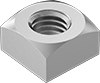
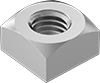
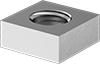
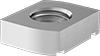
These Grade 5 square nuts are suitable for fastening most machinery and equipment.
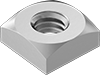
About half the strength of medium-strength steel square nuts, use these nuts in light duty fastening applications, such as securing access panels.
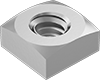
These square nuts have good chemical resistance and may be mildly magnetic.
More corrosion resistant than 18-8 stainless steel square nuts, these nuts have excellent resistance to chemicals and salt water.
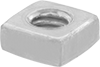
Plastic square nuts are chemical resistant, nonconductive, and lightweight.
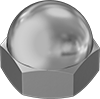
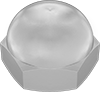
These cap nuts have good chemical resistance and may be mildly magnetic.
These cap nuts have excellent resistance to chemicals and salt water.
About half the strength of medium-strength steel cap nuts, use them in light duty fastening applications, such as securing access panels.
These nuts are about 25% stronger than medium-strength steel cap nuts.
These Grade 5 cap nuts are suitable for fastening most machinery and equipment.
Brass cap nuts are corrosion resistant in wet environments and electrically conductive.
Known for their strength, these steel cap nuts have a black-oxide finish to resist corrosion in dry environments.
Stainless steel cap nuts have excellent corrosion resistance in most environments.
Cover exposed threads with these caps to help prevent bacteria growth in food processing areas and other sanitary environments.
Low-profile cap nuts are about 20% shorter than standard cap nuts for use in low-profile applications.
An irregularly shaped thread grips the bolt for a stronger hold than nylon-insert cap locknuts.
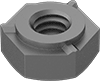
Weld these nuts to flat and uneven uncoated steel surfaces for a strong permanent hold.
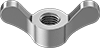
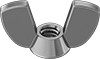
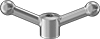
Wings provide more leverage for greater torque while tightening than knurled-head thumb nuts.
These wing nuts have good chemical resistance and may be mildly magnetic.
Brass wing nuts are corrosion resistant in wet environments and electrically conductive.
Stronger than stainless steel, these nuts are comparable in strength to Grade 9 bolts.
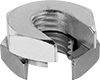
Attach these slip-on nuts at any point on a threaded rod for quick installation.
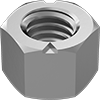
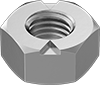
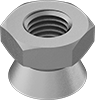
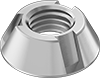
The most tamper-resistant nuts we offer, these have a hex head that breaks away upon tightening, leaving a non-removable cone. Install with a standard wrench.
Tri-groove nuts are narrower than sloped and drilled spanner nuts to fit in tight spaces. Install with a tri-groove socket bit and either a drive handle or an open-end wrench.
Hex speed nuts can be gripped with a wrench for ease of removal.
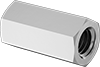
Connect two differently sized male-threaded parts, such as threaded rods, and tighten with a standard wrench.
Often called sleeve nuts, these thread adapters fasten parts with right-hand threads to parts with left-hand threads.
Change thread sizes or types, such as fine to coarse threads, on parts without changing gender.
Need to join two female-threaded parts, such as coupling nuts, with dissimilar inch thread sizes? Attach them to these adapters and tighten the exterior hex nut for a secure connection.
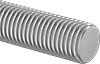
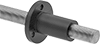
Also known as single-start and self-locking lead screws and nuts, these have a single thread that runs the length of the screw. The nut travels only when the screw turns, so your system won't unexpectedly move when the lead screw is at rest.
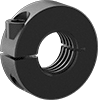
Thread these one-piece collars onto an Acme lead screw.
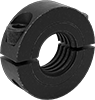
Mount these two-piece collars anywhere on an Acme lead screw without removing components.
Tighten these jam nuts against the turnbuckle body to prevent the fitting from loosening.
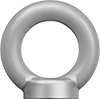
Create your own lifting eye by adding an eye nut to a stud or bolt.
Add an eye nut to threaded rod to hang the rod from rings, hooks, and hangers.
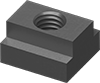
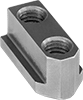
Designed to slide into T-slot tracks on machine tool tables, use these nuts to secure clamps and workpieces.
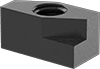
Install from the top of the T-slot track and secure with a quarter turn. Also known as quarter-turn T-slot nuts.
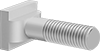
For quicker setups than a separate T-slot nut and stud, slide these bolts into T-slot tracks on machine tool tables.
Secure setup clamps and fixtures to your machine table, or assemble heavy machines, such as engine mounts.
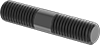
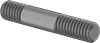
Also known as tap-end and fixture studs, these rods have friction-fit threads on one end to resist loosening and standard threads on the other side for attaching a nut.
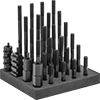
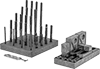
For mounting items to your machine table, these kits contain the full system of necessary components.
Get everything needed for basic workholding on a machine table.
Secure jaws to a CNC lathe chuck with industry standard 1.5 mm × 60° serrations or wider 3 mm × 60° serrations.
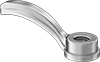
These handles are often used for operating machinery.
Use these handles for quick assembly and disassembly. Their offset grip provides leverage, making them a good alternative to wing nuts.
Also known as insert nuts, these convert slotted holes to threaded round holes and keep them centered in the channel.
Serrated grooves grip the lip of the channel.
Rated for high load capacity, use these inserts to connect threaded leveling mounts to heavy equipment.