We will reply to your message within two hours.
More
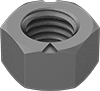
These nuts are suitable for fastening most machinery and equipment.
These metric nuts meet JIS (Japanese Industrial Standard) B 1181.
These nuts tighten when turned to the left; once fastened, they resist loosening from counterclockwise motion.
Closely spaced metric threads prevent these nuts from loosening due to vibration. About 25% stronger than medium-strength steel nuts, these nuts are comparable in strength to Class 10.9 bolts.
These nuts are about 25% stronger than medium-strength steel nuts.
About half the strength of medium-strength steel nuts, these nuts are for light duty fastening applications.
These nuts have good chemical resistance and may be mildly magnetic.
One-third the weight of steel, these aluminum nuts are corrosion resistant in wet environments and nonmagnetic.
Made from nylon 6/6, these nuts resist oil, grease, and solvents (except mineral acids).
These nuts should be used for light duty fastening applications, such as securing access panels.
These nuts tighten when turned to the left; once fastened, they resist loosening from counterclockwise motion. Made of Grade 2 and Class 04 steel, these nuts can be used for fastening panels and other light duty fastening applications.
These nuts are half the height of standard hex nuts, and have closely spaced threads to prevent loosening from vibration. Half as strong as medium-strength steel nuts, they are often used for light-duty applications, such as fastening signs in place.
Made from Grade 5 steel, these inch-sized nuts are suitable for most fastening applications.
These nuts are about 25% stronger than medium-strength steel thin hex nuts. Available in inch thread sizes.
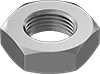
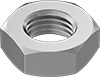
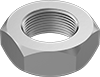
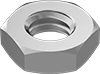
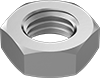
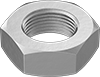
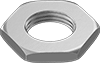
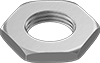
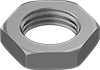
Made with fine-pitch threads, vibration is less likely to loosen these metric nuts than those with coarse-pitch threads since the threads sit closer together. Also called jam nuts, they are roughly half the height of standard hex nuts, so they’re good for applications with low clearance.
These metric nuts are made of 316 stainless steel and half as tall as regular hex nuts—use them around chemicals and salt water when space is limited.
With threads that tighten to the left and made of 316 stainless steel, these nuts won’t loosen from counterclockwise motion in saltwater and corrosive environments. They’re half the height of standard hex nuts, so they fit where there’s low clearance.
These nuts tighten to the left and won’t loosen from counterclockwise motion.
These steel panel nuts are zinc plated for corrosion resistance.
All of these stainless steel panel nuts have some chemical resistance.
Brass panel nuts are corrosion resistant in wet environments and electrically conductive.
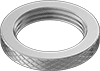
These panel nuts are knurled to provide a secure grip for tightening and loosening by hand.
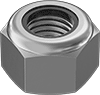
Closely spaced metric threads prevent loosening from vibration. These Class 10 steel locknuts are 25% stronger than our medium-strength steel nylon-insert locknuts.
Includes inch thread sizes. These Grade 8 steel locknuts are 25% stronger than our medium-strength steel nylon-insert locknuts.
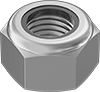
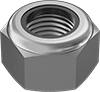
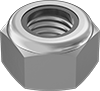
Get a grip on metric bolts exposed to vibration, wear, and changes in temperature. These metric locknuts have a nylon insert that holds onto bolts without damaging their threads.
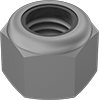
These metric locknuts have good chemical resistance.
More corrosion resistant than 18-8 stainless steel locknuts, these locknuts have excellent resistance to chemicals and salt water.
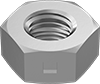
Comparable in strength to Grade 8 bolts, these locknuts are about three times stronger than low-strength steel extra-wide thin locknuts.
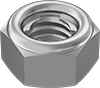
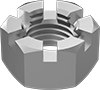
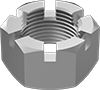
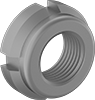
Also known as castle nuts, secure these nuts by inserting a cotter pin or safety wire through the slots and a drilled hole in your bolt for mild loosening resistance.
About half the strength of medium-strength steel locknuts, these are for light duty fastening applications, such as securing access panels.
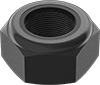
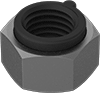
These metric locknuts have an irregularly shaped thread at the top of the nut that grips the bolt for a stronger hold than nylon-insert locknuts.
Comparable in strength to Grade 8 bolts, these locknuts are about 25% stronger than medium-strength steel locknuts.
Strong enough for use with most machinery and equipment, these Class 8 metric locknuts have an irregularly shaped thread in the middle of the nut that grips bolts tighter than nylon-insert locknuts.
These locknuts, also known as Fuji locknuts, maintain their holding power with reuse longer than nylon-insert locknuts. They have a spring ring that creates tension as you tighten the nut, keeping them in place.
When installed, the steel insert grips the threads and lifts away from the nut body, isolating the insert from the nut's load to resist spinoff caused by vibration.
Made from Grade 8 steel, these nuts are about 25% stronger than medium-strength steel flange nuts.
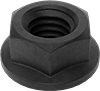
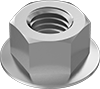
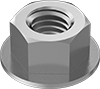
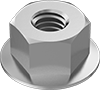
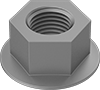
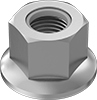
Also known as collar nuts, these metric nuts have a flange that distributes pressure across the surface, so you don't need a washer. Made of high-strength Class 10 steel, they’re about 25% stronger than medium-strength steel flange nuts.
These metric nuts meet JIS (Japanese Industrial Standard) B 1190.
Made to Japanese Industrial Standards, these nuts fasten most Japanese machinery and equipment without a washer.
No need for a washer—these metric medium-strength steel nuts have a flange that distributes pressure across its surface the way a washer does. Made of medium-strength, Class 8 steel, they’re suitable for fastening most machinery and equipment.
A smooth rounded body provides a finished look.
With a nylon insert that grips your threaded shaft or spindle without damaging its threads, these locknuts—also called shaft nuts—hold bearings, bushings, gears, and pulleys prone to vibration tightly in place.
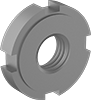
Often paired with spring lock washers to strengthen their hold, these retaining nuts—also known as shaft nuts—keep vibration from shifting bearings, bushings, pulleys, and gears on your threaded shaft or spindle.
Used in pairs or with another bearing retaining nut, these jam nuts—often called shaft nuts—hold bearings, bushings, pulleys, and gears in place on your threaded shaft or spindle.