
We will reply to your message within two hours.
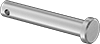
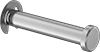
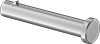
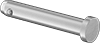
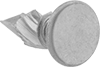
The low-profile head on these pins holds them in place on one side.
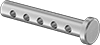
Also known as universal clevis pins, these pins have holes on 1/4" centers so you can change the length by moving the cotter pin.
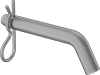
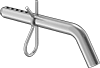
The bend makes these pins easy to insert and pull out.
These pins have multiple through holes; change the length by moving the cotter pin. The bend makes them easy to insert and pull out.
A large loop handle makes these pins easy to grip.
Install or remove these pins from either side.
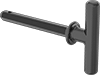
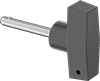
A plastic-coated T-handle welded to these pins makes them easy to grab.
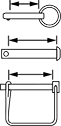
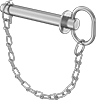
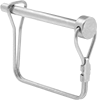
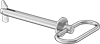
The wire retainer snaps closed to secure the pin for a one-piece alternative to a clevis and cotter pin combination. Also known as PTO pins.
Slide a retaining ring into the groove for a secure hold that takes up less space than a cotter pin.
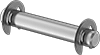
Install or remove these pins from either side. Slide a retaining ring into the groove for a secure hold that takes up less space than a cotter pin.
A swivel handle makes these pins easy to install and remove, while the toggle locks them in place. Flip the toggle to release the pin.
These one-piece fasteners lock in place with a toggle. Flip the toggle to release the pin.
Also known as gravity pins, these pins fit in holes on telescoping tubing to adjust the length.
Spring force holds pieces of telescoping tubing together. Also known as snap buttons and tubing buttons.
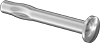
For the fastest installation, push these pins into a hole and a spring-loaded wedge pops out to lock them in place. Also known as slic pins.
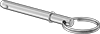
The smooth ring handle on these pins won't catch on parts. A spring-loaded, nonlocking retaining ball pops out when the pin is pushed through a hole, and retracts when the pin is pulled out.
These pins have a low-profile head, so they won't get knocked out of place. A spring-loaded, nonlocking retaining ball pops out when the pin is pushed through a hole, and retracts when the pin is pulled out.
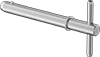
A T-handle makes these pins easy to grip. A spring-loaded, nonlocking retaining ball pops out when the pin is pushed through a hole, and retracts when the pin is pulled out.
A smooth ball handle is easy to grip and won't catch on other parts. A spring-loaded, nonlocking retaining ball pops out when the pin is pushed through a hole, and retracts when the pin is pulled out.
The smooth ring handle on these pins won't catch on parts. The shoulder keeps a portion of the pin outside the hole and makes them easy to grab.
A T-handle makes these pins easy to grip. The shoulder keeps a portion of the pin outside the hole and makes them easy to grab.
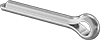
Also known as split pins, these have one prong slightly longer than the other so they’re easy to open. Bend prongs outward to secure.
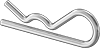
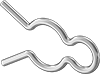
Also known as hitch pin clips and R-clips, these pins are easy to install and remove.
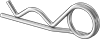
A coil makes a stronger grip than standard hairpin cotter pins to prevent accidental release.
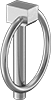
Slide the pin through a hole then snap the ring down to lock these pins in place. Also known as click pins.
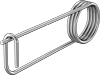
These pins are coiled for more tension than standard wire-snap cotter pins.
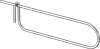
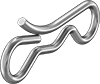
Also known as safety pins, these are easy to install and remove. Tension keeps them closed.
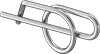
An extra loop locks these cotter pins more securely than other pins, so they can't vibrate out or be knocked off.
For parts that spin or are otherwise difficult to access, slide these pins in and tap them with a hammer for a temporary hold. Reposition work, then bend the prongs outward to secure.
The double-head design lets you push or pull these pins from either side of the hole. Once in place there's little chance they will be vibrated out or knocked off.
Clip these pins onto grooved shafts and clevis pins with retaining ring grooves.
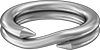
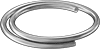
Also known as key rings, twist these rings into place to secure clevis pins, connect components, or add a pull handle. They don't have the sharp ends of other cotter pins.
Twist these rings on to lock pins in place. They don't have the sharp ends of other cotter pins.
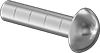
Grooves hold these pins in place, and a round head gives them a finished appearance.
These pins make good hinges or pivots. The grooved half locks pins in position, while the smooth half can act as a pivot. Also known as type H pins.
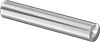
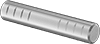
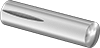
Grooves run the full length of these pins for a firm hold that won't spin. Use them in place of standard dowel, spring, and taper pins to fasten parts. Also known as type A pins.
Center-groove pins are often used in place of clevis pins or to create T-handles. The grooved center locks pins in position, while the smooth ends act as a pivot. Also known as type E pins.
These pins are commonly used as anchors for tension springs. The grooved half locks pins in position, and spring ends fit in to the notch. Also known as type G pins.
Quarter-groove pins are well suited for hinges or pivots. The grooved end locks pins in position, while the smooth portion can act as a pivot. Also known as type C pins.
Barbs bite into plastics and soft metals such as aluminum for a strong hold, and a round head gives a finished appearance.
Use these pins to fasten components made of soft materials such as plastic or aluminum. Opposing barbs bite into each piece, pulling them together for a tight, secure fit.
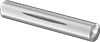
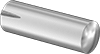
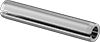
Also known as roll, tension, split, and expansion pins, these pins have a slot along one side that you squeeze closed to install them into unthreaded holes.
Also known as split pins, these have one prong slightly longer than the other so they’re easy to open.
Also known as hitch pin clips and R-clips, use these cotter pins in applications requiring quick installation and removal.
Clip these pins onto grooved shafts and clevis pins to keep components in place.
Slotted spring pins are also known as roll, tension, split, and expansion pins. Because the slot is pressed closed when the pins are inserted, they don't flex after installation.
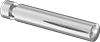
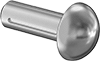
Clevis pins have a hole for a cotter pin on one end to lock them in place.
Also known as offset key stock, use step keys to repair keyways in gears and shafts.
A rounded bottom allows these keys to rock in their seat to relieve stress on the shaft caused by vibration or misalignment.
These keys are slightly undersized to fit in standard keyways.
Make a key that is the exact length you need. Slightly larger than the size listed, these oversized keys offer a tight fit in worn keyways.
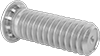
These steel studs are zinc plated to resist corrosion in wet environments.
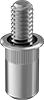
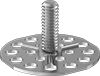
Add a stud to thin material when you only have access to one side.
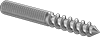
These studs are also known as hanger bolts—use them to hang, mount, and fasten parts to wood structures.
A zinc plating provides corrosion resistance in wet environments.
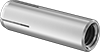
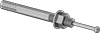
Install like a stud anchor—just thread the anchor, a nut, and a washer onto the end of a threaded rod, drive into a hole, and turn the nut to expand the base. Also known as rod anchors, they're often used with threaded rod to hang pipe and wiring.
Drive these tools with a hammer to expand anchors.
The fastest way to install shallow-hole female-threaded anchors. Just push the tip of the tool into the anchor and turn the tool with a power drill.
Use in applications requiring high strength.
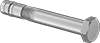
Turn the bolt to expand the nut for a secure hold in concrete. These anchors are often used to anchor machinery.
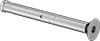
Bolts are beveled under the head for a flush finish in countersunk holes.
A drilled hole is required for installation.
A zinc plating provides mild corrosion resistance.
Also known as tank-strap bolts, these T-bolts are commonly used with a band clamp or a strap to hold fuel tanks and other objects in place.
Also known as round-head Type U drive screws.
Also known as flat-head Type 21 screws.
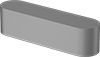
When installed, these keys fill oval keyways completely, reducing stress on the key and shaft. The rounded ends make it easy to slide gears, hubs, and other components into place. These are also known as feather keys.
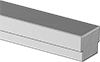
Cut this stock to length to create the machine key you need. Straight keys, with a square or rectangular cross section, are the most common type of key. Install in a keyway to transmit torque from shafts to gears and other components.
When a keyway is damaged, cut a new, wider one. This key stock is stepped to match repaired keyways in shafts or gears. Cut it to length to create the machine key you need.
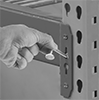
Prevent forklifts from knocking pallet racks apart—these 90° pins lock horizontal beams in place so you can safely load and unload pallets.