We will reply to your message within two hours.
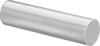
Use these metal dowel pins as pivots, hinges, shafts, jigs, and fixtures to locate or hold parts.
Slip these pins in and out during maintenance or prototyping—they’re undersized to make alignment easier.
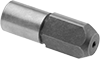
To remove these pins, thread a screw or tool into the tapped hole, then pull them out.
The flat side of these pins relieves trapped air, making them easier to insert in and remove from blind holes. To remove, thread a screw or tool into the tapped hole, then pull the pin out.
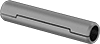
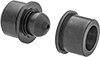
These pins make good hinges or pivots. The grooved half locks pins in position, while the smooth half can act as a pivot. Also known as type H pins.
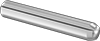
Grooves run the full length of these pins for a firm hold that won't spin. Use them in place of standard dowel, spring, and taper pins to fasten parts. Also known as type A pins.
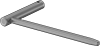
Center-groove pins are often used in place of clevis pins or to create T-handles. The grooved center locks pins in position, while the smooth ends act as a pivot. Also known as type E pins.
Pass wires and other components through these hollow pins.
Join two pieces of wood with these dowel pins. When glued, they expand for a tight fit.
These pins have a flat head to fit into a counterbored hole.
Push parts out of molds with these hardened pins. Also known as knockout and forged pins.
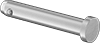
Slide a retaining ring into the groove for a secure hold that takes up less space than a cotter pin.
Install or remove these pins from either side. Slide a retaining ring into the groove for a secure hold that takes up less space than a cotter pin.
The low-profile head on these pins holds them in place on one side.
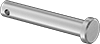
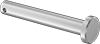
These pins combine the locking capabilities of a clevis pin with the precision diameter of a dowel pin for a tight fit.
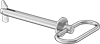
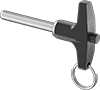
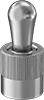
A swivel handle makes these pins easy to install and remove, while the toggle locks them in place. Flip the toggle to release the pin.
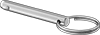
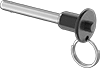
The smooth ring handle on these pins won't catch on parts. A spring-loaded, nonlocking retaining ball pops out when the pin is pushed through a hole, and retracts when the pin is pulled out.
These pins have a low-profile head, so they won't get knocked out of place. A spring-loaded, nonlocking retaining ball pops out when the pin is pushed through a hole, and retracts when the pin is pulled out.
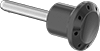
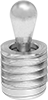
A high-profile knob is easy to grip, but fits in small spaces. A spring-loaded, nonlocking retaining ball pops out when the pin is pushed through a hole, and retracts when the pin is pulled out.
Two spring-loaded balls give these pins more holding power than quick-release pins with only one retaining ball. The balls pop out when the pin is pushed into a hole, and retract when the pin is pulled out.
For a more secure hold than standard quick-release pins, these pins lock in place until you push the button to release the spring-loaded retaining balls.
The extra height and smaller width of the grip make the button more accessible in tight spaces. For a more secure hold than standard quick-release pins, these pins lock in place until you push the button to release the spring-loaded retaining balls.
For the tightest spaces, these narrow-grip pins have the smallest heads of any of our locking quick-release pins. They lock in place until you push the button to release the spring-loaded retaining balls.
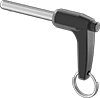
When there isn't enough room for a T-handle, an L-handle saves space but is still easy to grip. For a more secure hold than standard quick-release pins, these pins lock in place until you push the button to release the spring-loaded retaining balls.
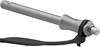
The shaft on these pins retracts into the head to hold thin sheets of material together. Pins lock in place until you push the button to release the spring-loaded retaining balls.
Attach these pins to a machine cover or access panel, then clip them in to receptacles installed in the enclosure for quick access. Pins lock in place until you release them.
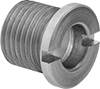
Use a screwdriver to install these receptacles in a threaded hole.
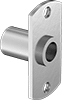
When you can't drill a through hole, use one of these flanged receptacles to provide a permanent, blind hole for a quick-release pin.
Use these retaining caps to secure the ends of quick-release pins in holes that are oversized or out of round.
A strong magnet in the head holds these pins in place on steel and other ferrous metals. Use them for light duty applications and blind holes.
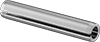
Also known as roll, tension, split, and expansion pins, these pins have a slot along one side that you squeeze closed to install them into unthreaded holes.
These spiral pins remain flexible after installation, so they absorb shock and vibration better than slotted spring pins. They work well in holes that are out of round.
For tough jobs, these spiral pins are 30% stronger than our standard coiled spring pins. They remain flexible after installation to absorb shock and vibration, and work well in holes that are out of round.
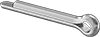
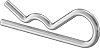
Also known as split pins, these have one prong slightly longer than the other so they’re easy to open. Bend prongs outward to secure.
Also known as hitch pin clips and R-clips, these pins are easy to install and remove.
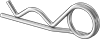
A coil makes a stronger grip than standard hairpin cotter pins to prevent accidental release.
Position, pivot, and align components. Also known as pilot pins and PEM® TP4, TPS, and MPP pins.
Threads on these pins stick out for easy removal from blind holes. Tighten the hex nut to draw the pin out.
To remove these pins, hit the small end with a punch to drive the pin out.
Screw the threaded end of these metric studs into a tapped hole and use the unthreaded end as a pivot point, hinge, shaft, or locator pin.
These steel studs are zinc plated to resist corrosion in wet environments.
18-8 stainless steel studs have good chemical resistance.
316 stainless steel studs have excellent resistance to chemicals and salt water.
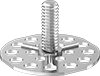
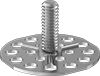
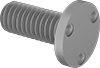
Pass these studs through a hole and weld them in place.
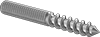
These metric 316 stainless steel studs have excellent resistance to chemicals and salt water. Also known as hanger bolts, use them to hang, mount, and fasten parts to wood structures.
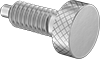
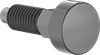
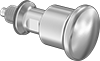
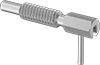
Retract the nose by pulling the knob.
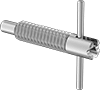
Lock the nose into the retracted position by pulling the knob and rotating it 90°.
Quickly align, join, or hold machine components in place in food, pharmaceutical, and other sanitary environments. Pulling the plunger knob and twisting it 90° will lock the nose into its retracted position.
Lock the nose into the retracted position by pulling the handle and rotating it 90°.
Lock the nose into the retracted position by pulling the ring and rotating it 90°.
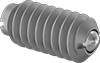
Designed with a flange to keep the plunger from being pushed through a hole when the ball is depressed.
The flangeless design allows these spring plungers to mount flush with a surface.
Install these spring plungers with a screwdriver—they're slotted on one or both ends.
Install with a hex key for more torque than slotted long-nose spring plungers.
Install with a driver.
These spring plungers have a nose that is about three-times longer than standard long hex-nose spring plungers.
Fasten from the nose end with a wrench for more torque than slotted long-nose spring plungers.
Slotted on both ends for installation with a screwdriver.
Install spring plungers from the nose end without depressing the nose.
When installed, these keys fill oval keyways completely, reducing stress on the key and shaft. The rounded ends make it easy to slide gears, hubs, and other components into place. These are also known as feather keys.
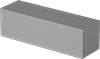
Straight keys, with a square or rectangular cross section, are the most common type of key. Install them in keyways to transmit torque from shafts to gears and other components.
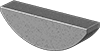
Woodruff keys work well near shaft shoulders and on tapered shafts. These keys have a rounded shape that makes them easy to remove when parts need to be taken apart frequently. Use them in light duty applications to connect gears and other components to shafts. Also known as half moon keys.
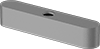
Thread a screw through the tapped hole to pop these keys out of a keyway. When installed, they fill oval keyways completely, reducing stress on the key and shaft. The rounded ends make it easy to slide gears, hubs, and other components into place.
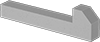
These keys have a tapered body that wedges in to the keyway for a more secure fit than standard machine keys. The gib head makes them easy to remove when parts need to be taken apart frequently, such as for maintenance or prototyping.
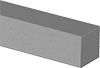
Cut this stock to length to create the machine key you need. Straight keys, with a square or rectangular cross section, are the most common type of key. Install in a keyway to transmit torque from shafts to gears and other components.
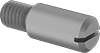
Without a head to get in the way, these screws fit in tight spaces where standard shoulder screws cannot. Either thread them in a countersunk hole for a flush mount, or install them with the shoulder sticking out to use them as pins or dowels for aligning and locating components.
Coiled spring pins are flexible after installation, so they absorb shock and vibration better than slotted spring pins. They also have higher dynamic load capacities and accommodate wider hole tolerances.
Slotted spring pins are also known as roll, tension, split, and expansion pins. Because the slot is pressed closed when the pins are inserted, they don't flex after installation.
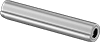
Dowel pins are commonly used as pivots, hinges, shafts, jigs, and fixtures to locate or hold parts. They're slightly oversized for a tight fit.
Also known as split pins, these have one prong slightly longer than the other so they’re easy to open.
These assortments include various sizes of key stock—choose a piece and cut it to your desired length.
Slightly larger than the size listed, these oversized keys offer a tight fit in worn keyways.
These keys are slightly undersized to fit in standard keyways.
A rounded bottom allows these keys to rock in their seat to relieve stress on the shaft caused by vibration or misalignment.
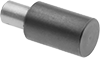
Support and position workpieces and fixtures from the bottom or side. These buttons press into a drilled hole for permanent installation.
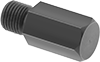
Use these buttons to support and position workpieces and fixtures from the bottom or side. Their hex shape lets you screw them into a threaded hole with a wrench or socket.
Mount through the counterbored hole with a socket head cap screw to support and position workpieces and fixtures from the bottom or side.
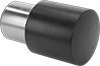
Support rounded or irregularly shaped workpieces from the bottom or side with minimal contact.
Install these pins in a plate or table and mate with holes in a workpiece for precise alignment.
Maintain consistent alignment in mating parts by installing a pin in one part and a liner in the other.
Precisely align drilled holes in two parts.
Threading makes these guide pins easier to remove and replace than press fit, so they're useful for high-wear applications.
As the workpiece pushes against the pin head in one direction, the internal spring pushes back to hold it in place for clamping.
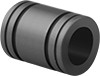
Sealed at the top to prevent debris from getting inside and making them seize up, these guide pins are a good choice for machining fixtures.
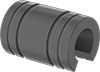
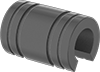
Build these components into fixture plates, machine subplates, and tombstones for quick changes. The system clamps and locates at the same time for accurate positioning with repeatability of ±0.0005".
Use these components in coordinate measuring machine (CMM) applications to raise a workpiece and reliably position it on a fixture plate with ¼"-20 holes.
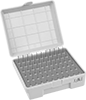
These metric Class Z plug gauges are used for precision go/no-go measuring of hole sizes and depths, checking hole location and distance, and setting micrometers. They’re also known as pin gauges.
Use these metric Class X plug gauges for precision go/no-go measuring of hole sizes and depths, checking hole location and distance, and setting micrometers. They’re also called pin gauges.
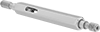
Take go and no-go measurements with the same tool. These gauges have a go gauge on one end, a no-go gauge on the other end, and a handle with bushings.
Take precision go/no-go measurements of hole sizes and depths, check hole location and distance, and set micrometers.
These gauges come with a certificate of calibration traceable to NIST that states they’ve passed a test for accuracy.
These have a go gauge on one end and a no-go gauge on the other end.
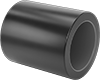
Thinner than standard linear sleeve bearings, these bearings fit where clearance is a concern.
Use these ultra-thin sleeve bearings in high-speed applications where clearance is a concern.
Because they usually do not require lubrication, linear sleeve bearings outperform linear ball bearings in dirty environments.
Ridges on the inside of these bearings wipe away dust and debris as the bearing travels on a shaft.
A ceramic liner makes high speeds as well as rapid acceleration and deceleration possible.
These bearings have a ceramic liner to help them achieve high speeds as well as rapid acceleration and deceleration.
Sleeve bearings outperform ball bearings in dirty environments. Use them for low speed applications.