
We will reply to your message within two hours.
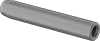
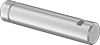
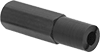
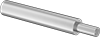
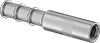
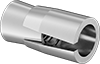
To remove these pins, thread a screw or tool into the tapped hole, then pull them out.
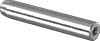
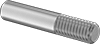
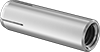
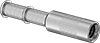
The flat side of these pins relieves trapped air, making them easier to insert in and remove from blind holes. To remove, thread a screw or tool into the tapped hole, then pull the pin out.
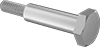
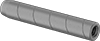
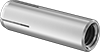
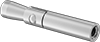
A spiral groove cut into these pins relieves trapped air but stays in 360° contact with the hole for a secure fit that's easy to insert in and remove from blind holes. To remove, thread a screw or tool into the tapped hole, then pull the pin out.
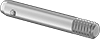
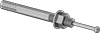
Add a knob or handle to the threaded shank. A spring-loaded, nonlocking retaining ball pops out when the pin is pushed through a hole, and retracts when the pin is pulled out.
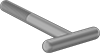
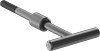
Choose a material, head type, end type, and size to create a custom pin.
Create a custom headed pin with your choice of material, dimensions, and end type.
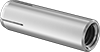
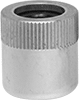
These internally threaded pins sit flush in an assembly. For easy removal from a blind hole, thread a screw into the pin and pull out.
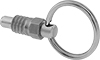
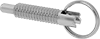
The ring allows you to attach these spring plungers to a lanyard.
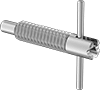
Lock the nose into the retracted position by pulling the ring and rotating it 90°.
Use the lanyard as a tether to secure the spring plunger to machinery and prevent accidental drops.
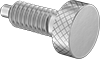
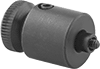
Retract the nose by pulling the knob.
Lock the nose into the retracted position by pulling the knob and rotating it 90°.
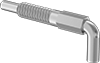
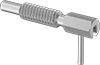
Lock the nose into the retracted position by pulling the handle and rotating it 90°.
Install by hand or with a hex key in low-clearance applications.
Thread onto machinery or attach a knob or handle to the threaded spindle.
Install with a hex key for more torque than slotted long-nose spring plungers.
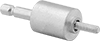
Install with a driver.
Fasten from the nose end with a wrench for more torque than slotted long-nose spring plungers.
Slotted on both ends for installation with a screwdriver.
Install with a hex key for more torque than slotted ball-nose spring plungers.
Install these spring plungers with a screwdriver—they're slotted on one or both ends.
Mount ball-nose and long-nose spring plungers to fixture surfaces.
Install spring plungers from the nose end without depressing the nose.
Screw these studs into a tapped hole and use them as a pivot point, hinge, shaft, or locator pin.
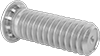
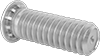
Weld these studs to uncoated steel surfaces.
These studs have good chemical resistance. Weld them to stainless steel surfaces.
Pass these studs through a hole and weld them in place.
A hollow center allows these studs to be used as an axle, a vent, or a passageway for wiring.
316 stainless steel studs have excellent resistance to chemicals and salt water.
These steel studs are zinc plated to resist corrosion in wet environments.
18-8 stainless steel studs have good chemical resistance.
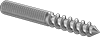
18-8 stainless steel studs have good chemical resistance and may be mildly magnetic. Also known as hanger bolts, use them to hang, mount, and fasten parts to wood structures.
These studs are also known as hanger bolts—use them to hang, mount, and fasten parts to wood structures.
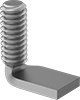
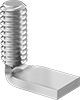
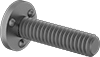
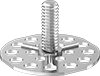
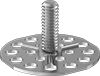
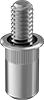
Add a stud to thin material when you only have access to one side.
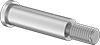
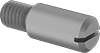
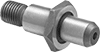
Without a head to get in the way, these screws fit in tight spaces where standard shoulder screws cannot. Either thread them in a countersunk hole for a flush mount, or install them with the shoulder sticking out to use them as pins or dowels for aligning and locating components.
A zinc plating provides mild corrosion resistance.
Also known as tank-strap bolts, these T-bolts are commonly used with a band clamp or a strap to hold fuel tanks and other objects in place.
Also known as clamping pins, these bolts have a collar that slides along the shaft and can be welded in place to clamp work in place and prevent over torquing.
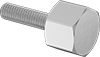
Stainless steel thumb screws have excellent corrosion resistance in most environments.
An adjustable stop allows you to set anchors at consistent depths. Use with a hammer.
The fastest way to install shallow-hole female-threaded anchors. Just push the tip of the tool into the anchor and turn the tool with a power drill.
Drive these tools with a hammer to expand anchors.
Also known as caulk-in anchors, these stay secure when there's not much material to hold.
Also known as double expansion anchors, these expand from both sides for full contact and a secure hold.
Often referred to as four-way expansion anchors, these expand in four directions to resist loosening from vibration.
Drive these tools with a hammer until the thicker portion of the tool makes contact with the anchor, causing it to expand.
These 18-8 stainless steel anchors have good chemical resistance.
More corrosion resistant than 18-8 stainless steel anchors, these 316 stainless steel anchors have excellent resistance to chemicals and salt water.
A zinc plating provides corrosion resistance in wet environments.
These 316 stainless steel anchors have excellent resistance to chemicals and salt water.
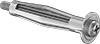
Install like a stud anchor—just thread the anchor, a nut, and a washer onto the end of a threaded rod, drive into a hole, and turn the nut to expand the base. Also known as rod anchors, they're often used with threaded rod to hang pipe and wiring.
Use in applications requiring high strength.
For narrow holes and small cavities where toggle anchors won't fit.
A drilled hole is required for installation.
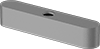
Thread a screw through the tapped hole to pop these keys out of a keyway. When installed, they fill oval keyways completely, reducing stress on the key and shaft. The rounded ends make it easy to slide gears, hubs, and other components into place.
Screw the shank into a threaded hole for quick installation and removal.
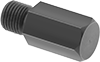
Use these buttons to support and position workpieces and fixtures from the bottom or side. Their hex shape lets you screw them into a threaded hole with a wrench or socket.
The swiveling tip supports uneven and angled surfaces.
Thread in a screw, handle, or other part to create the right size and shape guide pin for your application.
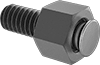
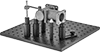
Use these components in coordinate measuring machine (CMM) applications to raise a workpiece and reliably position it on a fixture plate with ¼"-20 holes.
Weld threaded studs and pins to steel and stainless steel without damaging the opposite side of the material. This process uses heat from resistance to an electrical current.
These have a go gauge on one end and a no-go gauge on the other end.
These gauges come with a certificate of calibration traceable to NIST that states they’ve passed a test for accuracy.