
We will reply to your message in the morning.
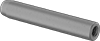
To remove these pins, thread a screw or tool into the tapped hole, then pull them out.
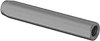
The flat side of these pins relieves trapped air, making them easier to insert in and remove from blind holes. To remove, thread a screw or tool into the tapped hole, then pull the pin out.
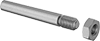
Threads on these pins stick out for easy removal from blind holes. Tighten the hex nut to draw the pin out.
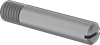
Screw the threaded end of these metric studs into a tapped hole and use the unthreaded end as a pivot point, hinge, shaft, or locator pin.
18-8 stainless steel studs have good chemical resistance.
These steel studs are zinc plated to resist corrosion in wet environments.
316 stainless steel studs have excellent resistance to chemicals and salt water.
These metric 316 stainless steel studs have excellent resistance to chemicals and salt water. Also known as hanger bolts, use them to hang, mount, and fasten parts to wood structures.
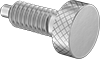
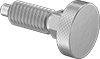
Retract the nose by pulling the knob.
Lock the nose into the retracted position by pulling the knob and rotating it 90°.
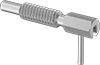
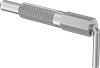
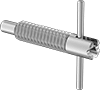
Lock the nose into the retracted position by pulling the handle and rotating it 90°.
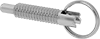
Lock the nose into the retracted position by pulling the ring and rotating it 90°.
Install with a hex key for more torque than slotted long-nose spring plungers.
Install with a driver.
Install these spring plungers with a screwdriver—they're slotted on one or both ends.
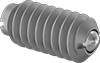
Install spring plungers from the nose end without depressing the nose.
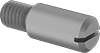
Without a head to get in the way, these screws fit in tight spaces where standard shoulder screws cannot. Either thread them in a countersunk hole for a flush mount, or install them with the shoulder sticking out to use them as pins or dowels for aligning and locating components.
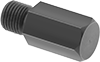
Use these buttons to support and position workpieces and fixtures from the bottom or side. Their hex shape lets you screw them into a threaded hole with a wrench or socket.
Build these components into fixture plates, machine subplates, and tombstones for quick changes. The system clamps and locates at the same time for accurate positioning with repeatability of ±0.0005".
Use these components in coordinate measuring machine (CMM) applications to raise a workpiece and reliably position it on a fixture plate with ¼"-20 holes.
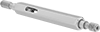
These have a go gauge on one end and a no-go gauge on the other end.
These gauges come with a certificate of calibration traceable to NIST that states they’ve passed a test for accuracy.