We will reply to your message within two hours.
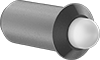
Use these pins for visibility or to color-code processes. For a more secure hold than standard quick-release pins, they lock in place until you push the button to release the spring-loaded retaining balls.
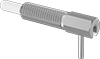
The shaft on these pins retracts into the head to hold thin sheets of material together. Pins lock in place until you push the button to release the spring-loaded retaining balls.
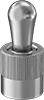
Attach these pins to a machine cover or access panel, then clip them in to receptacles installed in the enclosure for quick access. Pins lock in place until you release them.
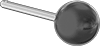
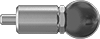
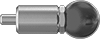
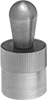
A smooth ball handle is easy to grip and won't catch on other parts. A spring-loaded, nonlocking retaining ball pops out when the pin is pushed through a hole, and retracts when the pin is pulled out.
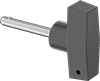
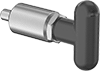
A T-handle makes these pins easy to grip. A spring-loaded, nonlocking retaining ball pops out when the pin is pushed through a hole, and retracts when the pin is pulled out.
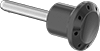
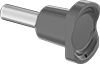
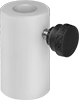
A high-profile knob is easy to grip, but fits in small spaces. A spring-loaded, nonlocking retaining ball pops out when the pin is pushed through a hole, and retracts when the pin is pulled out.
A strong magnet in the head holds these pins in place on steel and other ferrous metals. Use them for light duty applications and blind holes.
Plastic pins are a nonconductive and nonmagnetic alternative to metal dowel pins. Use them as pivots, hinges, shafts, jigs, and fixtures to locate or hold parts.
Lock the nose into the retracted position by pulling the knob and rotating it 90°.
Retract the nose by pulling the knob.
Lock the nose into the retracted position by pulling the handle and rotating it 90°.
A quarter turn of the handle locks these plungers in the retracted position. The T-handle is easy to grip.
A T-handle makes these spring plungers easy to grip.
A quarter turn of the handle locks these plungers in the retracted position. The smooth ball handle is easy to grip and won't catch on other parts.
A smooth ball handle is easy to grip and won't catch on other parts.
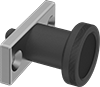
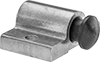
Two holes in the plate allow these plungers to be mounted to a flat surface.
Install with a hex key for more torque than slotted long-nose spring plungers.
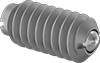
Install with a driver.
Slotted on both ends for installation with a screwdriver.
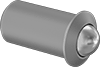
A flange keeps the plunger from being pushed through a hole when the ball is depressed.
Designed with a flange to keep the plunger from being pushed through a hole when the ball is depressed.
Install these spring plungers with a screwdriver—they're slotted on one or both ends.
As the workpiece pushes against the pin head in one direction, the internal spring pushes back to hold it in place for clamping.
Sealed at the top to prevent debris from getting inside and making them seize up, these guide pins are a good choice for machining fixtures.
As the face of these plungers is pushed in, the internal spring applies outward pressure to hold a workpiece in position against stops and rails.
Mount through the counterbored hole with a socket head cap screw to support and position workpieces and fixtures from the bottom or side.
Use these components in coordinate measuring machine (CMM) applications to raise a workpiece and reliably position it on a fixture plate with ¼"-20 holes.