


For Use With For Use With | Show |
|---|
|
For Use With For Use With | Hide |
|---|
Maximum Inlet Pressure Maximum Inlet Pressure |
|---|
|
Body Material Body Material |
|---|
|
Outlet Connection Type Outlet Connection Type |
|---|
 | Pipe |
Maximum Outlet Pressure Gauge Maximum OutletPressure Gauge |
|---|
|
Mounting Location Mounting Location |
|---|
|
Inlet Gender Inlet Gender |
|---|
|
Inlet Connection Style Inlet Connection Style |
|---|
 |
| Threaded |
Shape Shape |
|---|
 | 30° Elbow |
DFARS (Defense Acquisition Regulations Supplement) DFARS (Defense AcquisitionRegulations Supplement)  |
|---|
Outlet Gender Outlet Gender |
|---|
|
Diaphragm Material Diaphragm Material |
|---|
|
Gauge Port Location Gauge Port Location |
|---|
|
Inlet CGA Number Inlet CGA Number |
|---|
|
Inlet Thread Direction Inlet Thread Direction |
|---|
|
Inlet Pressure Gauge Included Inlet Pressure Gauge Included |
|---|
|
Inlet Thread Size Inlet Thread Size |
|---|
|
Minimum Outlet Pressure Gauge Minimum OutletPressure Gauge |
|---|
|
REACH (Registration, Evaluation, Authorization and Restriction of Chemicals) REACH (Registration,Evaluation, Authorization and Restriction of Chemicals) |
|---|
|
About Gas Regulators
More
Tank-Mount Pressure-Regulating Valves for Fuel Gases
- For Use With: See Table
- Temperature Range: -20° to 120° F
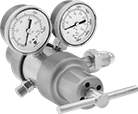
Attach these valves to acetylene, hydrogen, methane, propane, or propylene tanks to reduce a high inlet pressure to a lower, stable outlet pressure. They have Compressed Gas Association (CGA) numbered inlet fittings for secure connections to compressed gas tanks. Choose a valve with the same CGA number as your tank and other system components. Valves come with a gauge to monitor outlet pressure and a gauge to monitor inlet pressure from the tank.
Choose a valve with a maximum outlet pressure that’s approximately twice your application’s normal operating pressure. Your operating pressure should never exceed 75% of the valve’s maximum outlet pressure.
Single-stage valves reduce pressure in one step, which causes the outlet pressure to fluctuate slightly as you empty the tank. They’re best for applications where a constant outlet pressure isn’t critical.
Two-stage valves progressively reduce pressure over two steps for more consistent outlet pressure at all times. They’re often used in applications that require a constant outlet pressure regardless of the tank level.
Valves with a brass body have a longer service life than valves with a brass and steel body.
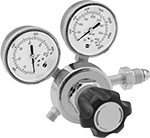
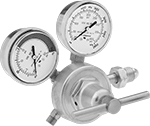
Inlet | Outlet | Material | |||||||||||
|---|---|---|---|---|---|---|---|---|---|---|---|---|---|
| CGA Number | Location | Thread Direction | Pressure Gauge Range, psi | Thread Size | Location | Thread Direction | Pressure Range, psi | Pressure Adjustment Method | Body | Seal | Diaphragm | Each | |
For Use With Propane and Propylene | |||||||||||||
UNF Male Outlet × NGO Male Inlet | |||||||||||||
| CGA 510 | Side | Left Hand | 0 to 400 | 9/16"-18 | Side | Left Hand | 0 to 50 | T-Handle | Brass | PTFE | Rubber | 0000000 | 0000000 |
| CGA 510 | Side | Left Hand | 0 to 400 | 9/16"-18 | Side | Left Hand | 5 to 50 | Knob | Brass/Steel | PTFE | Rubber | 0000000 | 000000 |
Inlet | Outlet | Material | |||||||||||
|---|---|---|---|---|---|---|---|---|---|---|---|---|---|
| CGA Number | Location | Thread Direction | Pressure Gauge Range, psi | Thread Size | Location | Thread Direction | Pressure Range, psi | Pressure Adjustment Method | Body | Seal | Diaphragm | Each | |
For Use With Propane and Propylene | |||||||||||||
UNF Male Outlet × NGO Male Inlet | |||||||||||||
| CGA 510 | Side | Left Hand | 0 to 400 | 9/16"-18 | Side | Left Hand | 0 to 50 | T-Handle | Brass/Steel | PTFE | Rubber | 0000000 | 0000000 |