

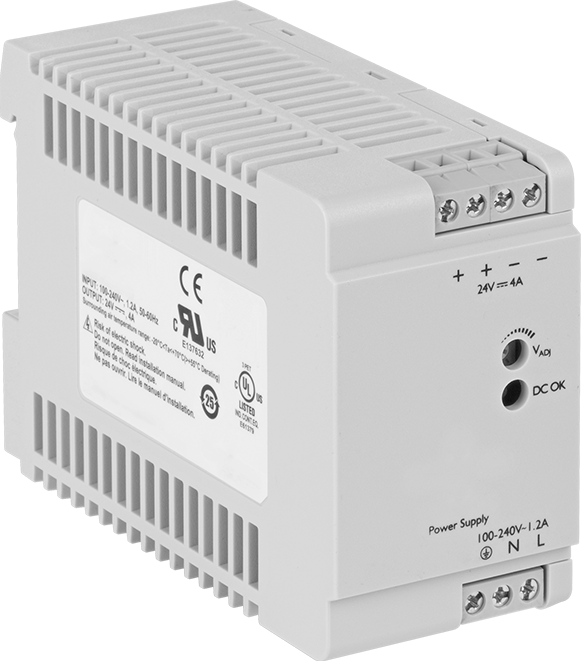
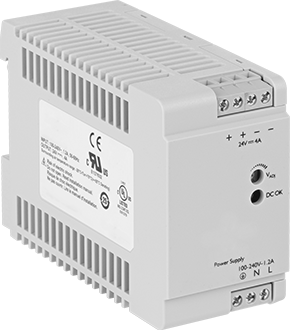
DIN-Rail-Mount Power Supply
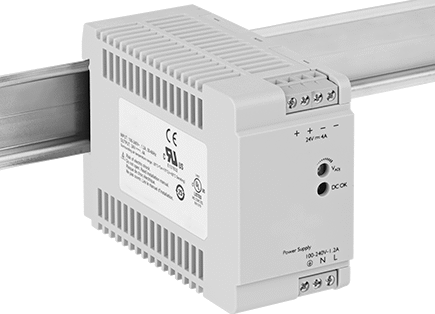
Single Phase, 24V DC, 4A
Input | |
Voltage | 100V AC to 240V AC |
Current @ Voltage | 1.2 amp @ 115V AC, 0.6 amp @ 230V AC |
Frequency | 50 Hz, 60 Hz |
Electrical Phase | Single |
Connection Type | Hardwire |
Electrical Connection | |
Input | Screw-Clamp Terminal |
Output | Screw-Clamp Terminal |
Output | |
Number of Power Connections | 2 |
Voltage | 24V DC |
Voltage Adjustment Range | 24V DC to 28V DC |
Current | 4 amp |
Maximum Noise Peak-to-Peak | 75 mV DC |
Power | 96 W |
Connection Type | Hardwire |
Power Factor @ Voltage | 0.9 @ 115V AC |
Efficiency @ Voltage | 89% @ 115V AC |
For Extra-Low Voltage Circuit Type | SELV |
Enclosure Rating | IP20 |
Certification | UL Listed |
Circuit Wiring Type | Parallel, Single |
Depth | 3.93" |
Electrical Protection Type | Over Temperature, Overcurrent, Overload, Overvoltage |
For DIN Rail | |
Trade Size | 3 |
Height | 35 mm |
Height | 2.95" |
Housing | |
Color | Gray |
Material | Plastic |
Manufacturer | |
Name | SolaHD |
Model Number | SVL4-24-100 |
Maximum Inrush Current @ Voltage | 35 amp @ 115V AC, 60 amp @ 230V AC |
Mounting Location | DIN Rail |
Temperature | 0° F to 155° F |
Voltage Regulator Type | Switching |
Width | 1.77" |
Country of Origin | Thailand |
DFARS Compliance | Specialty Metals COTS-Exempt |
Export Control Classification Number (ECCN) | EAR99 |
REACH Compliance | Not Compliant |
RoHS Compliance | RoHS 3 (2015/863/EU) Compliant with Exemptions |
RoHS Exemptions | 7(a), 7(c)-I |
Schedule B Number | 850440.9510 |
U.S.–Mexico–Canada Agreement (USMCA) Qualifying | No |
Mount these power supplies onto DIN rails inside electrical panels and enclosures—they convert AC to DC voltage to power electronic equipment. With a set of standard features, they're a cost-effective option for clean, controlled environments with a stable supply of electricity. Use them to power testing and measuring devices as well as commercial equipment, such as printers and ATMs. Unlike heavy duty power supplies, they're not made for tough, dirty environments.
All of these power supplies use switching regulation, which means they produce the stated voltage despite fluctuations in your input power and the power being drawn by your system, and they won’t become too hot. Some are also SEMI F47 compliant, meaning they meet standards for maintaining output voltage when input voltage dips. This is commonly known as voltage sag immunity.
If you exceed the maximum voltage, current, or load, these power supplies shut down to protect both the power supply and the connected equipment. Some also meet the voltage requirements for use in an SELV (separated extra low voltage) circuit.
With various domestic and international certifications, such as UL listing, CE marking, and TUV certification, these power supplies meet stringent safety standards. Power supplies with an NEC Class 2 or LPS output limit the risk of electrical shock should something fail inside the power supply. Power supplies with an IP20 rating prevent your fingers from touching internal components and accidentally shocking yourself.
Maximum Output Noise Peak-to-Peak—Maximum output noise is also known as ripple noise. The lower the value, the less interference the power supply creates. For most applications, a value over 100mVpp isn’t a problem. However, when using to power extremely sensitive electronics, such as audio equipment and high-precision measuring and testing equipment, you’ll want an output noise around 5mVpp or less.
Power Factor @ Voltage—Power factor shows how effectively a power supply draws AC power from the main electrical supply. The higher the power factor—up to a maximum score of 1—the lower your operating cost.
Efficiency @ Voltage—Efficiency describes how good a power supply is at converting the AC power it draws from your main electrical supply into DC power. High-efficiency power supplies cost less money to operate and produce less heat, meaning cooler temperatures in your electrical cabinet.