McMaster-Carr logo
    Filter by
    System of Measurement
    Filler Material
    Flexibility
    Maximum Exposure Temperature
    Spool Depth
    Attribute Image
    Color
    Tensile Strength
    Industrial Info Snippet
    Spool Material
    Spool Diameter
    Attribute Image
    Container Type
    Minimum Printing Temperature
    Flexural Modulus
    Length
    Clarity
    DFARS Specialty Metals
    Export Control Classification Number (ECCN)
    Industrial Info Snippet
    Printer Speed
    U.S.–Mexico–Canada Agreement (USMCA) Qualifying
    Enter e-mail addresses in the fields below
    Message
    Cancel
    Comments
    E-mail address (if you would like a response)
    2 Products

    Moisture-Resistant Polyester 3D Printer Filaments
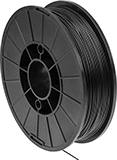
    Image of Product. Front orientation. 3D Printer Filaments. Moisture-Resistant Polyester 3D Printer Filaments .
    Image of Specification. Front orientation. Contains Border. Black. Moisture-Resistant Polyester 3D Printer Filaments .

    Black

    Parts printed with these polyester filaments absorb less moisture than other types of plastic, making them ideal for use in wet or humid environments. They are more durable and flexible than PLA, and easier to print than ABS. Use these filaments with fused filament fabrication (FFF) 3D printers, and print onto a heated print bed. Printing onto a cool surface causes the molten filament to change temperature rapidly, which can warp your designs. Although finished parts are moisture-resistant, these filaments are sensitive to humidity, and should be stored in a dehumidifying cabinet or a sealed container with desiccant for the best printing quality.
    Maximum exposure temperature is the point at which a printed part will begin to deform. Above this temperature, your printed parts will start to lose structural integrity.
    Carbon Fiber Filled—Carbon-fiber-filled PETG is often used to make rigid parts that are difficult to bend and break. Finished parts are easier to thread and machine than unfilled parts. Because these filaments are abrasive, use them only with abrasion-resistant nozzles.
    PETG—PETG contains glycol, so it is less brittle and easier to print than PETT and PCTG.
    Antistatic—Antistatic filaments make parts that prevent the buildup of static electricity. This helps prevent the buildup of dust or fibers on the surface of your finished part. However, they are not as effective at preventing electrostatic discharge as static-dissipative filaments.
    Tensile Strength—Tensile strength is the best measure of a filament's overall strength. Similar to the stress applied on a rope during a game of tug-of-war, it's the amount of pulling force a material can handle before breaking. A higher rating means a stronger filament. A tensile strength of 5,000 psi and above is considered good; 12,000 psi and above is excellent.
    Spool
    Dia.,
    mm
    Printing Temp.
    For Printer
    Bed Temp.
    Tensile Strength,
    psi
    Surface Resistivity,
    ohm/sq.
    Hardness
    Max. Exposure
    Temp.
    For Min. Nozzle
    Opening Dia., mm
    Dia.,
    mm
    Dp.,
    mm
    Material
    Wt.,
    g
    Each
    Carbon Fiber-Filled PETG—Antistatic, Extra High Strength, High Strength, Moisture Resistant, Spark Resistant
     
    Opaque Black
    1.75230° to 260° C
    446° to 500° F
    60° C
    140° F
    8,1201× 10^9 to 1× 10^12Not Rated 77° C
    170° F
    0.420060Plastic7503462N1000000
    2.85230° to 260° C
    446° to 500° F
    60° C
    140° F
    8,1201× 10^9 to 1× 10^12Not Rated 77° C
    170° F
    0.420060Plastic7503462N1100000
     
    back to top