





Static-Dissipative Flexible 3D Printer Filaments
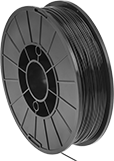
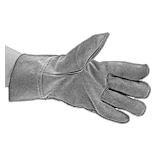
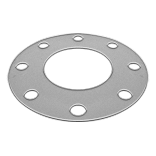
TPU blended with a static-dissipative compound, these filaments make gaskets, springs, grippers, and other pliable parts that divert electrostatic shocks in a controlled way, protecting nearby electronics and sensitive equipment. They meet ANSI/ESD and IEC standards for manufacturing, packaging, transporting, and storing items that can be damaged by electrostatic shocks. In addition to being flexible, TPU is also durable and withstands stresses better than ABS and PLA.
Print these filaments on a fused filament fabrication (FFF) 3D printer. You don’t need a heated printer bed, and printed parts resist shrinking and warping as they cool. Because they’re flexible, these filaments print best at a slow, consistent rate; high print speeds could cause them to jam. They don’t stand up well to moisture, so store them in a dehumidifying cabinet or other sealed container with a desiccant to keep them dry.
Durometer 80A filaments are more flexible than durometer 95A and 74D filaments. Durometer 95A filaments have a balance of flexibility and strength. Durometer 74D filaments are tough and durable. Similar to a tire tread, they can bend repeatedly without cracking.
To make sure your part dissipates static properly, use an electrical resistance tester to measure the surface resistivity. The target surface resistivity for TPU is 106 to 108 ohms. To adjust the resistivity, change the temperature of your printer’s extruder. As the extruder’s temperature increases, so will the printed part’s resistivity.
Tensile strength is the best measure of a filament’s overall strength. Similar to the stress applied to a rope during a game of tug-of-war, it’s the amount of pulling force a material can handle before breaking. A higher rating means a stronger filament. A tensile strength of 5,000 psi and above is considered good; 12,000 psi and above is excellent.
Maximum exposure temperature is the point at which a printed part will begin to deform. Above this temperature, your printed part will start to lose structural integrity.
Spool | ||||||||||||
|---|---|---|---|---|---|---|---|---|---|---|---|---|
| Dia., mm | Printing Temp. | For Printer Bed Temp. | Tensile Strength  | Max. Exposure Temp. | Specifications Met | For Min. Nozzle Opening Dia., mm | Dia., mm | Dp., mm | Wt., g | Color | Each | |
TPU Plastic | ||||||||||||
Durometer 80A (Soft) | ||||||||||||
| 1.75 | 230° to 250° C 446° to 482° F | 50° to 80° C 122° to 176° F | 3,100 psi (Poor) | Not Rated | ANSI/ESD S541, IEC 61340 | 0.4 | 200 | 60 | 750 | Black | 00000000 | 0000000 |
| 2.85 | 230° to 250° C 446° to 482° F | 50° to 80° C 122° to 176° F | 3,100 psi (Poor) | Not Rated | ANSI/ESD S541, IEC 61340 | 0.4 | 200 | 60 | 750 | Black | 00000000 | 000000 |
Durometer 95A (Medium Soft) | ||||||||||||
| 1.75 | 230° to 250° C 446° to 482° F | 50° to 80° C 122° to 176° F | 4,900 psi (Poor) | Not Rated | ANSI/ESD S541, IEC 61340 | 0.4 | 200 | 60 | 750 | Black | 00000000 | 000000 |
| 2.85 | 230° to 250° C 446° to 482° F | 50° to 80° C 122° to 176° F | 4,900 psi (Poor) | Not Rated | ANSI/ESD S541, IEC 61340 | 0.4 | 200 | 60 | 750 | Black | 00000000 | 000000 |
Durometer 74D (Medium) | ||||||||||||
| 1.75 | 230° to 250° C 446° to 482° F | 50° to 80° C 122° to 176° F | 4,700 psi (Poor) | 160° C 320° F | ANSI/ESD S541, IEC 61340 | 0.25 | 200 | 60 | 750 | Black | 00000000 | 000000 |
| 2.85 | 230° to 250° C 446° to 482° F | 50° to 80° C 122° to 176° F | 4,700 psi (Poor) | 160° C 320° F | ANSI/ESD S541, IEC 61340 | 0.25 | 200 | 60 | 750 | Black | 00000000 | 000000 |