



Static-Dissipative Impact-Resistant 3D Printer Filaments
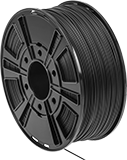
Create tool handles, tote trays, enclosures, and other parts that are banged or dropped often and used near sensitive electronics. These filaments are made of durable ABS or polycarbonate—roughly four times tougher than PLA—with a compound that diverts electrostatic discharges away from equipment. Print them on a fused filament fabrication (FFF) 3D printer. Due to their high melting point, they require a heated printer bed and tend to warp as they cool. They also emit an odor as they print, so you’ll need an enclosed printer or fume exhauster.
ABS filaments are a good place to start if you’re printing impact-resistant parts.
Polycarbonate filaments are nearly twice as impact resistant and stand up to heat better than ABS filaments. However, their higher melting point makes them more difficult to print, since they need more heat and are more likely to warp.
To make sure your part dissipates static properly, use an electrical resistance tester to measure the surface resistivity. The target surface resistivity for these filaments is 107 to 109 ohms. To adjust the resistivity, change the temperature of your printer’s extruder. As the extruder’s temperature increases, so will the printed part’s resistivity.
Tensile strength is the best measure of a filament’s overall strength. Similar to the stress applied on a rope during a game of tug-of-war, it’s the amount of pulling force a material can handle before breaking. A higher rating means a stronger filament. A tensile strength of 5,000 psi and above is considered good; 12,000 psi and above is excellent.
Maximum exposure temperature is the point at which a printed part will begin to deform. Above this temperature, your part will start to lose structural integrity.
Spool | ||||||||||||
|---|---|---|---|---|---|---|---|---|---|---|---|---|
| Dia., mm | Printing Temp. | For Printer Bed Temp. | Tensile Strength  | Hardness | Max. Exposure Temp. | For Min. Nozzle Opening Dia., mm | Dia., mm | Dp., mm | Wt., g | Color | Each | |
ABS Plastic | ||||||||||||
| 1.75 | 220° to 240° C 428° to 464° F | 100° to 110° C 212° to 230° F | 8,410 psi (Good) | Rockwell R120 (Hard) | 97° C 207° F | 0.4 | 200 | 75 | 750 | Black | 0000000 | 0000000 |
| 2.85 | 220° to 240° C 428° to 464° F | 100° to 110° C 212° to 230° F | 8,410 psi (Good) | Rockwell R120 (Hard) | 97° C 207° F | 0.4 | 200 | 75 | 750 | Black | 0000000 | 000000 |
Polycarbonate Plastic | ||||||||||||
| 1.75 | 260° to 300° C 500° to 572° F | 110° to 120° C 230° to 248° F | 9,860 psi (Good) | Rockwell R125 (Hard) | 135° C 275° F | 0.4 | 200 | 75 | 750 | Black | 0000000 | 000000 |