We will reply to your message within an hour.
Made of highly chemical-resistant materials, this tubing withstands harsh chemicals such as hydrochloric acid, sodium hydroxide, and sulfuric acid.
Use this general purpose tubing with a variety of chemicals.
Commonly used in applications requiring movement, such as metering (peristaltic) pumps and robotics, this tubing can handle continuous bending and flexing.

With a diameter of 2" or larger, this tubing has the girth to handle high volumes of acids and other harsh substances.
With excellent resistance to abrasion and tearing, this tubing can hold up in rugged environments.
Use this resilient tubing in high-temperature chemical applications up to 400° F.
Ultraviolet light won’t cause this tubing to degrade or deteriorate.
Hard walls give this tubing excellent strength in high-pressure and vacuum applications.
This durable tubing has the best abrasion and wear resistance of all our hard tubing for chemicals.
Run chemicals through this tubing at temperatures between -100° F and 500° F.
You don’t have to worry about this tubing cracking due to stress or impact—even over a wide range of temperatures.
Not only can this tubing handle temperatures between -450° F and 500° F, it also has a convoluted spiral design for good flexibility and smooth flow.
The corrugated design allows this tubing to extend and compress just like an accordion.
A lightweight alternative to stainless steel, this tubing can handle extreme-pressure applications up to 1,000 psi.
Keep your work site safe and clutter free—this coiled tubing extends when you need it and retracts out of the way when you don't.
An FEP liner gives this tubing better chemical resistance than any of our other firm tubing. It also provides a smooth interior for easy cleaning unrestricted flow.
Cold temperatures pose no problems for this tubing—it stays strong and flexible, even when temperatures drop to -100° F.
This tubing can withstand high-temperature chemical applications up to 400° F.
Designed for high-purity processes, this tubing is made without plasticizers like DEHP that can contaminate the fluid passing through it.
Not only is this tubing cured with platinum and free of plasticizers like DEHP, it can handle higher temperatures than any of our other high-purity soft tubing. Use in applications up to 450° F.
Designed for high-purity applications, this hard tubing is cleaned and bagged to prevent dirt and moisture from contaminating the inside. It is free of plasticizers like DEHP, so it won’t impart tastes or odors to the fluid running through it.
With hard walls and the ability to handle extreme temperatures, this tubing is the preferred material for semiconductor applications. The material contains extremely low levels of additives, so it won’t contaminate the fluid passing through it.
Made from TPE plastic, this tubing doesn’t contain plasticizers like DEHP, so it won’t impart tastes or odors to the fluid passing through.
The smooth, nonabsorbing interior on this tubing resists material buildup, so it is easy to clean.
This tubing can withstand temperatures up to 1200° F—the highest temperature rating of all the non-stainless steel tubing we offer. It is also known as Inconel.
This tubing won't degrade, even when used with harsh acids. It is also known as Monel.
Run corrosive substances through this tubing without worrying about pitting and stress cracking. It is also known as Hastelloy.
With excellent corrosion resistance, this pipe can handle a wide range of acids and other highly-corrosive chemicals. Use in metal surface treating applications, plating solution lines, and other chemical process applications. Layers of fiberglass give this pipe better strength and durability than any of our other pipe for chemicals.
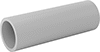
The inside of this pipe won’t leach contaminants into your line or accumulate particles—it’s polished to an ultra-smooth 12 Ra finish, which also makes it easy to clean. Made of polypropylene, it resists organic solvents, acids, and alkalis better than CPVC pipe.
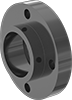
Flanges have excellent corrosion resistance to handle a wide range of acids and other highly-corrosive chemicals. Use in metal surface treating applications, plating solution lines, and other chemical process applications. They are reinforced with fiberglass layers for better strength and durability than any of our other pipe flanges for chemicals. Bolt two same-size flanges together with a gasket to create an access point within a line.
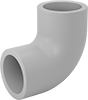
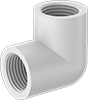
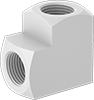
The inside of these fittings won’t leach contaminants into your line or accumulate particles—they’re polished to an ultra-smooth 12 Ra finish, which also makes it easy to clean. Made of polypropylene, they resist organic solvents, acids, and alkalis better than CPVC fittings.
The inside of these flanges won’t leach contaminants into your line or accumulate particles—they’re polished to an ultra-smooth 12 Ra finish, which also makes them easy to clean. Made of polypropylene, they resist organic solvents, acids, and alkalis better than CPVC pipe flanges.
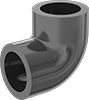
These fittings have excellent corrosion resistance to handle a wide range of acids and other highly-corrosive chemicals. They are commonly used in metal surface treating applications, plating solution lines, and other chemical process applications. Reinforced with layers of fiberglass, they have better strength and durability than any of our other pipe fittings for chemicals.
Not only do these PFA fittings have the chemical resistance to handle acid and salt water, they also have better crack resistance than other plastic pipe fittings for chemicals. They are commonly used in high-purity chemical flow processes, such as semiconductor and clean room applications.
Made of PVDF that’s finished to a 12 Ra smoothness, these fittings handle some of the harshest chemicals without leaching contaminants into your line. Comparable to Kynar, they handle most organic solvents that would dissolve CPVC, and chlorine or nitric acid that would weaken polypropylene.
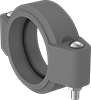
Use these clamps to connect easy-access CPVC pipe fittings and pipe.
Bolt two same-size flanges together with a gasket to create an access point within a line. Made of PTFE, they can handle a wider temperature range than any of our other plastic pipe flanges for chemicals. They are commonly used in high-purity chemical flow processes, such as semiconductor and clean room applications.
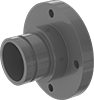
The grooved ends on these flanges connect to pipe with a clamp, so you can access your chemical process line for routine maintenance. Flanges have excellent chemical resistance to withstand a variety of salt solutions, acids, and other harsh substances. They are also known as Victaulic flanges.
Extreme temperatures are no problem for these fittings—they’re made of PTFE, so they can withstand a wider temperature range than any of our other plastic pipe fittings for chemicals. They are commonly used in high-purity chemical flow processes, such as semiconductor and clean room applications.
This PTFE pipe can withstand a wider temperature range than any of our other plastic pipe for chemicals. It is commonly used in high-purity chemical flow processes, such as semiconductor and clean room applications.
Also known as Victaulic fittings, these have grooved ends that connect to pipe with a clamp, so you can access your chemical process line for routine maintenance. Fittings have excellent chemical resistance to withstand a variety of salt solutions, acids, and other harsh substances.
Also known as Victaulic pipe, this pipe has grooved ends that connect to fittings and flanges with a clamp, so you can access your line for routine maintenance. It is CPVC, which has excellent chemical resistance to withstand a variety of salt solutions, acids, and other harsh substances.
Made of PVDF that’s finished to a 12 Ra smoothness, this pipe handles some of the harshest chemicals without leaching contaminants into your line.
This polypropylene pipe resists the damaging effects of ultraviolet light, so it’s suitable for outdoor use. It has the chemical resistance to withstand acids, solvents, and other harsh substances.
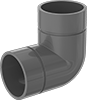
Made of polypropylene, these gravity-flow fittings withstand organic solvents, such as acetone, that would dissolve CPVC pipe. They also stand up to highly corrosive acids, such as hydrochloric acid, and alkalies.
Made of polypropylene, this gravity-flow pipe stands up to tough organic solvents, such as acetone, that would dissolve CPVC pipe. You can also use it for lines with highly corrosive acids, such as hydrochloric acid, and alkalies.
Use this pipe in gravity-flow applications that involve highly-corrosive chemicals–it is NSF certified for use in corrosive waste systems. Pipe is made of CPVC, which has better chemical resistance than ABS plastic to stand up to acids and other harsh substances.
These fittings are NSF certified for use in corrosive waste gravity-flow systems. Made of CPVC, they have better chemical resistance than ABS plastic gravity-flow fittings and can stand up to highly-corrosive acids and other harsh substances.
Made of PVDF, also known as Kynar, these fittings stand up to the harsh chemicals used to clean food processing lines. Unlike other plastic fittings, such as nylon and acetal fittings, they’ll resist degrading when exposed to strong alkali and highly acidic solutions.
Connect to CPVC pipe for use in high-temperature plumbing and water supply applications.
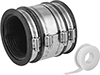
With an FEP sleeve and PTFE sealing tape, these connectors withstand chemicals better than rubber connectors. Use them for joining low-pressure chemical waste drainpipe and fittings or transitioning between different chemical piping.
Made of PVC, this sleeving resists chemicals, oil, and acids.
Use this PTFE sleeving in applications where temperatures reach up to 500° F.
Protect cable, hose, and pipe in high temperature environments—this sleeving withstands temperatures over 450° F. It stretches to fit over items for easy installation, then tightens around its contents for a secure fit.
Made of PPS plastic, this sleeving shields cable, hose, and pipe from oil, acids, and other chemicals. It stretches to fit over items for easy installation, then tightens around its contents for a secure fit.
Save time installing sleeving around wire, cable, and hose.
A slit along the length makes this sleeving easy to install over wire, cable, and hose without disconnecting them. The corrugated construction gives it impact and abrasion resistance similar to conduit, with more flexibility.
Made of nylon, this sleeving is the most impact- and abrasion-resistant slit corrugated sleeving we offer. A slit along the length makes it easy to install over wire, cable, and hose without disconnecting them.
Rated UL 94 V-2, this sleeving resists combustion and minimizes the spread of flames. A slit along the length makes it easy to install over wire, cable, and hose without disconnecting them. It has impact and abrasion resistance similar to conduit, with more flexibility.
Made of PTFE, this sleeving has excellent resistance to chemicals and acids. A reusable alternative to tape and cable ties, it allows you to route wire and cable between the spirals.
All valves have threaded NPT connections.
With a plastic body and a fluoroelastomer seal, these valves can stand up to aggressive and corrosive solutions in chemical-processing applications.
Also known as actuated ball valves, these provide higher flow rates than other air-driven valves.
Also known as piston valves, these have a compact, lightweight actuator that allows them to be installed in any mounting orientation. They’re often used in water-treatment applications.
Also known as diaphragm valves, these have a diaphragm that can handle dirty liquid, slurries, and abrasive media without damage.
These valves have socket-weld connections for bonding to unthreaded male plastic pipe.
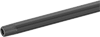
Bolt these valves to ANSI flanges—they meet ASME dimensional standards. They have a plastic body and a seal that withstand aggressive and corrosive solutions in chemical-processing applications.
Made of PVDF to withstand corrosive solutions, these valves are ideal for use in chemical processing. Their luer lock fittings are quick to connect and disconnect for convenience.
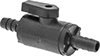
Barbs grip onto tubing, providing a secure hold. To withstand aggressive and corrosive solutions in chemical-processing applications, these valves have a plastic body and a chemical-resistant seal.
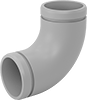

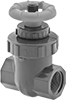
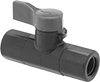
For use with threaded pipe, these valves have NPT connections.
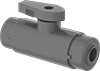
Insert tubing into the fittings on these valves—no heat, solder, or flux required. To withstand aggressive and corrosive solutions, they have a chemical-resistant fluoroelastomer seal and a plastic body.
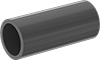
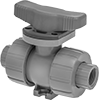
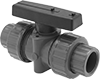
For fast installation and removal from pipelines, these valves have union fittings that disassemble into multiple pieces. All have a fluoroelastomer seal and a plastic body that can stand up to aggressive and corrosive solutions in chemical-processing applications.
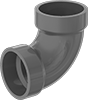
Streamline your installation and removal process. These valves give you the leak-tight permanent connection of a socket connect with the ease of fittings that come apart.
For chemical-processing applications in confined areas, these valves have a low-profile handle to fit in tight spots. A rubber seal and a plastic body stand up to aggressive, corrosive solutions.
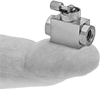
To withstand aggressive and corrosive solutions in miniature chemical-processing pipelines, these tiny valves have a chemical-resistant fluoroelastomer seal and a corrosion-resistant 303 stainless steel body.
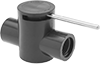
There’s no need to unbolt these valves for cleaning—remove the valve handle and slide the valve apart for inline access to internal components. Also known as elliptical valves, they have a fluoroelastomer seal and a polypropylene body to withstand aggressive and corrosive solutions in chemical-processing applications.
A threaded union on these valves makes them easy to install and remove without disrupting your line.
No need to remove these valves from your line to access their internal components—the three-piece bolted body comes apart. Ideal in chemical-processing applications, the seal and polypropylene body stand up to aggressive and corrosive solutions.
Control the flow of chemical solutions from any garden hose. With a fluoroelastomer seal and polypropylene body, these valves withstand strong chemicals, such as chlorinated water and phosphoric acid.