












About Glove Sizing
More
Loose-Fitting Polyethylene Disposable Gloves
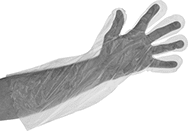
Slip these gloves on and off—they’re roomier than latex gloves, so they’re quicker to put on but offer less tactility. To help offset that loss of feel, they have a textured surface that improves grip. Plus, the inside is powder-free, so contaminants won’t shed into your work. These gloves are often worn for food handling and other low-precision tasks. The thicker the glove, the more it resists punctures and tears.
Gloves with a sleeve extend to your elbow or shoulder to protect your hand and arm. They’re commonly used for handling large bags of feed, examining livestock, and other agricultural tasks.
Gloves that are FDA compliant are safe to use in direct contact with food.
Available Sizes | |
|---|---|
| Size | Glove Size  |
| L | 9 |
Pkg. | ||||||||||
|---|---|---|---|---|---|---|---|---|---|---|
| Thick., mil | Lg. | Texture | Liner Type | Color | Specifications Met | Size | Pkg. Qty. | 1-5 | 6-Up | |
Food-Service Gloves with Sleeve | ||||||||||
Polyethylene Plastic | ||||||||||
| 1 | 18" | Textured | Powder Free | Clear | FDA Compliant 21 CFR 110.10, FDA Compliant 21 CFR 177.1950 | L | 250 | 9683N11 | 00000 | 00000 |
Metal- and X-Ray-Detectable Sleeves

Protect your shirt sleeves from stains and wear in food-processing environments. Since these sleeves contain metal and chemical additives that will get picked up by metal detectors and X-ray machines if they fall into your line, they help you comply with Hazard Analysis and Critical Control Point (HACCP) programs. They’re also bright blue, so they’re easily seen and removed if they end up in a batch.
Made of TPU plastic, these sleeves are tear resistant and flexible, even in cold temperatures. They resist chemicals and oil, so they’re commonly used with vegetable oil and animal fat. Sleeves are machine washable.
| Length | Thickness, mil | Cuff Style | Color | Size | Pair | |
TPU Plastic | ||||||
|---|---|---|---|---|---|---|
| 17 3/4" | 6 | Elastic | Blue | One Size | 6951N11 | 000000 |
Metal-Detectable Coated Work Gloves
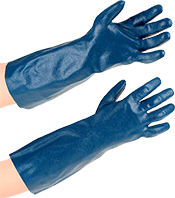
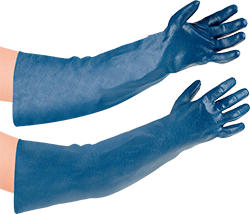
These gloves have a metal additive that will set off metal detectors if they fall into your line, so you can safely handle food and tools in a sanitary facility. They help you comply with Hazard Analysis and Critical Control Point (HACCP) programs for preventing contaminated food from leaving your facility. They’re also bright blue, which makes them easy to find and retrieve.
Fully coated in nitrile, these gloves are oil and chemical resistant, so they won’t break down from fatty foods or harsh cleaners. Nitrile is a good alternative for those with latex allergies—it’s also more durable than latex. The texture helps you grip tools and work surfaces, and the seamless cotton lining keeps you comfortable. These gloves meet EN 388 (3121), which means they protect you from abrasive surfaces and provide light protection against cuts, tears, and punctures. They also meet German food standard 31 LFGB, which means they are compliant with European regulatory requirements and free of toxic substances.
Available Sizes | |
|---|---|
| Size | Glove Size |
| M | 8 |
| L | 9 |
| XL | 10 |
| Lg. | Coverage | Texture | Coating Coverage | Lining Material | Cuff Style | Color | Specifications Met | Choose a Size | Pair | |
Nitrile-Rubber-Coated Nitrile Rubber | ||||||||||
|---|---|---|---|---|---|---|---|---|---|---|
| 15 3/4" | Full Hand and Arm | Textured | Full | Cotton Fabric | Open | Blue | EN 388 (3121), LFGB Section 31 Certified | 6940N2 | 000000 | |
| 23 5/8" | Full Hand and Arm | Textured | Full | Cotton Fabric | Open | Blue | EN 388 (3121), LFGB Section 31 Certified | 6940N3 | 00000 | |
Neoprene Chemical-Resistant Gloves

From acids to alkalis, these neoprene gloves protect your hands from chemicals. They resist tears, have good dexterity, and stay flexible across a wide range of temperatures. They're often used when cleaning and maintaining equipment.
Gloves with a sleeve extend past the elbow to protect arms and hands.
Extreme-temperature gloves handle wide temperature ranges. They have an EN 407 contact heat rating of 2 or higher, which means they’ll withstand their maximum temperature for at least 15 seconds before there’s a risk of second-degree burns. They’re also rated to EN 511 standards for cold resistance.
Textured gloves give you extra grip on wet or oily objects. Gloves that meet ANSI/ISEA 105 or EN 388 standards are rated for various forms of protection, such as cuts, abrasions, or punctures.
Gloves that meet EN 374 Type A or Type B standards protect against chemical permeation for at least 30 minutes. Each letter in the rating represents a chemical that these gloves were tested against.
Temp., °F | Pair | ||||||||||||
|---|---|---|---|---|---|---|---|---|---|---|---|---|---|
| Thick., mil | Lg. | Texture | Lining Material | Cuff Style | Color | Min. | Max. | For Use With | Specifications Met | Choose a Size (Glove Size) | 1-3 | 4-Up | |
Extreme-Temperature Gloves with Sleeve | |||||||||||||
Neoprene Rubber | |||||||||||||
| 67 | 26" | Textured | Fleece Fabric | Open | Black | 32° | 480° | Acetone, Hydraulic Fluid, Hydrochloric Acid, Hydrofluoric Acid, Hydrogen Peroxide, Isopropyl Alcohol, Mineral Spirits, Nitric Acid, Sodium Hydroxide, Sulfuric Acid | FDA Compliant 21 CFR 177.2600, EN 374 Type A (AKLMPT), EN 388 (3122B), EN 407 (32XX4X), EN 511 (121) | 5399T33 | 000000 | 000000 | |
Nitrile Chemical-Resistant Gloves
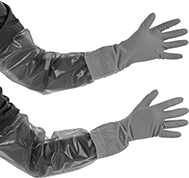
Shield your hands from a variety of chemicals, such as hydraulic fluids, oil, alcohol, and gasoline. These gloves are often worn during valve maintenance and metalworking.
Gloves with a sleeve extend past the elbow to protect arms and hands. Textured gloves give you extra grip on wet or oily objects. Gloves that meet ANSI/ISEA 105 or EN 388 standards are rated for various forms of protection, such as cuts, abrasions, or punctures.
Gloves that meet EN 374 Type A, B, or C are rated to European standards for chemical resistance. Gloves with a Type A or Type B rating resist chemical permeation for at least 30 minutes. Each letter in the rating represents a chemical that these gloves were tested against.
Available Sizes | |
|---|---|
| Size | Glove Size |
| M | 8 |
| L | 9 |
| XL | 10 |
| 2XL | 11 |
Pair | |||||||||||||
|---|---|---|---|---|---|---|---|---|---|---|---|---|---|
| Thick., mil | Lg. | Texture | Lining Material | Cuff Style | Color | Min. Temp., °F | Max. Temp., °F | For Use With | Specifications Met | Choose a Size | 1-11 | 12-Up | |
Nitrile Rubber-Coated Nitrile Rubber | |||||||||||||
| 40 | 26" | Textured | Cotton/Polyester Fabric Blend | Elastic | Blue | Not Rated | 280° | Hydrochloric Acid, Mineral Spirits, Nitric Acid, Sodium Hydroxide, Sulfuric Acid, Turpentine | FDA Compliant 21 CFR 177.2600, EN 374 Type B (JKL), EN 388 (4111X) | 9781N27 | 000000 | 000000 | |
PVC Chemical-Resistant Gloves

Protect your hands from common chemicals, such as sodium hydroxide and sulfuric acid. Often used for chemical washdowns, these gloves are good for tasks where durability is more important than dexterity. They hold up to repeated use, and they won’t absorb water even after soaking for long periods. However, they offer less chemical protection than our other chemical-resistant gloves. They shouldn’t be used with strong organic solvents.
Gloves that meet ANSI/ISEA 105 or EN 388 standards are rated for various forms of protection, such as cuts, abrasions, or punctures.
Gloves that meet EN 374 Type A or B standards protect against chemical permeation for at least 30 minutes. Each letter in the rating represents a chemical that these gloves were tested against.
Available Sizes | |
|---|---|
| Size | Glove Size |
| S | 7 |
| M | 8 |
| L | 9 |
| XL | 10 |
Pair | |||||||||||||
|---|---|---|---|---|---|---|---|---|---|---|---|---|---|
| Thick., mil | Lg. | Texture | Lining Material | Cuff Style | Color | Min. Temp. | Max. Temp. | For Use With | Specifications Met | Choose a Size | 1-11 | 12-Up | |
PVC Plastic-Coated PVC Plastic | |||||||||||||
| 72 | 24 1/2" | Textured | Cotton Fabric | Elastic | Blue | Not Rated | Not Rated | Hydrochloric Acid, Nitric Acid | ANSI/ISEA 105, EN 374 Type B (KLT), EN 388 (3121B), FDA Compliant 21 CFR 177.2600 | 9937N14 | 000000 | 000000 | |