


Filter by


For Sharpening
Abrasive Material
Relative Size
RoHS

Sharpening Angle Adjustability
U.S.–Mexico–Canada Agreement (USMCA) Qualifying
Width
DFARS Specialty Metals
Export Control Classification Number (ECCN)
Stone Type
Pocket-Size Blade Sharpeners
For Sharpening Knives
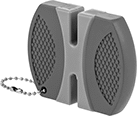 | 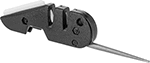 |
2 Slots | 2 Slots and 2 Stones |
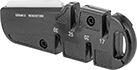 | |
4 Slots and 1 Stone |
Carbide Abrasive—For coarse sharpening, carbide aggressively removes material to form a new edge.
Diamond Abrasive—Our hardest abrasive. Diamond can sharpen any blade material, even hardened steel.
Tungsten Steel Abrasive—An affordable option that's great for touch-ups on somewhat sharp blades. Since it's softer than carbide, tungsten steel removes less material than carbide for more control. However, this also means it dulls more quickly.
Ceramic Abrasive—For use after coarse sharpening, ceramic refines and polishes your blade’s edge. You can also use ceramic to touch up blades that are still somewhat sharp.
Slots | Stones | ||||||||
|---|---|---|---|---|---|---|---|---|---|
No. of | Abrasive Material (Grit Rating) | No. of | Abrasive Material (Grit Rating) | Lg. | Wd. | Ht. | Each | ||
| 2 | For Straight-Blade Knives—Tungsten Steel (Coarse Grit) with Fixed Angle (24°) For Straight-Blade Knives—Ceramic (Fine Grit) with Fixed Angle (22°) | — | — | 3" | 1/2" | 2 1/4" | 0000000 | 00000 | |
| 2 | For Straight-Blade Knives—Carbide (Coarse Grit) with Fixed Angle (22.5°) For Straight-Blade Knives—Ceramic (Fine Grit) with Fixed Angle (22.5°) | 2 | For Straight- and Serrated-Blade Knives—Tapered Round Diamond (Medium Grit) For Straight- and Serrated-Blade Knives—Rectangle Ceramic (Fine Grit) | 4" | 1/2" | 1 1/4" | 0000000 | 00000 | |
| 4 | For Straight-Blade Knives—Carbide (Coarse Grit) with Fixed Angle (17°) For Straight-Blade Knives—Carbide (Coarse Grit) with Fixed Angle (20°) For Straight-Blade Knives—Carbide (Coarse Grit) with Fixed Angle (25°) For Straight-Blade Knives—Carbide (Coarse Grit) with Fixed Angle (30°) | 1 | For Straight- and Serrated-Blade Knives—Rectangle Ceramic (Fine Grit) | 4 1/4" | 1/2" | 1 1/2" | 0000000 | 00000 | |
| 4 | For Straight-Blade Knives—Diamond (Medium Grit) with Fixed Angle (17°) For Straight-Blade Knives—Diamond (Medium Grit) with Fixed Angle (20°) For Straight-Blade Knives—Diamond (Medium Grit) with Fixed Angle (25°) For Straight-Blade Knives—Diamond (Medium Grit) with Fixed Angle (30°) | 1 | For Straight- and Serrated-Blade Knives—Rectangle Ceramic (Fine Grit) | 4 1/4" | 1/2" | 1 1/2" | 0000000 | 00000 | |
